Grinding Chatter Marks: How to Tell Whether the Problem Is the Wheel or the Machine

Grinding Wheel Knowledge Base

Grinding Chatter Marks: How to Tell Whether the Problem Is the Wheel or the Machine

Chatter marks — visible waviness, regular or irregular repeated patterns, or vibration-induced surface texture on ground workpieces — are one of the most disruptive quality problems in precision grinding. When chatter appears, the immediate reaction is often to change the grinding wheel. But chatter can originate from the wheel surface condition, the dressing or truing practice, the wheel specification, the wheel mounting and balance, the machine spindle, the workholding setup, or external vibration sources — and changing the wheel without narrowing down the source may waste production time without resolving the issue. This guide walks through a practical diagnostic approach: how to read the chatter pattern, which factors to check on the wheel side, which factors to check on the machine side, when dressing may help, and what information to prepare before requesting a grinding wheel review.

Chatter marks can originate from wheel surface condition, dressing, balance, mounting, spindle condition, or machine vibration — not only from the wheel specification
The pattern of the chatter — regular vs. irregular, persistent vs. intermittent, improving after dressing vs. returning quickly — each points toward a different direction
A step-by-step diagnostic check helps avoid replacing a grinding wheel that is not the root cause of the chatter
Providing photos of the wheel surface, workpiece chatter pattern, grinding wheel size, and basic grinding conditions leads to a more focused application review

Overview

About Grinding Chatter Marks: How to Tell Whether the Problem Is the Wheel or the Machine

Grinding chatter is a form of self-excited or forced vibration that leaves visible marks on the workpiece surface. These marks can appear as regular repeating lines or waves, irregular vibration patterns, or a general waviness that affects surface finish and dimensional accuracy. Chatter differs from grinding burn or random surface roughness — it has a recognizable periodicity or pattern that can often be linked to a specific rotating component, a wheel surface irregularity, or a machine dynamic characteristic. The diagnostic challenge is that wheel-related chatter and machine-related chatter can produce similar-looking marks on the workpiece, and in some cases both factors contribute. A regular repeating pattern at a frequency that matches the wheel rotation speed may indicate a wheel surface irregularity, a dressing issue, or a wheel balance condition. A pattern that does not match the wheel speed may point toward spindle, workholding, or external machine vibration. Marks that improve after dressing suggest a wheel-surface-related factor. Marks that return quickly after dressing — or do not improve at all — may point toward machine condition, wheel specification mismatch, or grinding parameters. Based on 20+ years of grinding wheel manufacturing experience, we review all of these factors together — wheel specification, wheel surface condition, dressing practice, balance, machine condition, and grinding parameters — before recommending a wheel change. This article helps you narrow down the likely direction and prepare the right information for a more focused review.

Key Takeaways

  • Chatter marks are a symptom, not a diagnosis: the cause may be wheel-related, machine-related, or a combination of both — changing the wheel immediately may not solve the issue.
  • Start by reading the chatter pattern: regular repeating marks may point toward wheel surface, dressing, or balance; irregular or frequency-mismatched marks may point toward machine vibration or workholding.
  • If chatter improves after dressing but returns quickly, review the wheel specification, grinding conditions, and machine factors — not only the dressing practice.
  • A focused application review requires the chatter pattern description, wheel surface photos, grinding wheel size, workpiece material, and basic grinding conditions.
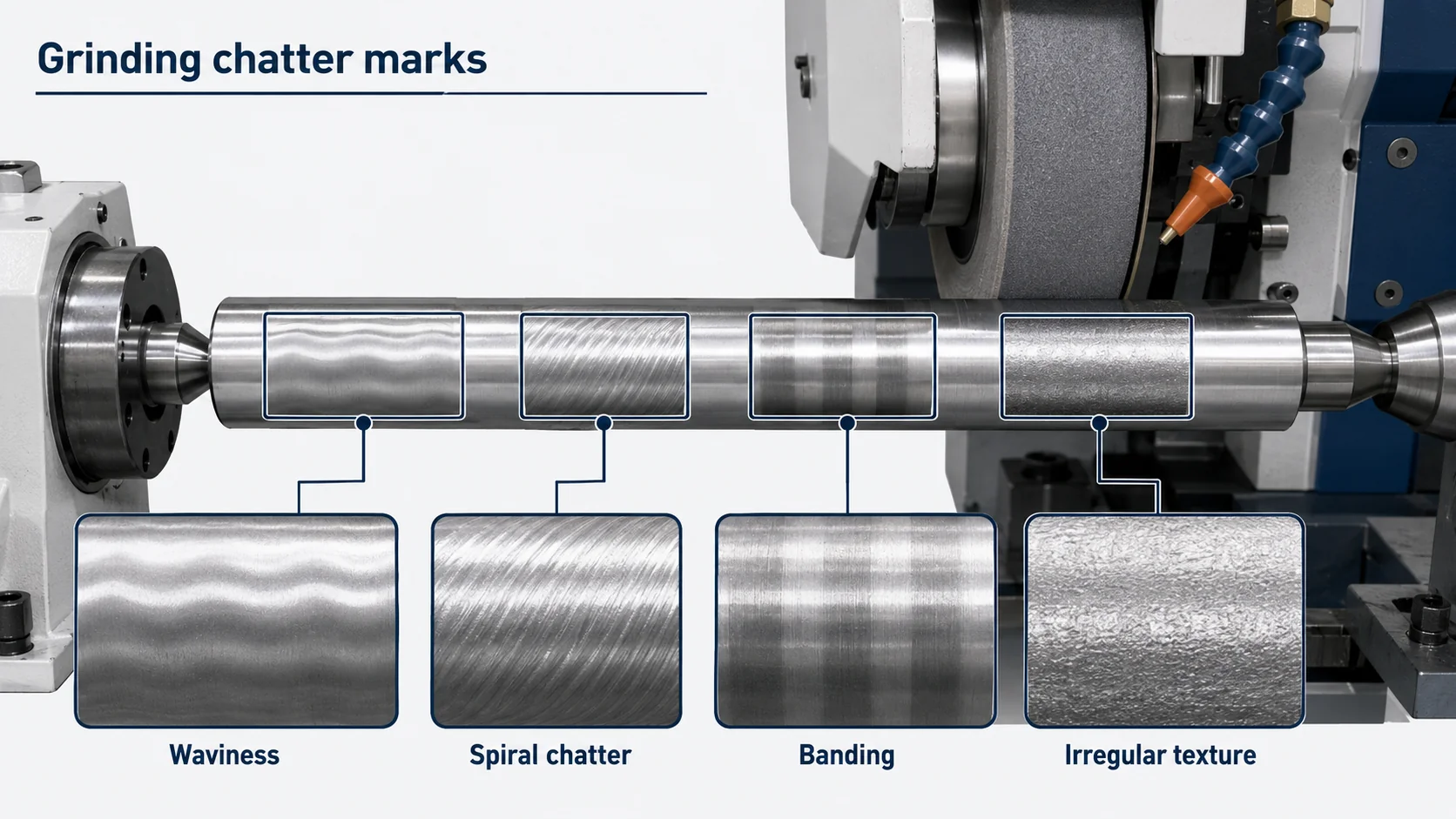
Precision cylindrical grinding scene — grinding wheel contacting a rotating workpiece with visible surface inspection context, dial indicator or profilometer nearby, emphasizing chatter pattern identification and surface waviness measurement on ground components
Chatter marks can appear as regular repeating lines, irregular vibration patterns, or waviness affecting surface finish and dimensional accuracy.

Applications

Where Grinding Chatter Commonly Appears

Chatter risk and the likely diagnostic direction vary by grinding application. Each application below includes the typical chatter risk and the first area to review.

Cylindrical grinding — shafts, spindles, and precision rolls

Chatter risk from workpiece deflection, wheel balance, and machine rigidity

Check wheel balance, workholding stability, and machine condition before changing the wheel specification

Bearing raceway and hardened bearing steel grinding

Finish sensitivity at high hardness; chatter directly affects bearing noise and life

Check wheel surface condition, wheel grade match, and CBN suitability before reviewing machine factors

Hydraulic shaft and precision shaft grinding

Long contact arc; surface finish affects sealing performance

Check wheel balance and dressing consistency, then review coolant delivery and machine condition

Fine-finish grinding with high surface consistency requirements

Very low tolerance for any vibration; even minor imbalance or spindle wear can produce visible marks

Check wheel balance, spindle condition, and mounting precision; review grit size and bond type for fine-finish suitability

Diagnostic Guide

Quick Diagnostic Table

Start with observable grinding signals before changing wheel specification or dressing frequency.

Use this quick diagnostic table to narrow down the likely direction. Match the chatter pattern and behavior to the most probable cause and the first thing to check.

Step 1

Regular repeating pattern matching wheel rotation speed

What you may see

Evenly spaced marks or waves around the workpiece circumference or along the ground surface, with spacing that matches the wheel rotational frequency.

Most likely direction

Wheel surface irregularity — uneven wear, a single loaded or glazed patch, an out-of-round condition after dressing, or wheel imbalance.

First thing to check

Inspect the wheel surface for uneven wear, local loading, or a single shiny spot. Check wheel balance and truing condition. Verify that dressing was even across the full wheel face.

Step 2

Random or irregular vibration marks

What you may see

Non-uniform chatter marks, intermittent patterns, or marks that appear on some parts but not others with no clear periodicity.

Most likely direction

Machine vibration, workholding instability, or external vibration sources — not primarily a wheel surface issue.

First thing to check

Check fixture rigidity, workholding clamping condition, and whether the machine is exposed to external vibration from nearby equipment. Inspect spindle bearings for wear or clearance.

Step 3

Chatter improves after dressing

What you may see

Chatter marks are reduced or eliminated immediately after dressing, and surface finish returns to the target range.

Most likely direction

The wheel surface condition was the primary factor — dull grains, uneven wheel face, or a glazed or loaded surface layer that dressing removed.

First thing to check

Record how many parts are ground before chatter returns. Check whether dressing parameters are consistent and whether the dressing tool is in good condition.

Step 4

Chatter returns quickly after dressing

What you may see

Chatter is reduced after dressing but reappears after only a few parts — much sooner than the expected dressing interval.

Most likely direction

The wheel specification may not be well-matched to the grinding conditions, or machine vibration is exciting the wheel surface to degrade faster than expected.

First thing to check

Check whether the wheel hardness grade, grit size, or bond type is suitable for the workpiece material and grinding parameters. Inspect machine condition — spindle, workholding, and vibration sources.

Step 5

Chatter appearing after a wheel change

What you may see

Chatter marks or vibration that were not present with the previous wheel appear immediately or shortly after installing a new or different wheel.

Most likely direction

Wheel mounting, balance, or specification difference — the new wheel may not be balanced to the same standard, may have a different hardness or structure, or may not be correctly mounted.

First thing to check

Verify the wheel is correctly mounted and flanges are clean and properly tightened. Check wheel balance. Compare the new wheel specification with the previous one — any changes in hardness, grit, bond, or dimensions.

Still unsure whether the chatter comes from the wheel or machine condition? Share photos of the wheel surface, workpiece material, grinding wheel size, chatter pattern, and basic grinding conditions so we can review the application direction.

Send application details for review →
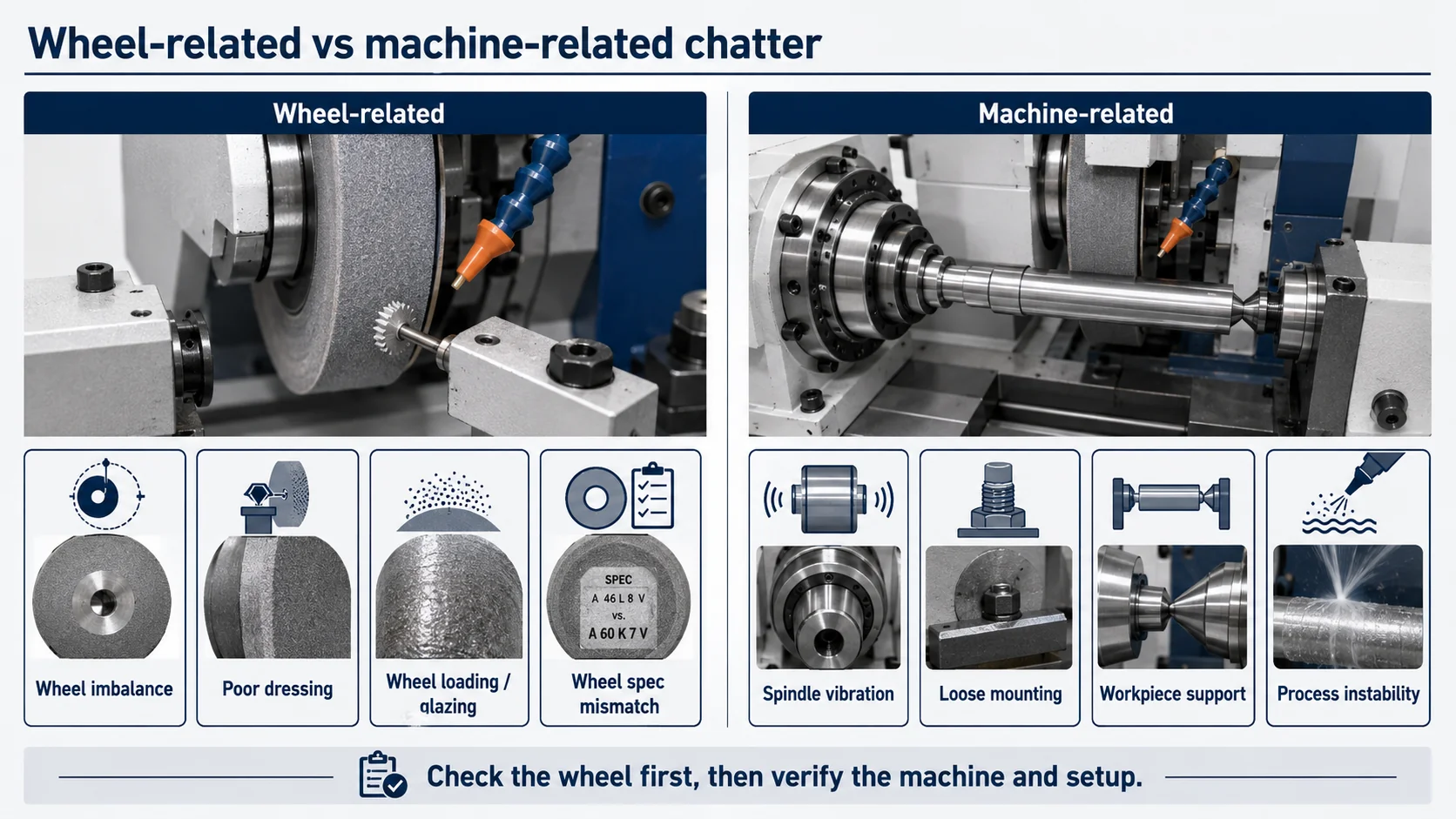
Two-panel technical comparison — left panel showing wheel surface conditions that may contribute to chatter (uneven wear, loading, poor dressing), right panel showing machine-related factors (spindle runout, workholding instability, external vibration) — helping identify the likely direction before changing the grinding wheel
Chatter marks may originate from wheel surface condition and dressing practice, or from machine vibration and mounting — the pattern helps narrow down the direction.

Factor map

Wheel-Related and Machine-Related Causes of Grinding Chatter

Each cause below lists what to check first and what may be worth reviewing next. Wheel-related causes and machine-related causes often need to be checked together — a wheel surface issue may be the result of machine vibration, and a machine vibration issue may be amplified by an unsuitable wheel specification.

1

1. Wheel Glazing or Loading (Wheel-Related)

A glazed wheel surface — shiny, smooth, with dull abrasive grains — may rub instead of cut, generating vibration and chatter marks. A loaded wheel surface — with workpiece material packed into the pores — may cut unevenly, producing irregular patterns. What to check first: the wheel surface appearance before dressing. A shiny surface suggests glazing; dark packed areas suggest loading. What may be worth reviewing next: wheel hardness grade, structure (porosity), abrasive type, and dressing practice, depending on the workpiece material and grinding conditions. For more detail on recognizing these conditions, see our guide on grinding wheel loading vs glazing.

2

2. Uneven Wheel Surface Condition (Wheel-Related)

A wheel surface that is not uniform — with high spots, low spots, or uneven wear across the face — may produce a regular repeating pattern on the workpiece at the wheel rotation frequency. What to check first: whether the wheel face shows uneven wear, a single loaded or glazed patch, or an out-of-round condition. What may be worth reviewing next: dressing consistency across the full wheel face, wheel mounting, and whether the wheel has been subjected to uneven grinding pressure or an interrupted cut.

3

3. Dressing or Truing Condition (Wheel-Related)

Inconsistent dressing — uneven dress lead, varying depth, worn dressing tool, or dressing that does not cover the full wheel width — can leave the wheel surface irregular, producing chatter marks at a frequency related to the wheel rotation. What to check first: dressing parameter consistency, dressing tool condition, and whether the full wheel face is dressed evenly. What may be worth reviewing next: whether the dressing lead and depth are appropriate for the wheel bond type and the grinding operation. For more on dressing practice, see our grinding wheel dressing frequency guide.

4

4. Wheel Balance or Mounting Condition (Wheel-Related)

An unbalanced wheel or a wheel that is not correctly mounted on the spindle can produce vibration at the wheel rotational frequency, creating regular chatter marks on the workpiece. What to check first: wheel balance after mounting, flange cleanliness, and whether the wheel is seated correctly on the spindle. What may be worth reviewing next: whether the balancing method is appropriate for the wheel size and grinding speed, and whether the wheel mounting procedure follows the manufacturer's recommendation.

5

5. Wheel Specification Mismatch (Wheel-Related)

A wheel that is too hard for the application may glaze and generate chatter through rubbing. A wheel that is too soft may wear unevenly and lose profile, also producing surface marks. A grit size that is too fine may increase friction and vibration tendency. What to check first: whether the current wheel specification — hardness grade, grit size, bond type, and structure — is suitable for the workpiece material, hardness, and grinding parameters. What may be worth reviewing next: whether a specification adjustment in hardness, grit, or bond could reduce the chatter tendency. Providing complete application data to the wheel manufacturer helps assess whether the current specification is well-matched.

6

6. Spindle Condition (Machine-Related)

Spindle bearing wear, insufficient bearing preload, or spindle runout can produce vibration at the spindle rotation frequency or its harmonics, which may appear as chatter marks on the workpiece. What to check first: spindle runout, bearing condition, and whether spindle vibration is present when the wheel is not in contact with the workpiece. What may be worth reviewing next: whether the spindle has been serviced recently, whether the chatter frequency matches the spindle speed, and whether the problem is present on all parts or only some.

7

7. Fixture and Workholding Stability (Machine-Related)

A workpiece that is not rigidly held — due to worn centers, loose chucks, inadequate clamping force, or worn work rests in centerless grinding — may vibrate during grinding, producing chatter marks that can be mistaken for a wheel problem. What to check first: workholding condition, center alignment, chuck or collet wear, and whether the workpiece is supported rigidly throughout the grinding cycle. What may be worth reviewing next: whether the chatter pattern changes when workholding is adjusted or when a different fixture setup is used.

8

8. Machine Vibration Sources (Machine-Related)

External vibration from nearby equipment, an inadequate machine foundation, or worn machine components (belts, pulleys, hydraulic pumps) can transmit vibration through the machine structure to the grinding zone. What to check first: whether the machine is properly isolated from external vibration sources and whether the foundation or mounting is adequate. What may be worth reviewing next: whether the chatter is present when nearby equipment is turned off, whether the machine has loose or worn drive components, and whether the chatter frequency matches any known machine component speed.

9

9. Wheel Mounting on the Machine (Machine-Related)

Even a correctly balanced wheel can produce chatter if the mounting flanges are worn, dirty, or improperly tightened, or if the spindle taper or flange faces are damaged. This is a machine-side mounting issue, not a wheel quality issue. What to check first: flange condition, flange face cleanliness, and proper tightening procedure. What may be worth reviewing next: whether the flanges are correct for the wheel size and whether the spindle nose or taper shows signs of wear or damage.

10

10. Repeated Mechanical Vibration Frequency (Machine-Related)

When chatter marks show a consistent frequency that does not match the wheel rotation speed, the source may be a rotating machine component — a motor, a hydraulic pump, a belt drive, or a balancing system — operating at a different speed. What to check first: measure the chatter mark spacing on the workpiece and calculate the frequency. Compare against known machine component speeds. What may be worth reviewing next: whether the chatter frequency shifts when spindle speed is changed (suggests a forced vibration source) or stays constant (suggests a structural resonance or fixed-frequency external source).

Selection Guide

When Dressing May Help — and When It May Not

Use these practical tips to narrow down the right wheel specification for your grinding application.

1

If chatter marks are reduced or eliminated after dressing and do not return through a normal production interval, the wheel surface condition — glazing, loading, or uneven wear — was likely the primary factor. Maintain the current dressing practice and monitor the dressing interval.

2

If chatter improves after dressing but returns quickly — after only a few parts — dressing alone is not solving the root cause. The wheel specification (hardness, grit, structure, or bond) may not be well-matched to the grinding conditions, or machine vibration may be accelerating wheel surface degradation. Review both the wheel specification and machine condition.

3

If dressing reduces chatter partially but the surface finish still does not meet the target, check whether the dressing tool is worn, the dressing parameters are appropriate for the wheel bond type, or the wheel surface is not being fully opened across the full face width.

4

If dressing does not improve chatter at all — or if the same pattern persists unchanged — the problem is likely not wheel-surface-related. Check spindle condition, workholding stability, machine vibration, wheel mounting, and whether the wheel specification is fundamentally mismatched to the application.

5

For CBN and diamond grinding wheels, dressing requirements differ from conventional abrasive wheels. The dressing method, tool type, and parameters must be appropriate for the bond system. In some cases, a truing operation may be needed before dressing to restore wheel geometry and concentricity.

6

When dressing cannot maintain stable chatter-free grinding through a production shift, providing complete application data — wheel specification, dressing method, grinding parameters, machine condition, and chatter pattern description — helps the wheel manufacturer recommend whether a specification adjustment, process change, or machine-side check is the better direction.

Before You Inquire

Information needed for quotation

Providing the details below helps us recommend the right wheel specification and prepare an accurate factory quotation faster.

Workpiece material, grade, and hardness (e.g., GCr15 HRC 60+/−2; 40Cr HRC 50+/−5; aluminum 6061)
Grinding process — surface, cylindrical (external or internal), centerless, internal bore, or form grinding
Grinding wheel size — outer diameter × inner diameter/bore × thickness; or machine model so dimensions can be verified
Wheel type and abrasive if known — conventional (aluminum oxide, silicon carbide), CBN, or diamond; bond type, grit size, and hardness grade if available
Description of the chatter pattern — regular or irregular, spacing/frequency if measurable, whether it affects all parts or is intermittent, and when the problem started
Photos of the wheel surface — before and after dressing if possible — showing the wheel face condition
Photo or video of the chatter pattern on the workpiece, if available — the visual pattern helps narrow down the likely direction
Dressing method, tool type, dressing lead, depth, and frequency — and whether chatter improves after dressing
Coolant type, concentration, flow rate, and whether coolant visibly reaches the grinding zone
Machine model, spindle speed (RPM), and any recent maintenance, repairs, or changes to the machine setup
Estimated monthly or annual wheel consumption quantity for production planning

Send these details through the inquiry form, or contact us on WhatsApp for a preliminary recommendation.

Send Grinding Details

FAQ

Common questions about grinding chatter marks: how to tell whether the problem is the wheel or the machine

Quick answers to common buyer questions before sending an inquiry.

What causes chatter marks in cylindrical grinding?

Chatter marks in cylindrical grinding can originate from wheel-related factors (wheel surface condition, glazing, loading, uneven wear, wheel imbalance, dressing inconsistency, or wheel specification mismatch) or machine-related factors (spindle bearing condition, workholding rigidity, machine vibration, wheel mounting, or external vibration sources). The chatter pattern — regular repeating marks, irregular marks, marks that improve after dressing, or marks that return quickly — helps narrow down the direction. In many cases, both wheel and machine factors contribute, and they should be checked together rather than assuming a single cause.

Can wheel imbalance cause grinding chatter?

Yes. An unbalanced grinding wheel can produce vibration at the wheel rotational frequency, creating regular repeating chatter marks on the workpiece surface. The spacing of the marks typically corresponds to the wheel rotation speed. Wheel imbalance should be checked as part of the standard diagnostic sequence — verify balance after mounting, ensure flanges are clean and correctly tightened, and confirm the balancing method is appropriate for the wheel size and operating speed. However, wheel imbalance is not the only possible cause of regular chatter patterns — uneven wheel surface condition, inconsistent dressing, and spindle runout can produce similar-looking marks.

Can dressing reduce chatter marks?

Dressing can reduce or eliminate chatter marks when the chatter is related to the wheel surface condition — glazing, loading, uneven wear, or a surface irregularity. A proper dressing pass removes the affected surface layer, exposes fresh abrasive grains, and restores wheel face uniformity. If chatter improves after dressing and remains stable through a normal production interval, the wheel surface condition was likely the primary factor. If chatter returns quickly after dressing, the root cause may involve the wheel specification, machine condition, or grinding parameters — and dressing alone will not provide a lasting solution.

Why does chatter return quickly after dressing?

When chatter is reduced after dressing but returns after only a few parts, it can indicate that: (1) the wheel specification — hardness grade, grit size, or bond type — is not well-matched to the grinding conditions, causing the wheel surface to degrade faster than expected; (2) machine vibration is accelerating wheel surface degradation; (3) the dressing parameters are not appropriate for the wheel bond type, leaving the wheel surface in a condition that degrades rapidly; or (4) the grinding parameters (speed, feed, depth of cut) are outside the range that the wheel specification can support stably. Review the wheel specification together with machine condition and grinding parameters — not only the dressing practice.

Can coolant affect grinding vibration marks?

Yes. Coolant delivery that is inconsistent, insufficient, or not reaching the grinding zone can contribute to vibration marks in several ways: thermal expansion of the workpiece from inadequate cooling can change the grinding contact condition during the cycle; poor lubrication can increase friction and chatter tendency; and inadequate chip flushing can lead to wheel loading, which produces uneven cutting and surface marks. Check whether the coolant stream is directed at the grinding zone, the flow rate and pressure are adequate, the nozzle position is correct, and the coolant is clean and at the proper concentration. Coolant-related chatter often appears intermittently or varies with grinding cycle conditions.

How do I know whether chatter comes from the wheel or the machine?

There is no single test that works for every case, but several observations can help narrow down the direction: (1) If chatter improves after dressing and remains stable, the wheel surface condition was likely the primary factor. (2) If chatter returns quickly after dressing or does not improve at all, check machine condition next. (3) If the chatter mark spacing matches the wheel rotation frequency, inspect the wheel surface, balance, and dressing. (4) If the chatter mark spacing does not match the wheel speed, check spindle, workholding, and machine vibration sources. (5) If the same wheel produces chatter on one machine but not another, the issue is likely machine-related. (6) If chatter started after a wheel change, compare the new wheel specification and check mounting and balance.

When should I consider changing the grinding wheel?

A grinding wheel change should be considered after wheel surface condition, dressing practice, wheel balance, mounting, and machine condition have been reviewed — and the evidence points toward the wheel specification as the likely contributing factor. If the wheel is structurally worn, has lost profile beyond what dressing can recover, or if the specification review indicates a different abrasive type, bond, grit size, hardness grade, or structure would better match the application, then a wheel change is appropriate. If the current wheel specification is suitable but machine vibration, spindle condition, or workholding stability is the primary factor, changing the wheel is unlikely to resolve the chatter. Providing the current wheel specification, workpiece details, machine information, and chatter pattern description helps the manufacturer recommend a suitable replacement direction.

Can the same grinding wheel produce chatter on one machine but not another?

Yes. A grinding wheel that performs without chatter on one machine may produce chatter on another — even when grinding the same workpiece material. This is because machine rigidity, spindle condition, bearing wear, workholding setup, coolant delivery, and vibration isolation differ between machines. If a wheel produces chatter on one machine but runs smoothly on another, the issue is more likely machine-related than wheel-related. This comparison is one of the most useful diagnostic checks when multiple machines are available. The wheel specification that works on a rigid CNC cylindrical grinder may need adjustment for a lighter or older machine with different dynamic characteristics.

What is the difference between grinding chatter and regular surface roughness?

Grinding chatter produces a recognizable pattern — regular repeating lines, waves, or vibration marks that show periodicity and can often be linked to a specific frequency (wheel rotation, spindle speed, or another rotating component). Regular surface roughness from an unsuitable grit size or dressing condition tends to be more random and uniform across the surface, without the distinct periodicity of chatter marks. Chatter also often produces audible noise or vibration during grinding, while normal surface roughness does not. If the marks have a measurable spacing that matches a known rotating speed in the grinding system, it is likely chatter rather than a general roughness issue.

What information should I provide for a grinding chatter review?

To receive a focused application review for grinding chatter, provide: workpiece material and hardness; grinding process; grinding wheel size and specification if known; description of the chatter pattern (regular or irregular, spacing if measurable, when it started, whether it affects all parts); photos of the wheel surface before and after dressing; photo or video of the chatter pattern on the workpiece if available; dressing method, tool type, and frequency — and whether chatter improves after dressing; coolant type and delivery; machine model and spindle speed; and any recent maintenance or changes. Complete application data helps the wheel manufacturer assess whether the chatter is more likely wheel-related, machine-related, or both.

WhatsApp Inquiry