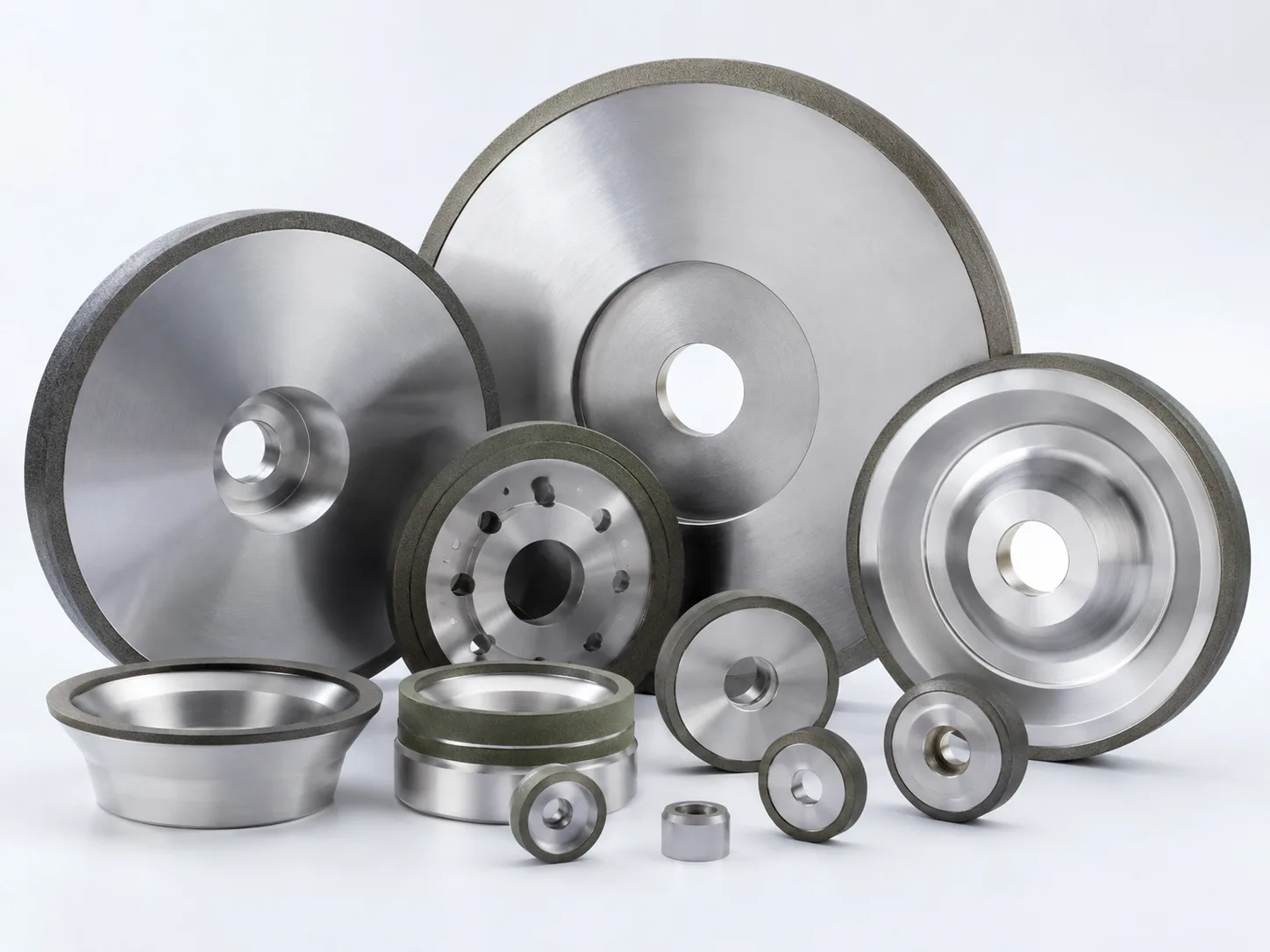
How to Choose a Grinding Wheel: Abrasive, Bond, Grit & Application Guide

Grinding Wheel Knowledge Base

How to Choose a Grinding Wheel: Abrasive, Bond, Grit & Application Guide

Selecting the right grinding wheel is one of the most important decisions in any grinding operation. The correct wheel specification can mean the difference between efficient material removal, consistent surface finish, and long wheel life - versus burning, chatter, short wheel life, and inconsistent part quality. This guide walks through the key factors to consider when choosing a grinding wheel: workpiece material, abrasive type, bond type, grit size, wheel hardness, wheel shape and dimensions, machine parameters, coolant conditions, and your surface finish or tolerance targets. Each factor is interconnected, and the optimal wheel specification balances all of them for your specific grinding application.

Workpiece material determines the abrasive type - the most fundamental selection decision
Bond type, grit size, and hardness must be selected together, not independently
Machine spindle speed, power, and rigidity constrain safe wheel dimensions and specifications
Providing complete application information helps wheel manufacturers recommend the right specification

Overview

About How to Choose a Grinding Wheel: Abrasive, Bond, Grit & Application Guide

Grinding wheel selection is an engineering decision that involves multiple interdependent factors. A grinding wheel consists of abrasive grains held together by a bond system, with porosity providing chip clearance and coolant access. Changing any single specification parameter - abrasive type, grit size, hardness grade, bond type, or wheel dimensions - affects grinding behavior. The abrasive type must match the workpiece material. The grit size determines material removal rate and surface finish capability. The wheel hardness grade controls how the abrasive grains fracture and self-sharpen during grinding. The bond type governs wheel durability, cutting freedom, and dressing requirements. These factors are not independent - a grit size that works well with a vitrified bond may behave differently with a resin bond. A hardness grade that works on a rigid cylindrical grinder may be inappropriate on a lighter surface grinder. This guide explains each selection factor and how they relate to real grinding applications.

Applications

Common grinding applications

How to Choose a Grinding Wheel: Abrasive, Bond, Grit & Application Guide are selected for these industrial grinding applications.

Surface Grinding

Surface grinding of flat steel plates, mold plates, and machine beds typically uses vitrified bond aluminum oxide or CBN wheels. Wheel diameter and width are selected according to the surface grinder spindle and table size. Softer wheel grades are used for hard materials and large contact areas; harder grades for soft materials and small contact areas.

Cylindrical Grinding

External and internal cylindrical grinding of shafts, pins, sleeves, and cylindrical components requires wheels matched to the workpiece diameter, length, and material. The grinding wheel specification - particularly hardness and grit size - must account for the wheel-to-workpiece contact arc and the machine's spindle power and rigidity.

Centerless Grinding

Centerless grinding of bearing rollers, hydraulic rods, and cylindrical parts uses wider wheels than cylindrical grinding. The wheel specification must balance cutting action with wheel wear across the full wheel width. Both the grinding wheel and regulating wheel must be specified for the workpiece diameter and through-feed or in-feed process.

Carbide and Hardened Steel Workpiece Grinding

Grinding of carbide workpieces and hardened steel (HSS) workpieces uses diamond wheels for carbide and CBN wheels for HSS. Resin bond wheels are common for this type of grinding because they provide good surface finish with reduced edge chipping.

Internal Grinding

Internal bore grinding uses small-diameter wheels that must maintain cutting efficiency at high spindle speeds in confined spaces. The wheel specification - especially hardness, grit size, and bond - must account for the small wheel diameter, high RPM, and often limited coolant access in the bore.

Form and Profile Grinding

Form grinding of gear teeth, thread profiles, and complex shapes requires wheels with excellent profile retention. Vitrified bond CBN or diamond wheels are commonly used for precision form grinding. The wheel hardness and bond must maintain the formed profile through production runs with minimal dressing.

Workpiece Materials

Suitable workpiece materials

Below are the most common workpiece materials matched with these grinding wheel applications.

Carbon Steel and Alloy Steel

Aluminum oxide grinding wheels are the standard choice for carbon steel, alloy steel (40Cr, 42CrMo, 20CrMnTi), and general ferrous materials. Brown aluminum oxide (A) for general use; white aluminum oxide (WA) for hardened steels and precision work.

Hardened Steel - HRC 50

Above HRC 50, CBN grinding wheels become the most economical choice for production volumes. Below HRC 50 or at lower volumes, white aluminum oxide wheels in appropriate grit and hardness provide a cost-effective alternative.

Bearing Steel

For bearing steel (GCr15, 100Cr6, SUJ2) above HRC 58, CBN wheels deliver the best combination of wheel life, surface quality, and part consistency. White aluminum oxide wheels are used for lower-volume or softer bearing steel applications.

Cast Iron

Silicon carbide grinding wheels are the preferred conventional abrasive for cast iron because the sharp, friable grains resist loading from the free graphite in cast iron. CBN wheels are used for high-volume precision cast iron grinding.

Cemented Carbide

Diamond grinding wheels are the standard for carbide grinding. Resin bond diamond for finish and edge quality, metal bond diamond for maximum wheel life. Green silicon carbide wheels are a lower-cost alternative for moderate-volume carbide applications.

Advantages

Key Technical Points

Key benefits and performance characteristics for industrial grinding applications.

Match Abrasive to Material

The abrasive type - aluminum oxide, silicon carbide, CBN, or diamond - must be compatible with the workpiece material. A correctly matched abrasive cuts efficiently and wears at a predictable rate. A mismatched abrasive wears rapidly, loads, glazes, or produces poor surface quality.

Balance Grit, Hardness, and Bond

Grit size, wheel hardness grade, and bond type work as a system. Fine grit with a soft bond may break down too quickly. Coarse grit with a hard bond may glaze and burn the workpiece. A balanced specification maintains consistent cutting performance through the grinding cycle.

Consider the Complete Grinding System

The grinding wheel is one element of a system that includes the machine, spindle, coolant, workpiece material, fixturing, and operator. A wheel that works well in one shop may perform differently in another if machine rigidity, coolant delivery, or operating practices differ.

Optimize for Total Cost Per Part

Wheel selection should consider total cost per ground part - not just wheel purchase price. A higher-cost superabrasive wheel may reduce cycle time, extend dressing intervals, and produce more parts per wheel change, resulting in lower total cost per part in appropriate applications.

Match Wheel Dimensions to Machine Capability

Wheel outer diameter, bore, and thickness must be compatible with the grinding machine's spindle, flanges, guards, speed rating, and power. Operating a wheel outside machine specifications is unsafe and typically produces poor grinding results.

Use Application Data, Not Guesswork

The most reliable wheel selections are based on complete application data: workpiece material, hardness, grinding process, machine, surface finish target, and current grinding performance. A wheel manufacturer can recommend a specification when given complete information.

Selection Guide

Selection Guide

Use these practical tips to narrow down the right wheel specification for your grinding application.

1

Start with workpiece material - this determines abrasive type. Ferrous materials (steel, bearing steel, HSS) - aluminum oxide or CBN. Non-ferrous metals (aluminum, copper, brass) - silicon carbide. Cast iron - silicon carbide or CBN. Carbide, ceramics, glass, stone - diamond.

2

Select abrasive type by material and production volume - conventional abrasives (A, WA, C, GC) for general and moderate-volume applications. Superabrasives (CBN, diamond) for high-volume production of hard materials where long wheel life and consistent quality justify the higher initial cost.

3

Choose bond type by operation - vitrified bond for most precision grinding: free cutting, good profile stability, easy to dress. Resin bond for finishing, reduced chipping, and improved surface finish. Metal bond for maximum wheel life in high-volume production. Electroplated for complex formed profiles.

4

Pick grit size by finish and stock removal needs - coarse grits (24-60) for heavy stock removal and rough grinding. Medium grits (60-100) for general-purpose grinding. Fine grits (100-240) for finish grinding and precision surfaces. Finer than 240 for superfinishing and mirror finishes.

5

Select hardness grade based on material hardness and contact area - softer grades (H–K) for hard workpiece materials and large contact areas to promote grain fracture and self-sharpening. Harder grades (L–P) for soft workpiece materials and small contact areas where grain retention is needed.

6

Verify wheel dimensions against machine specifications - confirm outer diameter, bore/ID, thickness, and maximum operating speed are within machine and spindle limits. Provide the machine model to the wheel manufacturer so dimensions and mounting specifications can be verified.

Before You Inquire

Information needed for quotation

Providing the details below helps us recommend the right wheel specification and prepare an accurate factory quotation faster.

Workpiece material and hardness (e.g., 45# carbon steel, GCr15 HRC 60+/-2, cemented carbide grade)
Grinding process - surface, cylindrical (external or internal), centerless, or form grinding
Wheel dimensions - outer diameter, inner diameter/bore, thickness; or machine model so dimensions can be matched
Machine model, spindle speed (RPM), spindle power, and coolant type if applicable
Target surface finish (Ra) and dimensional tolerance required
Current grinding problem if replacing an existing wheel - burning, short life, poor finish, vibration, low efficiency
Estimated monthly or annual wheel consumption quantity
Drawing or photo of the workpiece, current wheel, or required profile, if available

Send these details through the inquiry form, or contact us on WhatsApp for a preliminary recommendation.

Send Grinding Details

Industries

Industries served

How to Choose a Grinding Wheel: Abrasive, Bond, Grit & Application Guide are used across these manufacturing sectors. We provide grinding wheel solutions for industrial grinding applications. We do not supply the customer workpieces themselves, such as bearings, hydraulic components, molds, or mechanical parts.

Bearing grinding applications - raceway, ring, and roller precision grinding
Automotive component grinding applications - transmission, engine, and chassis part grinding
Hydraulic parts grinding applications - rod, cylinder, piston, and valve component grinding
Mold grinding applications - mold plate, cavity, core, and insert grinding
Carbide and hardened steel workpiece grinding - carbide and HSS workpiece grinding
General precision engineering - shaft, spindle, and precision component grinding

FAQ

Common questions about how to choose a grinding wheel: abrasive, bond, grit & application guide

Quick answers to common buyer questions before sending an inquiry.

What is the most important factor when choosing a grinding wheel?

Workpiece material is the most fundamental factor because it determines which abrasive type can be used. Using the wrong abrasive for the workpiece - for example, silicon carbide on steel, or diamond on steel - results in rapid wheel wear and poor grinding performance regardless of how well the other specifications are chosen. Start with the material, then select abrasive type, then bond, grit, and hardness together.

How do I know what grit size to use?

Grit size is selected based on the required surface finish and material removal rate. Coarse grits (24-60) remove material quickly and are used for rough grinding where surface finish is not critical. Medium grits (60-100) provide a balance of stock removal and finish for general-purpose grinding. Fine grits (100-240) are used for finish grinding where surface quality is the priority. Finer grits (above 240) are used for superfinishing and mirror-surface applications. The grit size should be selected together with bond type and hardness - not in isolation.

What does wheel hardness (grade) mean?

Wheel hardness refers to the strength of the bond holding the abrasive grains - not the hardness of the abrasive material itself. A 'soft' wheel (lower grade letter, e.g., H, I, J) has a weaker bond that releases abrasive grains more readily, exposing fresh cutting edges. This is needed for hard workpiece materials and large contact areas. A 'hard' wheel (higher grade letter, e.g., L, M, N, P) holds grains more firmly and is used for soft workpiece materials and small contact areas. Incorrect hardness selection is one of the most common causes of grinding problems - too hard leads to glazing and burning; too soft leads to rapid wheel wear and poor form retention.

Can the same wheel specification work on different machines?

Not necessarily. The grinding machine's spindle speed, power, rigidity, coolant delivery, and vibration characteristics all affect how a wheel performs. A wheel that works well on a rigid CNC cylindrical grinder may not perform the same way on a lighter manual machine - even grinding the same workpiece. Machine-specific factors should be considered when specifying a wheel, which is why wheel manufacturers typically ask for the machine model.

Should I use wet or dry grinding?

Wet grinding (with coolant) is recommended for most precision grinding applications. Coolant reduces grinding zone temperatures, flushes away chips, lubricates the wheel-workpiece interface, and helps maintain consistent grinding conditions. Dry grinding is limited to applications where coolant cannot be used - certain coated abrasive operations, or when the workpiece material is sensitive to coolant. The wheel bond and hardness specification may differ between wet and dry grinding for the same application.

What information should I provide to get a wheel recommendation?

To receive an accurate wheel recommendation, provide: workpiece material and hardness, grinding process (surface, cylindrical, internal, centerless, etc.), wheel dimensions or machine model, spindle speed and power, target surface finish (Ra), desired material removal rate or cycle time, current grinding problem if any, coolant type (wet or dry), and estimated quantity. A drawing or photo of the workpiece or current wheel helps the manufacturer respond with a more precise recommendation.

WhatsApp Inquiry