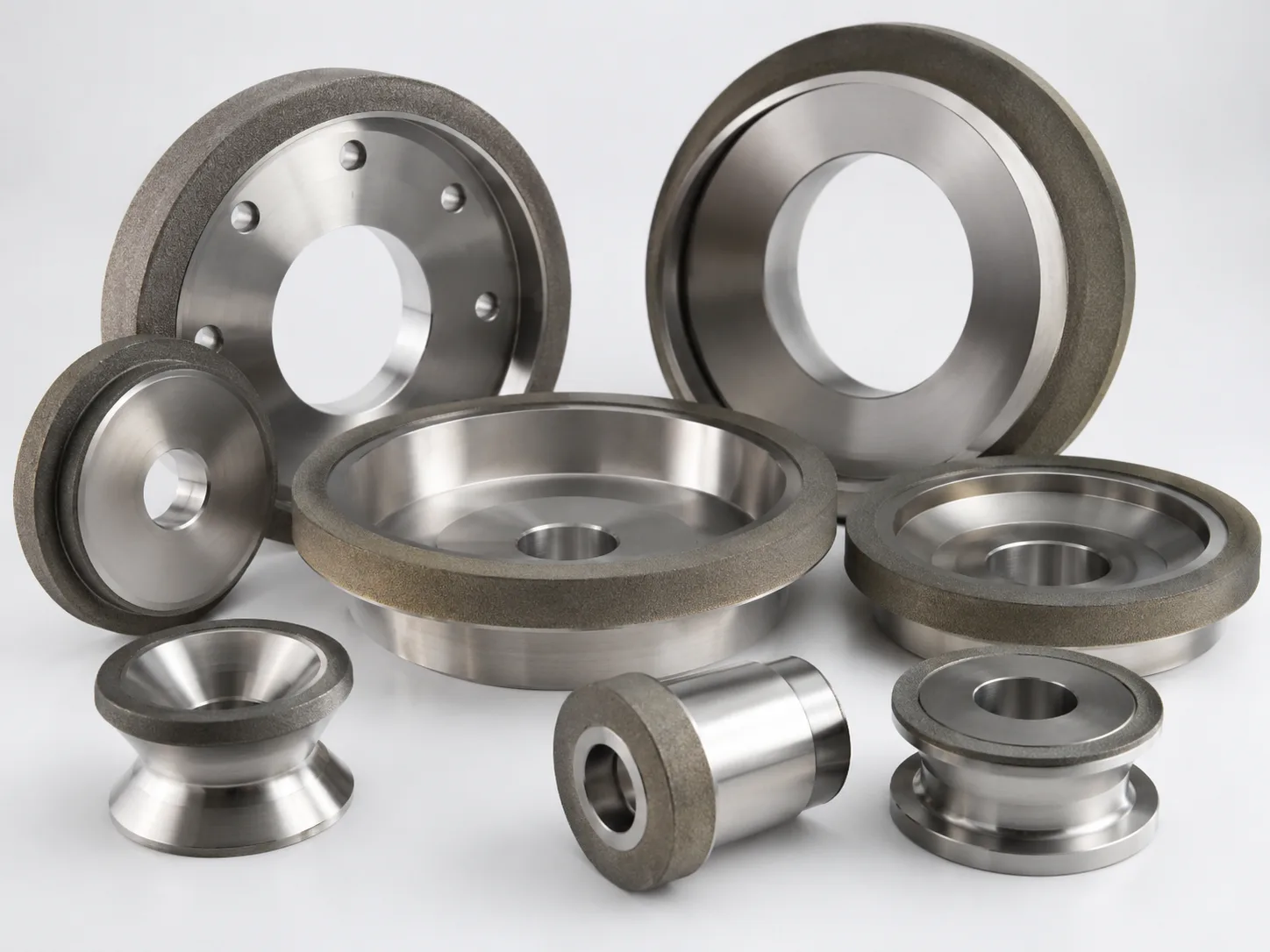
CBN vs Diamond Grinding Wheels: Materials, Applications & Selection

Grinding Wheel Knowledge Base

CBN vs Diamond Grinding Wheels: Materials, Applications & Selection

CBN (Cubic Boron Nitride) and diamond are the two superabrasive materials used in high-performance grinding wheels. Both offer significantly longer wheel life and more consistent grinding performance than conventional aluminum oxide or silicon carbide wheels - but they are not interchangeable. Selecting the wrong superabrasive for your workpiece material leads to rapid wheel wear, poor surface finish, and uneconomical grinding costs. This guide explains the key differences, typical applications, and selection factors to help you determine which superabrasive wheel type fits your grinding application.

CBN is designed for ferrous materials - bearing steel, hardened steel, high-speed steel, cast iron
Diamond is designed for non-ferrous hard materials - carbide, ceramics, glass, stone, tungsten steel
The critical difference: diamond reacts with iron at grinding temperatures, CBN does not
Final selection depends on workpiece material, machine, bond type, grit, and grinding conditions

Overview

About CBN vs Diamond Grinding Wheels: Materials, Applications & Selection

CBN and diamond are both manufactured superabrasives produced under high-temperature, high-pressure synthesis. They share exceptional hardness - diamond is the hardest known material, and CBN is second only to diamond - giving both superabrasive wheel types the ability to maintain sharp cutting edges far longer than conventional abrasives. However, their chemical behavior at grinding temperatures is fundamentally different. Diamond contains carbon, which reacts with iron in ferrous materials at the elevated temperatures generated during grinding. This chemical reaction causes rapid diamond wear when grinding steel. CBN (Cubic Boron Nitride) is chemically stable against iron, making it the correct superabrasive for hardened steel, bearing steel, high-speed steel, and cast iron. Understanding this chemical difference - rather than just comparing hardness - is the foundation of correct superabrasive wheel selection.

Applications

Common grinding applications

CBN vs Diamond Grinding Wheels: Materials, Applications & Selection are selected for these industrial grinding applications.

Bearing Steel Grinding (CBN)

CBN grinding wheels are the industry standard for grinding bearing rings, raceways, and rollers made from GCr15, 100Cr6, and SUJ2 bearing steels. CBN maintains cutting efficiency and profile stability through high-volume bearing production runs without the chemical wear that diamond experiences on steel.

Hardened Steel and Mold Steel Grinding (CBN)

Hardened alloy steels, tool steels, and mold steels above HRC 50 are best ground with CBN wheels. CBN delivers stable material removal with reduced grinding burn risk on heat-sensitive hardened surfaces. Diamond wheels would wear rapidly and uneconomically on these materials.

Carbide Tool and Insert Grinding (Diamond)

Cemented carbide workpieces, tungsten carbide parts, ceramics, glass, stone, and other hard or brittle non-ferrous materials are the primary application for diamond grinding wheels. Diamond's extreme hardness cuts these materials cleanly and maintains sharp cutting edges through extended production runs.

Ceramic Component Grinding (Diamond)

Technical ceramics - alumina, zirconia, silicon nitride - require diamond grinding wheels for precision machining without micro-cracking or surface damage. Diamond is the only abrasive hard enough to grind advanced ceramics efficiently.

High-Speed Steel and Tool Steel Grinding (CBN)

High-speed steel (M2, M42, T1) workpieces, hardened punches, and hardened dies benefit from CBN grinding. CBN wheels cut HSS cleanly with less loading and glazing compared to conventional wheels, and without the chemical wear that makes diamond unsuitable for these ferrous materials.

Glass and Stone Processing (Diamond)

Glass edge grinding, beveling, and stone fabrication are diamond wheel applications. Diamond delivers smooth edges and consistent finish on glass, natural stone, and engineered quartz. CBN is not suitable for these non-ferrous, non-metallic materials.

Workpiece Materials

Suitable workpiece materials

Below are the most common workpiece materials matched with these grinding wheel applications.

Bearing Steel - GCr15, 100Cr6, SUJ2, 52100 (Use CBN)

Bearing steel is a ferrous material. CBN grinding wheels are chemically stable against iron and deliver long wheel life, consistent surface finish, and stable profile retention on bearing steel raceways, rings, and rollers. Diamond wheels should not be used.

Hardened Alloy Steel - HRC 50 (Use CBN)

Quenched and tempered alloy steels including 40Cr, 42CrMo, and similar grades are ferrous materials that require CBN for efficient superabrasive grinding. CBN maintains cutting efficiency on hardened surfaces without the diamond-iron chemical reaction.

High-Speed Steel - M2, M42, T1 (Use CBN)

HSS is a ferrous tool steel. CBN wheels cut HSS cleanly and resist loading. Diamond wheels on HSS would suffer rapid chemical wear from the iron-diamond reaction at grinding temperatures.

Cemented Carbide - WC-Co Grades (Use Diamond)

Tungsten carbide with cobalt binder is a non-ferrous hard material. Diamond grinding wheels provide high cutting efficiency and long wheel life on carbide. CBN is not recommended - diamond is the correct abrasive for carbide.

Technical Ceramics - Al2O3 ZrO2 Si3N4(Use Diamond)

Advanced ceramics are non-ferrous, non-metallic hard materials. Diamond grinding wheels are required for precision machining without surface damage. Neither CBN nor conventional abrasives are suitable alternatives.

Advantages

Key Technical Points

Key benefits and performance characteristics for industrial grinding applications.

CBN: Chemical Stability with Ferrous Materials

The defining advantage of CBN is its chemical stability when grinding iron-containing materials. Unlike diamond, CBN does not react with iron at grinding temperatures, making it the only superabrasive suitable for steel, bearing steel, high-speed steel, and cast iron.

Diamond: Highest Hardness for Non-Ferrous Materials

Diamond is the hardest known material, providing very high hardness and wear resistance when grinding carbide, ceramics, glass, stone, and other non-ferrous hard materials where chemical reactivity with iron is not a concern.

Both: Extended Wheel Life vs. Conventional Abrasives

Both CBN and diamond wheels significantly outlast aluminum oxide and silicon carbide wheels in their respective application ranges, reducing wheel change frequency, improving part-to-part consistency, and lowering total grinding cost per part in appropriate applications.

Both: Thermal Conductivity

CBN and diamond both have high thermal conductivity compared to conventional abrasives. This carries heat away from the grinding zone, reducing the risk of thermal damage to heat-sensitive workpieces when the wheel is correctly specified.

Both: Profile Retention

Both superabrasive types maintain wheel form and cutting profile through extended grinding runs, reducing dressing frequency and improving dimensional consistency in production environments where profile accuracy is critical.

Both: Multiple Bond Options

Both CBN and diamond wheels are available in resin, vitrified, metal, and electroplated bonds, allowing the wheel specification to be optimized for specific grinding conditions - from aggressive stock removal to fine surface finishing.

Selection Guide

Selection Guide

Use these practical tips to narrow down the right wheel specification for your grinding application.

1

Identify the workpiece material first - this is the single most important factor. If the material contains iron (steel, bearing steel, HSS, cast iron), CBN is the correct superabrasive. For carbide, ceramics, glass, stone, and non-ferrous hard materials, diamond is the correct choice.

2

Check the material hardness - superabrasive wheels are generally most cost-effective when grinding materials above HRC 50. For softer steels below HRC 45, conventional aluminum oxide wheels may be more economical than CBN.

3

Consider production volume - higher volumes favor superabrasive wheels because the extended wheel life and reduced downtime offset the higher initial wheel cost. Calculate total cost per part, not just wheel purchase price.

4

Match the bond type to the grinding operation - vitrified bond for profile stability and free cutting, resin bond for surface finish and reduced chipping, metal bond for maximum wheel life, electroplated for complex profiles.

5

Specify grit size according to surface finish requirements - finer grits for finish grinding, coarser grits for stock removal. The grit size range should be selected together with bond type and concentration for optimal results.

6

When uncertain, provide workpiece material, hardness, grinding process, machine model, and finish target to the wheel manufacturer. A proper wheel recommendation considers all these factors together - not just abrasive type alone.

Before You Inquire

Information needed for quotation

Providing the details below helps us recommend the right wheel specification and prepare an accurate factory quotation faster.

Workpiece material and hardness (e.g., GCr15 bearing steel HRC 60+/-2, or cemented carbide grade)
Grinding process - surface, cylindrical, internal, centerless, or form grinding
Wheel dimensions - outer diameter, inner diameter/bore, and thickness
Machine model, spindle speed, and coolant type
Target surface finish (Ra) and dimensional tolerance
Current grinding problem if replacing an existing wheel - e.g., short life, burning, poor finish
Estimated monthly or annual wheel quantity
Drawing or photo of the workpiece or current wheel, if available

Send these details through the inquiry form, or contact us on WhatsApp for a preliminary recommendation.

Send Grinding Details

Industries

Industries served

CBN vs Diamond Grinding Wheels: Materials, Applications & Selection are used across these manufacturing sectors. We provide grinding wheel solutions for industrial grinding applications. We do not supply the customer workpieces themselves, such as bearings, hydraulic components, molds, or mechanical parts.

Bearing grinding applications - bearing steel ring, raceway, and roller grinding (CBN application)
Hard-material workpiece grinding - carbide, ceramic, and tungsten steel workpiece grinding (diamond application)
Automotive component grinding applications - hardened steel transmission and engine part grinding (CBN application)
Precision mold and die manufacturing - hardened mold steel and carbide mold component grinding
Glass processing - architectural, automotive, and display glass fabrication (diamond application)
Aerospace component grinding - hardened alloy steel and ceramic composite grinding

FAQ

Common questions about cbn vs diamond grinding wheels: materials, applications & selection

Quick answers to common buyer questions before sending an inquiry.

What is the main difference between CBN and diamond grinding wheels?

CBN (Cubic Boron Nitride) grinding wheels are for ferrous materials - hardened steel, bearing steel, high-speed steel, and cast iron. Diamond grinding wheels are for non-ferrous hard materials - cemented carbide, technical ceramics, glass, stone, and tungsten steel. The fundamental difference is chemical: diamond reacts with iron at grinding temperatures, causing rapid abrasive wear, while CBN remains chemically stable against iron. For steel grinding, CBN is the correct superabrasive. For carbide, ceramics, and non-ferrous hard materials, diamond is the correct choice.

Can diamond grinding wheels be used on steel?

Diamond grinding wheels should not be used on steel or any ferrous material. At the high temperatures generated during grinding, the carbon in diamond reacts chemically with iron in the workpiece, causing rapid diamond wear and uneconomical grinding costs. This is not a matter of wheel specification - it is a fundamental chemical limitation. For all steel grinding applications, CBN grinding wheels are the correct superabrasive choice.

Can CBN wheels be used on carbide?

CBN wheels are not recommended for carbide grinding. While CBN is harder than carbide, CBN is specifically designed for ferrous materials. Diamond grinding wheels are the industry standard for cemented carbide grinding because diamond is significantly harder than carbide and provides far longer wheel life and better grinding economics. Using CBN on carbide would result in slower material removal and higher wheel wear compared to diamond.

Which is harder - CBN or diamond?

Diamond is harder than CBN. Diamond is the hardest known material, and CBN is second to diamond in hardness. However, hardness alone does not determine which wheel to use - chemical compatibility is more important. CBN is the correct superabrasive for ferrous materials despite being slightly softer than diamond, because CBN does not chemically react with iron at grinding temperatures.

Are superabrasive wheels worth the higher cost?

In appropriate applications, superabrasive wheels typically deliver lower total cost per ground part than conventional wheels - despite higher initial wheel cost - because they last significantly longer, require less frequent dressing and wheel changes, produce more consistent part quality, and can operate at higher material removal rates. The economics are most favorable for high-volume production grinding hardened materials. For low-volume or occasional grinding of softer materials, conventional wheels may be more economical.

Can both CBN and diamond wheels be used in the same grinding machine?

Yes, many grinding machines can use either CBN or diamond wheels if the wheel dimensions, mounting, speed rating, and coolant system are compatible. However, careful cleaning is required when switching between CBN and diamond wheels on the same machine to prevent cross-contamination of abrasive grains, which can cause surface quality issues. Always consult the machine manufacturer and the wheel specification before changing wheel types.

WhatsApp Inquiry