What causes grinding wheel loading?
Loading occurs when workpiece material, chips, or grinding debris stick to or fill the open pores between abrasive grains on the wheel surface. Common causes include: wheel structure too dense (insufficient porosity), abrasive type not suited to the workpiece material, coolant delivery insufficient to flush chips, dressing too light to open the wheel surface, and grinding parameters that cause rubbing rather than cutting. Soft, ductile, or gummy materials are particularly prone to causing loading. In many cases, loading results from a combination of factors — wheel specification, material characteristics, and process conditions — rather than a single cause.
Is loading the same as glazing?
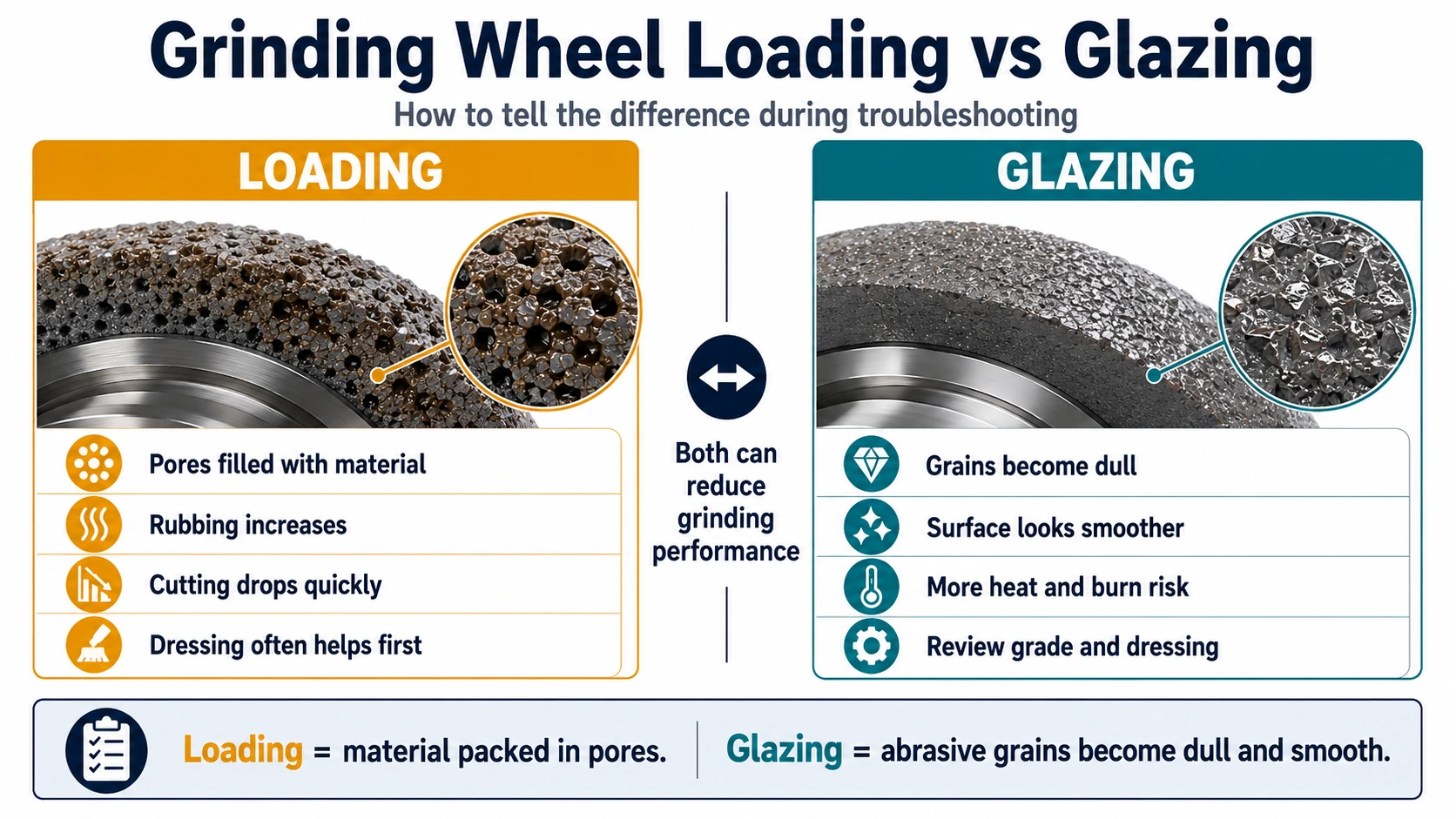
No — loading and glazing are different problems with different causes. Loading is when workpiece material fills the wheel pores; the surface looks smeared or packed. Glazing is when abrasive grains become dull and flattened; the surface looks shiny or polished. Both reduce cutting ability and increase heat, but the corrective direction is different. Loading typically requires a more open wheel structure, different abrasive type, or improved coolant delivery. Glazing typically requires a softer wheel grade, more aggressive dressing, or different abrasive type. Confusing the two can lead to changes that make the problem worse — for example, using a softer wheel to fix loading may increase wheel wear without reducing loading.
Why does my grinding wheel load up after dressing?
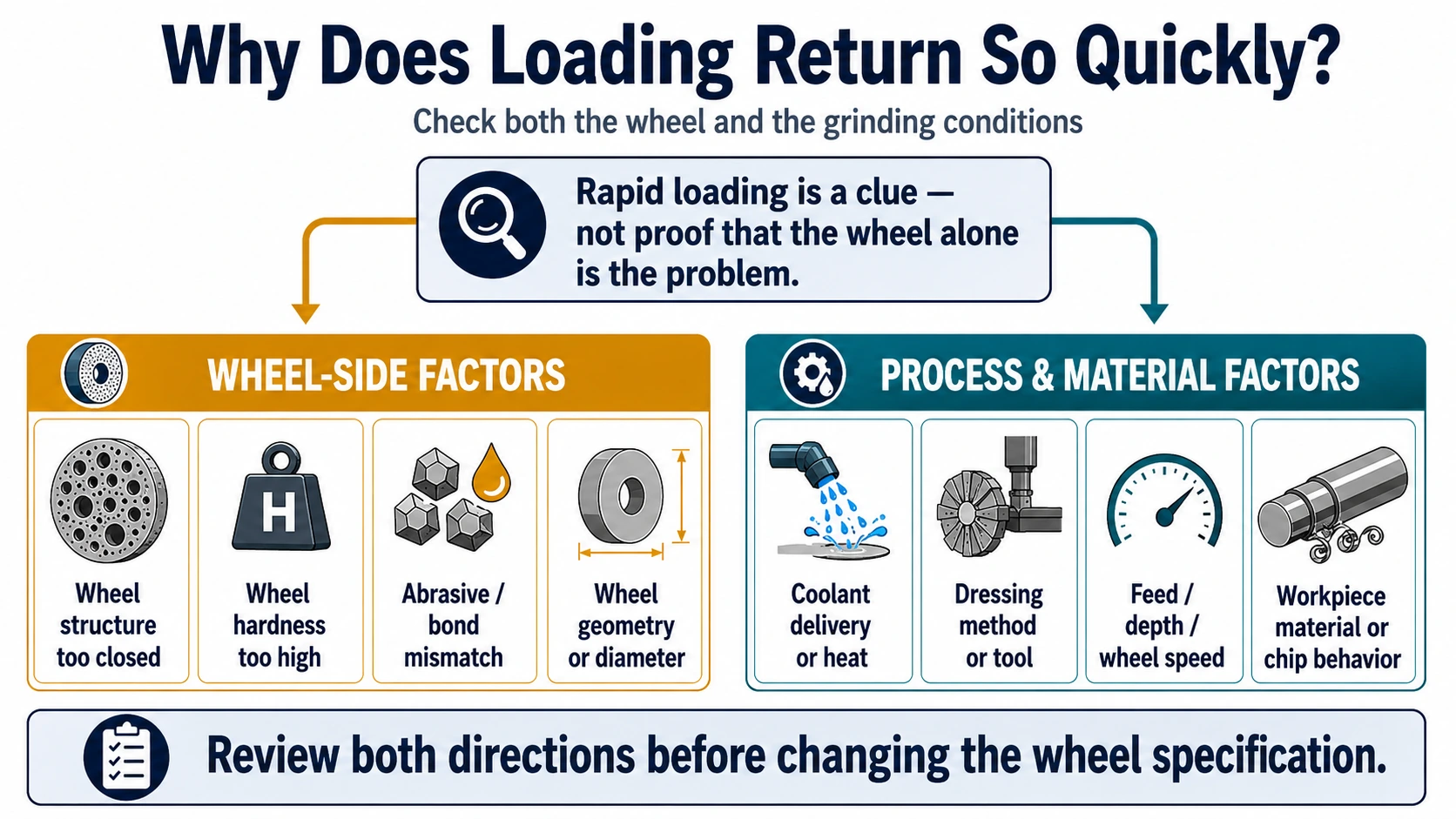
Dressing removes the loaded surface layer and exposes fresh abrasive grains with open porosity — which is why cutting improves temporarily. If loading returns quickly, the underlying cause has not been addressed. Possible reasons: the wheel structure is too dense for the material and removal rate; the abrasive type is not suitable for the workpiece material (e.g., aluminum oxide on ductile aluminum); coolant is not flushing chips effectively; dressing parameters are too light and not opening the wheel surface enough; or grinding parameters are causing rubbing rather than cutting. A consistent, short loading interval after dressing strongly suggests the wheel specification or process conditions should be reviewed.
Can coolant cause grinding wheel loading?
Yes — coolant plays an important role in chip evacuation. If coolant does not reach the grinding zone — because of incorrect nozzle position, insufficient flow rate, blocked nozzles, or dirty coolant — chips are not flushed away and can pack into the wheel surface. Coolant concentration and type also matter: too low a concentration may provide insufficient lubrication, increasing friction and material adhesion; the wrong coolant type may not provide adequate lubricity for the material being ground. Before changing the wheel specification, verify that coolant is reaching the grinding zone, at the correct concentration, and in clean condition. In some cases, improving coolant delivery alone can significantly reduce loading.
Can a harder wheel cause loading?
A harder wheel can contribute to loading, but not directly. A wheel that is too hard for the application holds abrasive grains too firmly — they do not fracture to expose fresh cutting edges. As grains become dull, the wheel begins rubbing rather than cutting, generating more heat and potentially causing material to smear onto the wheel surface. Additionally, a hard wheel combined with a dense structure provides very little chip clearance. However, simply switching to a softer wheel is not always the right fix for loading — it depends on whether the loading is caused by dull grains (where a softer grade may help) or by insufficient porosity (where a more open structure is needed regardless of grade).
How can I reduce grinding wheel loading?
The most effective approach depends on the root cause. Start with these checks: (1) Wheel structure — a more open structure may provide more chip clearance, read within the wheel manufacturer's own specification system. (2) Abrasive type — match to the workpiece material; silicon carbide resists loading on non-ferrous metals, CBN on hardened steel. (3) Coolant delivery — verify nozzles are aimed at the grinding zone with adequate flow and concentration. (4) Dressing — use adequate depth and lead rate to open the wheel surface; check dressing tool condition. (5) Grinding parameters — ensure the combination of depth, feed, and speed promotes cutting rather than rubbing. (6) Grit size — a coarser grit may reduce loading if surface finish requirements allow. Often, a combination of two or three of these adjustments produces the best result.
When should I change the wheel specification?
Consider a specification change when: loading returns quickly and consistently after dressing despite verified coolant delivery, dressing parameters, and grinding conditions; the loading rate is predictable and tied to the material (suggesting the abrasive type or structure is not well-matched); the current wheel requires frequent dressing that impacts productivity; or you are grinding a material known to cause loading with the current abrasive type (e.g., aluminum oxide on aluminum). When requesting a new specification, provide: workpiece material and hardness, current wheel specification, grinding process, coolant details, dressing method, and photos of the loaded wheel surface. This helps the manufacturer recommend a specification matched to your specific conditions.
What information should I provide for wheel selection?
To get a suitable wheel recommendation for a loading problem, provide: workpiece material and hardness; grinding process type; current wheel specification (abrasive, bond, grit, hardness, structure, dimensions); machine model and spindle speed; coolant type and delivery method; dressing method and tool condition; a description of the loading problem — how quickly it occurs, on what material, and whether it is consistent; target surface finish (Ra); and photos of the loaded wheel surface. The more complete the information, the more targeted the specification recommendation can be. Partial information is still useful — it allows the manufacturer to ask the right follow-up questions.
Is CBN less likely to load than conventional abrasive wheels?
CBN (Cubic Boron Nitride) grinding wheels are generally less prone to loading than conventional aluminum oxide wheels when grinding hardened ferrous materials — but they are not immune to loading. CBN grains are harder and sharper, maintaining cutting edges longer and generating less frictional heat. This reduces the tendency for material to adhere to the wheel surface. However, if coolant delivery is poor, the wheel structure is too dense, or the material is prone to smearing, even a CBN wheel can load. CBN is primarily chosen for its wheel life, cutting efficiency, and thermal performance on hardened steels — reduced loading tendency is a secondary benefit in appropriate applications. For non-ferrous materials where loading is the main problem, silicon carbide is often a more practical and economical choice than CBN.
Can dressing method affect loading?
Yes — dressing method and tool condition directly affect how open and sharp the wheel surface is after dressing. A dressing pass that is too light or uses too fine a lead rate may not remove enough material to expose fresh abrasive grains and open pores — the surface may look clean but is actually still relatively closed. A worn or damaged dressing tool may not effectively fracture the bond to expose grains. For loading-prone applications, a slightly more aggressive dress (adequate depth, faster lead rate) can produce a rougher, more open wheel surface that resists loading longer. However, a rougher surface may also produce a rougher workpiece finish — so dressing parameters must balance loading resistance with surface finish requirements.