Grinding Wheel Knowledge Base
Why Do Grinding Burn Marks Appear on the Workpiece Surface?
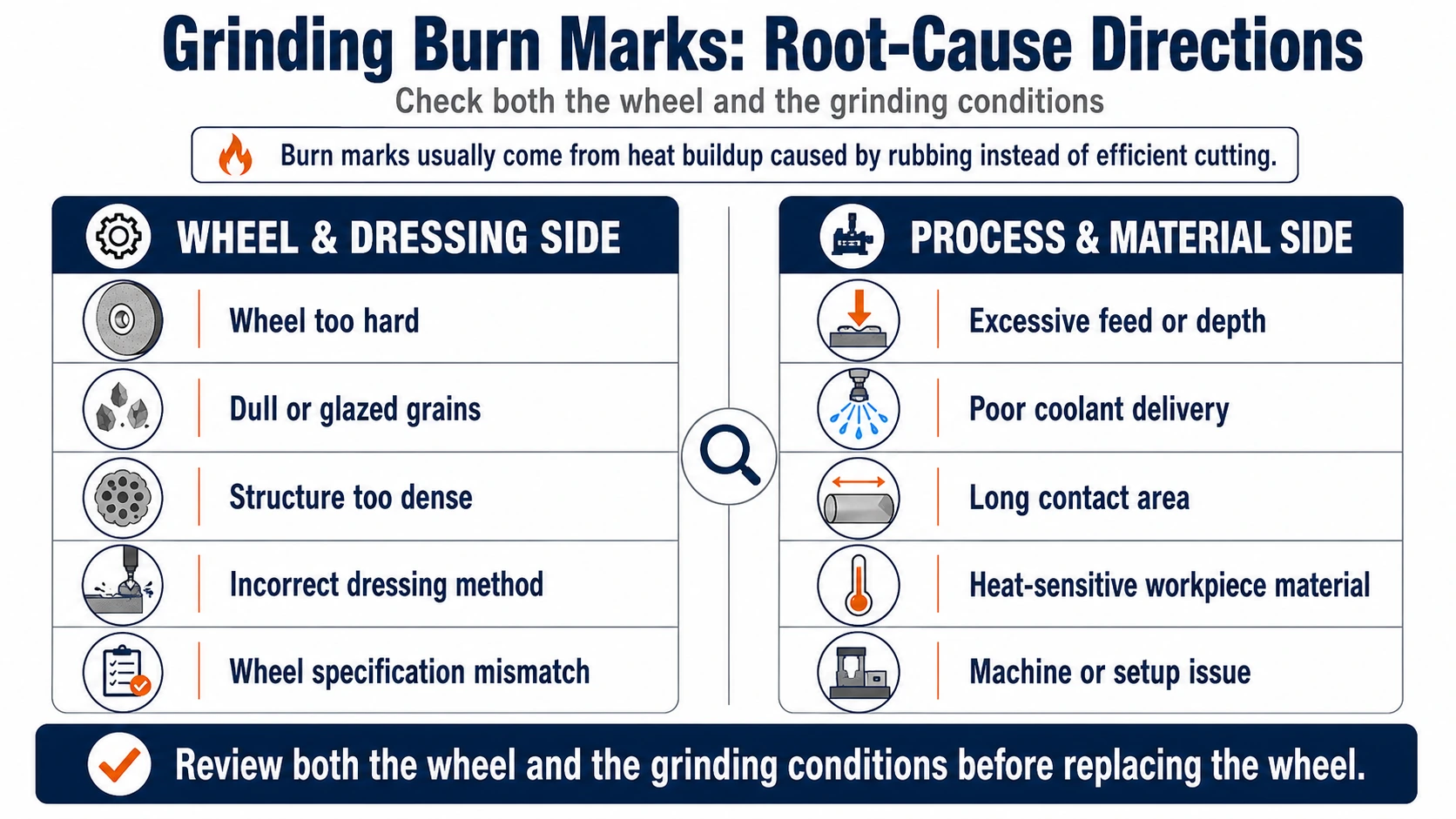
The workpiece comes off the grinder with blue marks, brown discoloration, or shiny heat spots. The wheel may still look usable, but the grinding zone is generating more heat than the process can remove. Burn marks are not just a cosmetic issue — they are a signal that thermal conditions at the grinding contact zone are out of balance. The cause may be wheel-related (glazing, loading, hardness too high, structure too dense), process-related (coolant delivery, dressing condition, grinding parameters), or material-related. This guide helps identify the most likely cause and what to check before changing the grinding wheel.
Overview
Why grinding burn happens and what to check first
Grinding burn marks are surface discoloration or thermal damage caused by excessive heat generation during grinding. They may appear as blue, brown, dark, shiny, or locally discolored areas on the workpiece surface. The root mechanism is simple: more heat is being generated at the grinding contact zone than the cooling system and chip removal can carry away. When the heat entering the workpiece surface exceeds the material's thermal tolerance, surface discoloration and possibly subsurface metallurgical changes occur. Unlike loading or glazing — which are wheel surface problems — burn marks appear on the workpiece, making them immediately visible. The challenge is that multiple factors can contribute simultaneously: a wheel that is too hard may glaze and rub, coolant may not reach the zone, dressing may be too light, or the contact area and parameters may simply generate too much heat for the system's cooling capacity. This guide walks through the common causes and what to check first.
Key Takeaways
- Grinding burn means more heat is being generated at the contact zone than the process can remove — it is a thermal balance problem
- Loading, glazing, and dull grains turn cutting into rubbing, generating more frictional heat — check the wheel surface condition before assuming the specification is wrong
- Coolant direction, dressing method, wheel hardness, grit size, and grinding parameters all affect burn risk — changing one factor without checking the others may not solve the problem
- Before changing the wheel, collect: photos of burn marks and wheel surface, workpiece material, wheel specification, dressing condition, coolant information, and grinding parameters

What Are Grinding Burn Marks?
Grinding burn marks are visible surface discoloration caused by excessive heat at the grinding contact zone. Unlike loading or glazing, which affect the wheel surface, burn marks appear directly on the workpiece — making them immediately noticeable during quality inspection.
How burn marks form during grinding
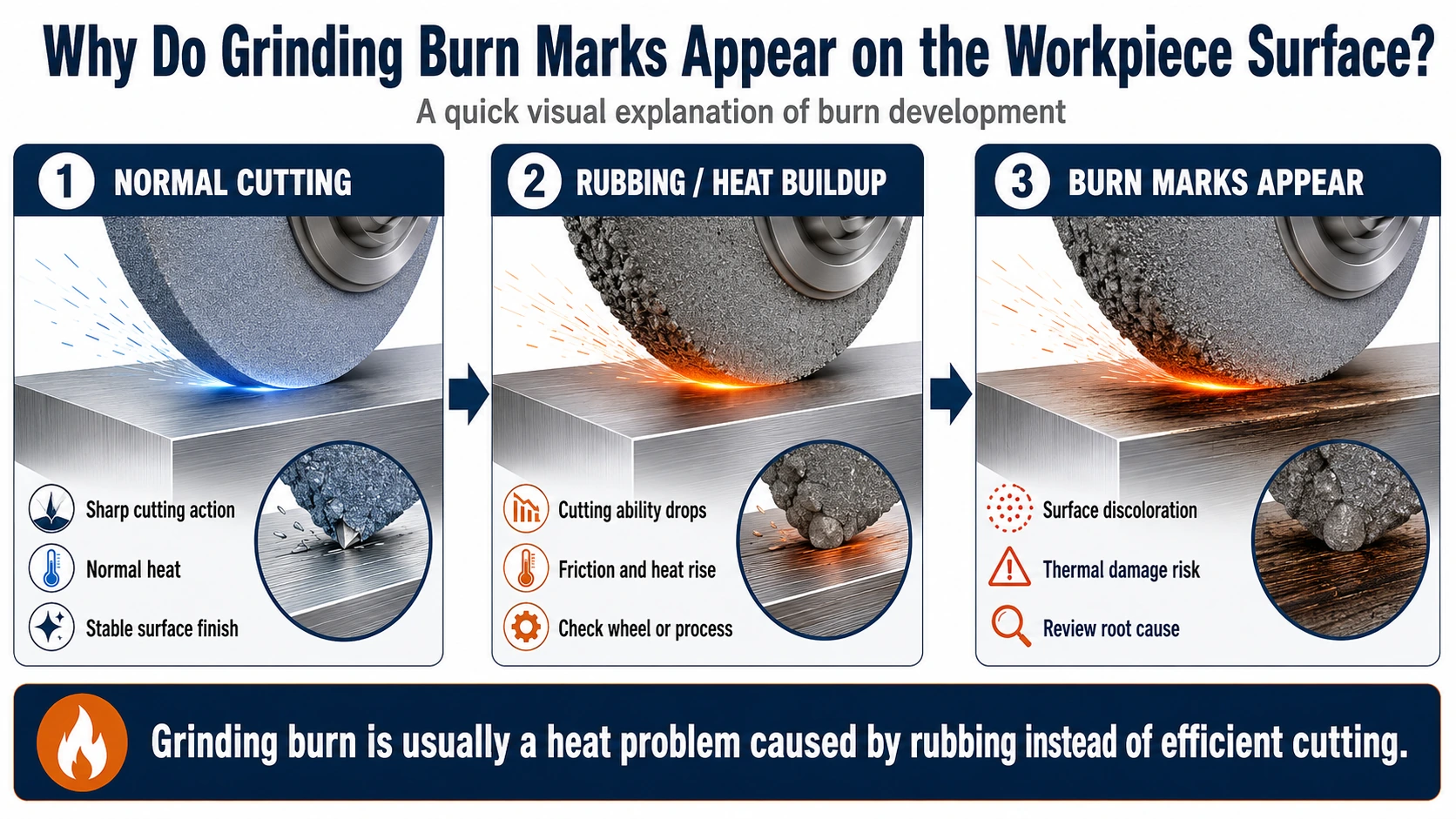
During grinding, abrasive grains shear material from the workpiece — a process that converts mechanical energy into heat. Under normal conditions, most heat is carried away by grinding chips, coolant, and the wheel itself. Burn occurs when heat entering the workpiece exceeds the material's thermal tolerance. The surface layer reaches temperatures that cause oxidation discoloration — blue, brown, or straw-colored marks — and may experience microstructural changes beneath the surface. In precision grinding, even light burn marks can indicate conditions that affect surface integrity and part performance.
Why burn matters beyond appearance
Burn marks are not only a visible quality defect — they indicate that thermal conditions during grinding are out of balance. When burn appears repeatedly, it means the grinding system is generating more heat than it can manage. The same thermal conditions that produce visible burn can also cause subsurface changes — residual tensile stress, re-hardened layers, or micro-cracking — that reduce fatigue life and wear resistance. In bearing, hydraulic, and precision component grinding, surface integrity is a functional requirement, not just a cosmetic one.
Common Signs of Grinding Burn
Burn marks can appear in several forms. Spotting them early helps identify the root cause before it affects part quality across the production run.
Blue, brown, or dark discoloration on the workpiece surface
The most direct sign — visible color change ranging from light straw or gold to dark blue or black. The color indicates the approximate surface temperature reached. Blue marks typically mean higher temperatures than straw-colored marks. Burn may be localized (at edges, corners, or the start/end of the grinding pass) or distributed across the surface. If burn appears consistently in the same location, check whether coolant access is restricted at that point or whether the contact arc generates more heat there.
Shiny or polished patches on the ground surface
Not all thermal damage produces color change. Some burn appears as unusually shiny or polished areas where the surface has been heated and smeared rather than cleanly cut. This is more common with certain material types and can be harder to detect during visual inspection. Checking under different lighting angles or using a surface finish measurement can help identify these areas.
Surface finish becomes inconsistent or unstable
Burn often correlates with degraded surface finish. As heat increases, the wheel-workpiece interaction changes — thermal expansion affects dimensional control, and the surface may become rougher, wavier, or show chatter marks alongside burn. If Ra values are drifting upward and burn marks are appearing together, the root cause is likely thermal.
Burn appears after dressing effect fades
A classic pattern: after dressing, the wheel cuts well and no burn is visible. After a number of parts, burn marks begin to appear — first faint, then more obvious. This pattern suggests the wheel surface condition is degrading (glazing or loading) and the post-dressing cutting ability is being lost. The burn is a symptom of the wheel surface condition deteriorating — not necessarily a specification problem.
Wheel surface shows glazing or loading alongside burn
When burn appears together with a glazed (shiny, polished) or loaded (material-clogged) wheel surface, the connection is usually direct: the wheel surface has lost its ability to cut freely and has begun rubbing instead. Addressing the glazing or loading — through dressing, wheel specification review, or process adjustment — often reduces or eliminates the burn.
Workpiece feels hotter than usual after grinding
If the workpiece temperature after grinding is noticeably higher than normal — even when burn marks are not yet visible — the system is approaching the burn threshold. This is a useful early warning sign for operators: rising workpiece temperature often precedes visible burn. Check coolant delivery and grinding parameters before burn marks start appearing.
Applications
Quick Diagnostic Table for Grinding Burn
Match what you observe with likely causes and first checks. Use the direction column to decide whether to investigate the wheel, the process, or both.
Burn appears soon after dressing
Workpiece shows burn marks even when the wheel surface is freshly dressed and looks sharp.
Check coolant delivery, grinding parameters (depth/feed/speed), and contact area. If burn appears with a sharp wheel, the heat generation is too high for the cooling system — not a wheel surface problem.
Burn appears gradually after several parts
After dressing, no burn. After a number of parts, burn begins to appear and gets worse. Wheel surface may look glazed or loaded.
Check wheel surface condition when burn appears. If glazed, review hardness grade and dressing. If loaded, review structure and abrasive type. The wheel is losing its cutting ability during the run.
Wheel surface looks shiny or polished
The wheel face is reflective. Burn marks appear on the workpiece alongside a glazed wheel surface.
The wheel is likely too hard for the application — grains wear flat instead of fracturing. Review hardness grade, dressing depth/lead rate, and whether a softer grade or CBN wheel could help.
Wheel surface looks loaded with material
Workpiece material is visible in wheel pores. Burn appears alongside loading, especially on ductile materials.
Loading increases friction and heat. Review wheel structure (more porosity), abrasive type, and coolant delivery. For non-ferrous materials, silicon carbide may resist loading better than aluminum oxide.
Burn occurs only on specific materials or batches
The same wheel and parameters work well on one material but produce burn on another — even if hardness is similar.
Material characteristics — thermal conductivity, hardenability, ductility — affect how heat builds up. Different materials may need different wheel specifications, even at similar hardness levels.
Burn occurs near edges, corners, or large contact areas
Burn marks consistently appear at the same locations — workpiece edges, corners, or where the contact arc is widest.
Heat concentrates where coolant access is limited (edges) or where contact area is large. Check coolant nozzle aim at those locations. Consider a softer wheel grade or adjusted parameters for those areas.
Coolant flow looks weak or misdirected
Coolant stream does not appear to reach the grinding zone. The area may look dry or the stream may be deflected.
Reposition coolant nozzles to aim directly at the grinding zone, increase flow rate, check pump pressure and filter cleanliness. Coolant that wets the wheel or workpiece but does not penetrate the contact zone is not doing its job.
Burn appears with chatter or unstable finish
Burn marks appear together with chatter patterns, waviness, or inconsistent surface finish across the workpiece.
Multiple symptoms together suggest a systemic issue: machine vibration, spindle condition, wheel balance, or a wheel specification that is too hard — causing both rubbing (burn) and instability (chatter). Check machine condition alongside wheel specification.
Advantages
Key Technical Points
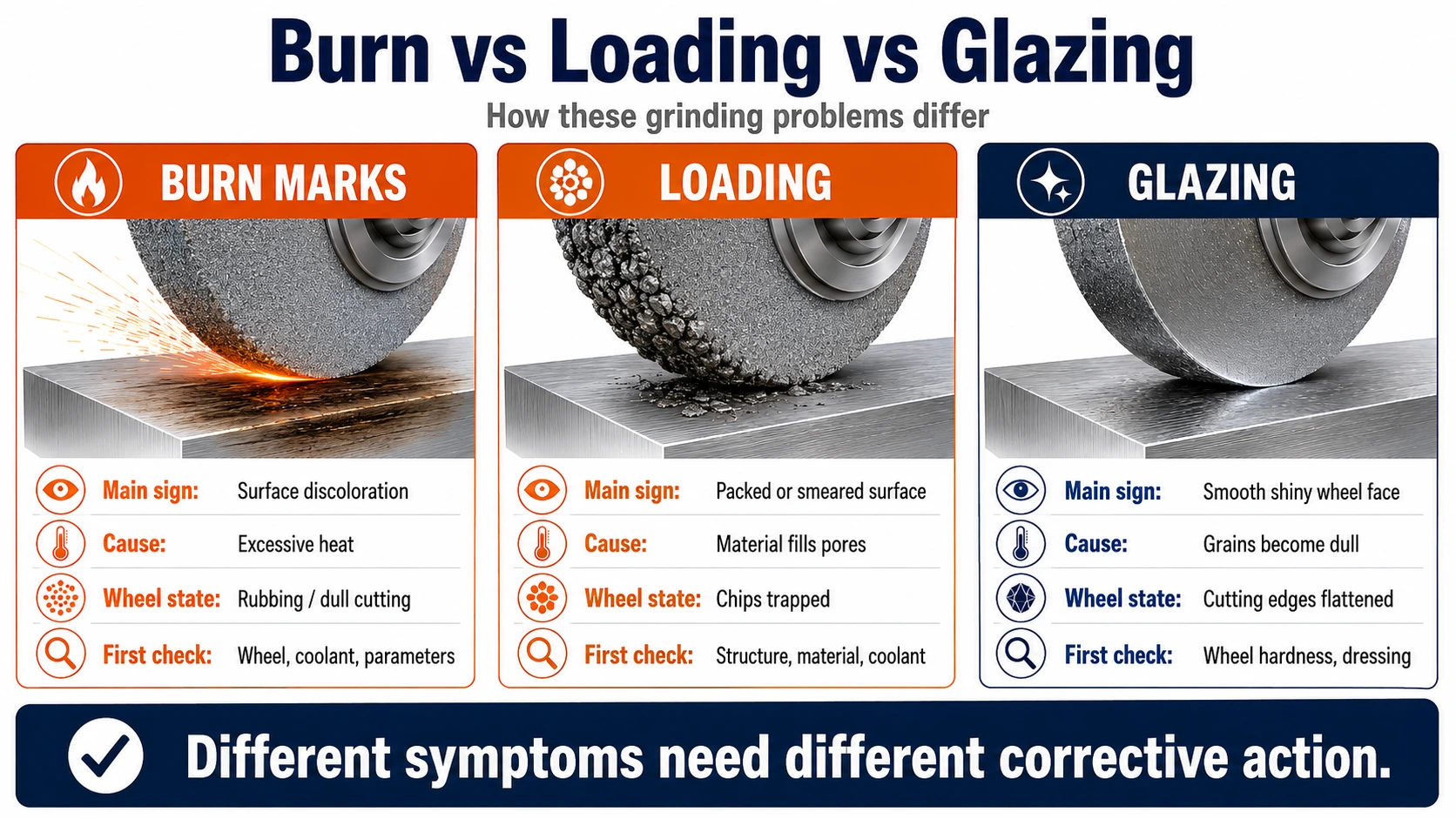
A simple visual comparison helps distinguish a normal cutting surface from loading and glazing, so corrective actions target the actual failure mode.
Use this table to match burn-related observations with likely causes and practical checks. Each card points toward a specific direction — coolant, dressing, wheel specification, or process parameters.
Burn with glazed wheel surface
Burn with loaded wheel surface
Burn only on specific material batches
Burn with chatter or unstable finish
Burn returns quickly after dressing
Not sure whether the burn marks come from wheel loading, glazing, coolant delivery, or wheel specification mismatch? Share workpiece photos, wheel surface photos, workpiece material, grinding wheel size, dressing condition, coolant condition, and basic grinding parameters so we can review the application direction.
Send Application Details →
| Feature | Loading | Glazing | Burn |
|---|---|---|---|
| What it is | Workpiece material fills wheel pores | Abrasive grains become dull and flattened | Surface discoloration and thermal damage on the workpiece |
| Where it appears | On the wheel surface | On the wheel surface | On the workpiece surface |
| How it relates to heat | Clogged pores increase rubbing and heat | Dull grains increase friction and heat | Excess heat enters the workpiece surface |
| Key check | Wheel structure, abrasive type, coolant | Wheel hardness, dressing parameters | Heat balance: wheel + coolant + parameters + material |
| Can one cause another? | Loading can increase heat → may lead to burn | Glazing increases friction → may lead to burn | Burn is the result; loading or glazing may be the cause |

Selection Guide
What to Check Before Changing the Wheel
Use these practical tips to narrow down the right wheel specification for your grinding application.
Workpiece material and hardness — Confirm exact grade. Heat sensitivity varies between materials even at similar hardness. Check material certificate if burn appeared after a batch change.
Current wheel specification — Note abrasive type, grit size, hardness grade, structure, and bond. A wheel that is too hard or too dense is a common burn cause.
Wheel surface condition — Check for glazing (shiny, polished surface) or loading (material in pores). Dress the wheel and observe whether burn is eliminated temporarily.
Dressing method and tool condition — Check dressing depth, lead rate, and tool condition. A worn tool or too-light dress may not open the wheel surface enough.
Coolant delivery — Verify nozzle position, flow rate, concentration, and cleanliness. Coolant must penetrate the grinding zone, not just wet the wheel or workpiece.
Grinding parameters — Review depth of cut, feed rate, and wheel speed. A combination that generates more heat than the cooling system can remove will cause burn regardless of wheel condition.
Contact area — Large contact arcs between wheel and workpiece increase heat generation and reduce coolant access. Check whether the contact geometry has changed.
Machine condition — Vibration, spindle bearing wear, or wheel runout can cause intermittent contact that concentrates heat in local areas, producing burn marks.
Workpiece photos — Document burn mark location, pattern, and severity. The location often indicates whether the cause is coolant access, contact geometry, or wheel condition.
Whether burn responds to dressing — If burn disappears after dressing and returns predictably, the wheel surface condition is the primary factor. If burn persists after dressing, look to coolant, parameters, or material.
Before You Inquire
Information needed for quotation
Providing the details below helps us recommend the right wheel specification and prepare an accurate factory quotation faster.
Send these details through the inquiry form, or contact us on WhatsApp for a preliminary recommendation.
Send Grinding Details →Industries
Industries served
Why Do Grinding Burn Marks Appear on the Workpiece Surface? are used across these manufacturing sectors. We provide grinding wheel solutions for industrial grinding applications. We do not supply the customer workpieces themselves, such as bearings, hydraulic components, molds, or mechanical parts.
FAQ
Common questions about why do grinding burn marks appear on the workpiece surface?
Quick answers to common buyer questions before sending an inquiry.
What causes grinding burn marks?
Grinding burn marks are caused by excessive heat generation at the grinding contact zone — more heat enters the workpiece surface than the cooling system can remove. The root cause may be wheel-related (hardness too high, structure too dense, glazing, or loading — all of which turn cutting into rubbing and generate more friction), process-related (coolant not reaching the grinding zone, dressing too light, grinding parameters too aggressive), or material-related (heat-sensitive workpiece material, inconsistent stock, or material batch variations). In most production situations, burn results from a combination of factors rather than a single cause. Observing when and where burn appears — and whether dressing temporarily eliminates it — provides the most useful diagnostic information.
Can grinding wheel loading cause burn marks?
Yes — loading can contribute to grinding burn. When workpiece material fills the wheel pores, the wheel loses its ability to cut freely and begins rubbing the workpiece instead. Rubbing generates significantly more frictional heat than cutting. The loaded material in the pores also blocks coolant from reaching the grinding zone, further reducing heat removal. If burn appears together with a loaded wheel surface, addressing the loading tendency — through a more open wheel structure, different abrasive type, or improved coolant delivery — may reduce or eliminate the burn.
Is glazing related to grinding burn?
Yes — glazing is one of the most common wheel-related causes of grinding burn. When abrasive grains become dull and flattened instead of fracturing to expose fresh cutting edges, the wheel rubs the workpiece rather than cutting it. Rubbing generates far more frictional heat than cutting, which can quickly raise the workpiece surface temperature above the burn threshold. A glazed wheel surface typically looks shiny or polished. If burn appears alongside a glazed wheel, dressing may temporarily restore cutting ability and eliminate burn — but if glazing returns quickly, the wheel hardness grade or dressing parameters should be reviewed.
Why does burn appear after dressing?
Burn appearing after dressing can happen for two different reasons. If burn appears immediately after dressing, even with a sharp wheel surface, the heat generation is too high for the cooling system — check coolant delivery, grinding parameters, and contact area. If burn does not appear immediately after dressing but develops gradually after a number of parts, the wheel surface is degrading during the run (glazing or loading) and losing its cutting ability. In this case, the post-dressing improvement is temporary because the underlying wheel specification or process conditions cause rapid surface degradation. Tracking how many parts are produced before burn appears provides useful diagnostic information.
Can coolant cause grinding burn?
Yes — coolant delivery is one of the most common causes of grinding burn. If coolant does not reach the grinding contact zone — because of incorrect nozzle position, insufficient flow rate, blocked nozzles, or the wrong coolant type or concentration — heat cannot be removed where it is generated. The coolant stream must penetrate the air barrier created by the rotating wheel and reach the actual contact point. Coolant that wets the wheel or workpiece surface but does not enter the grinding zone is not doing its job. Before concluding that the wheel specification is the problem, verify coolant nozzle position, flow rate, pump pressure, concentration, and cleanliness.
Can a harder wheel cause burn marks?
A wheel that is too hard for the application is one of the most common wheel-related causes of grinding burn. A hard wheel holds abrasive grains too firmly — instead of fracturing to expose fresh sharp edges as they wear, the grains become dull and flattened. The dull grains rub the workpiece instead of cutting, generating excessive frictional heat. Additionally, a hard wheel combined with a dense structure provides less chip clearance and coolant access. If the wheel surface looks glazed (shiny, polished) and burn is present, reviewing the hardness grade is often the first specification adjustment to consider. However, simply switching to a softer wheel is not always the complete solution — dressing parameters, coolant delivery, and grinding parameters should also be checked.
How can I reduce grinding burn?
The most effective approach depends on identifying the root cause. Start with these checks: (1) Wheel surface — dress the wheel with adequate depth and lead rate and observe whether burn is eliminated. If yes, the wheel surface was a contributing factor. (2) Coolant delivery — verify nozzles are aimed at the grinding zone with sufficient flow and pressure. (3) Grinding parameters — reduce depth of cut or increase feed rate if possible; review whether the contact area is excessively large. (4) Wheel specification — if the wheel glazes quickly after dressing, consider a softer hardness grade, more open structure, or CBN for hardened ferrous materials. (5) Dressing — ensure the dressing tool is in good condition and parameters produce an open wheel surface. Often, a combination of two or three adjustments produces the best result.
When should I change the wheel specification?
Consider a specification change when: burn returns quickly and consistently after dressing despite verified coolant delivery, dressing parameters, and acceptable grinding conditions; the wheel consistently glazes or loads within a predictable short interval, and adjusting dressing does not extend the interval; the workpiece material has changed and the current specification no longer performs as expected; or the contact area or grinding parameters cannot be changed and the current specification cannot manage the heat. When requesting a new specification, provide: workpiece material and hardness, current wheel specification, grinding process, coolant details, dressing method, grinding parameters, and photos of burn marks and wheel surface. This helps the manufacturer recommend a specification matched to your specific thermal conditions.
What information should I provide for wheel selection?
To get a suitable wheel recommendation for a burn problem, provide: workpiece material and hardness; grinding process type; current wheel specification (abrasive, bond, grit, hardness, structure, dimensions); machine model and spindle speed; coolant type and delivery method; dressing method and tool condition; a description of the burn problem — when it appears, pattern/location, whether it responds to dressing; target surface finish (Ra); and photos of burn marks and wheel surface. The more complete the information, the more targeted the specification recommendation can be.
Is CBN suitable for reducing heat in some grinding applications?
CBN (Cubic Boron Nitride) grinding wheels can reduce heat generation in suitable applications — specifically hardened ferrous materials such as bearing steel, tool steel, and hardened alloy steel. CBN grains are harder and sharper than conventional aluminum oxide abrasives, maintaining cutting edges longer and generating less frictional heat. CBN also has higher thermal conductivity, which helps carry heat away from the grinding zone into the wheel body, reducing the heat entering the workpiece. However, CBN is not a universal solution: it is designed for ferrous materials (not carbide, ceramics, or non-ferrous metals), it requires appropriate machine conditions, and it represents a higher initial wheel cost that is typically justified by longer wheel life and reduced quality issues in high-volume production. For applications where burn is persistent despite optimized conventional wheel specifications and process conditions, CBN may be worth evaluating.
Explore More
Related grinding wheel pages
Continue browsing related products, applications, and technical information.