How to Choose a Grinding Wheel Dressing Tool: Single-Point, Rotary and Form Dressing

Grinding Wheel Knowledge Base

How to Choose a Grinding Wheel Dressing Tool: Single-Point, Rotary and Form Dressing

The right dressing tool depends on two things: what the dressing operation has to accomplish, and what the wheel being dressed is made of. Until both are established, the tool category cannot be decided. Dressing the worn face of a bonded wheel and dressing an electroplated single-layer wheel are not the same operation, and the right choice for a form roll carrying a tight profile can be the wrong one for hand dressing a general-purpose wheel. This guide sets out those distinctions first, then looks at where single-point, rotary and form dressing each fit.

Truing, dressing, conditioning and cleaning are different objectives — and they call for different tools
Stationary dressing and rotary dressing are separate process architectures, not a better-and-worse pair
Bond and wheel construction decide more about the method than the dresser name does
Electroplated single-layer wheels sit outside bonded-wheel dressing practice entirely
The machine often settles which dressing approach is available before any dresser is chosen

Overview

About How to Choose a Grinding Wheel Dressing Tool: Single-Point, Rotary and Form Dressing

Dressing questions usually arrive as a tool question — which dresser should be used, or which one should replace the current one. The more useful starting point is the operation itself. A wheel that is no longer round and a wheel whose face has gone shiny from dull grain need different things done to them, and a tool chosen without that distinction is being selected against the wrong target.

The second starting point is the wheel. Bond, construction and how the abrasive is held all change what a dressing tool can usefully do, and they change it far more than the name on the dresser does. A method that works on a conventional aluminium oxide wheel is not automatically transferable to a CBN or diamond wheel, and on an electroplated single-layer wheel the usual bonded-wheel assumptions do not hold at all.

The machine completes the picture, and it is often the constraint that settles the answer first. Not every machine can carry a rotary dressing unit, and form generation needs capabilities a plain surface grinder does not have. Working in the order — task, then wheel, then machine, then dresser — avoids most of the wasted changes.

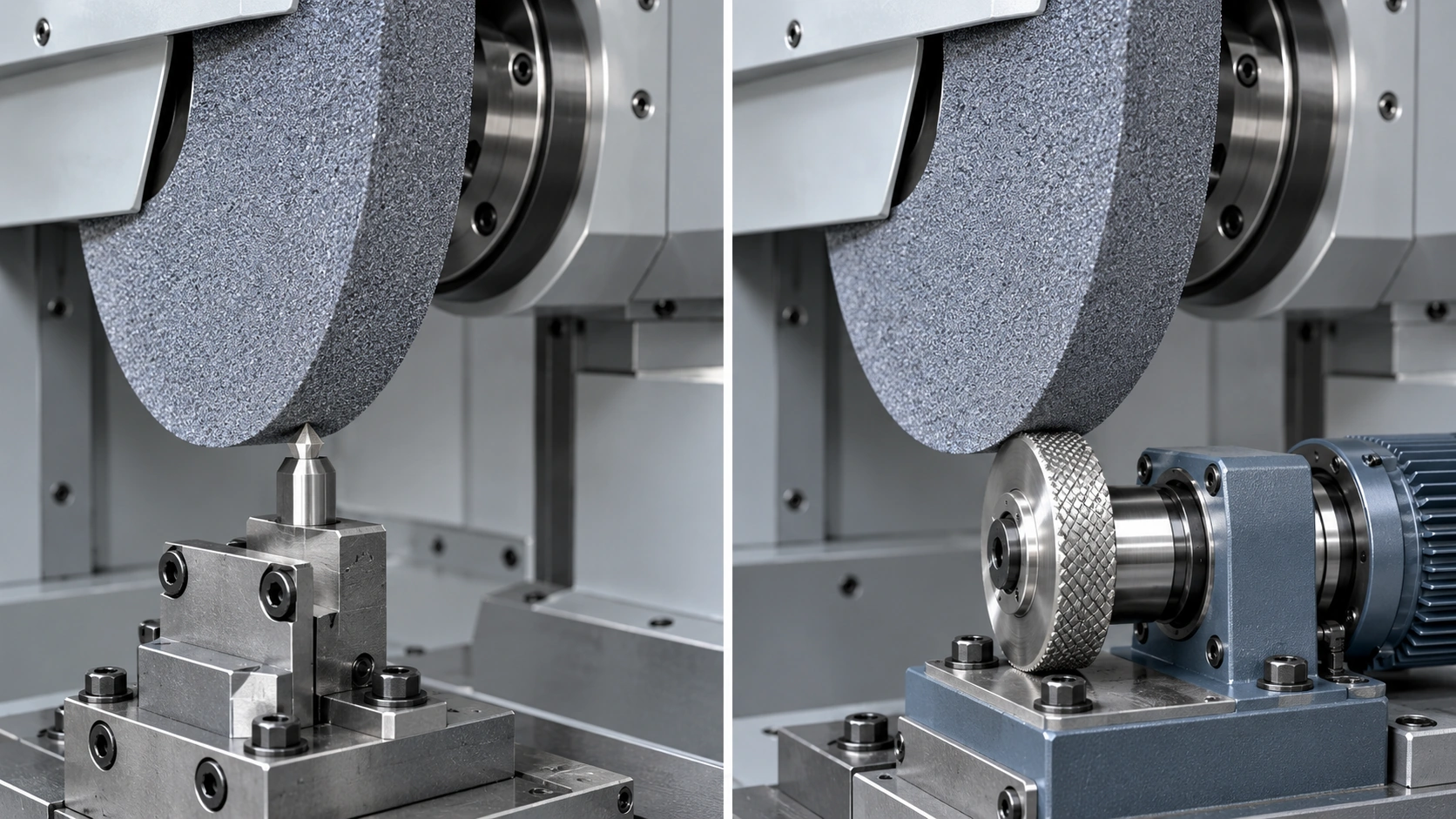
Two-panel comparison of a grinding wheel being dressed. On the left, a single-point dressing tool is held stationary in a clamped machine holder and presented to the wheel face. On the right, a rotary dressing disc mounted on a driven spindle is presented to the same wheel face.
The same grinding wheel dressed two ways. On the left a single-point tool is clamped stationary in a machine holder and presented to the wheel face; on the right a rotary dressing disc on a driven spindle meets the same face. These are two different dressing arrangements serving different process requirements — not a better-and-worse pair, and neither is a hand-held tool.

Four things a dressing operation can be asked to do

The word dressing is used broadly to cover four different jobs. Treating them as one is the most common reason the wrong tool gets selected.

Truing — restoring the wheel's form

Truing restores the wheel form by correcting deviation from the required geometry, profile or concentricity. The focus is the geometry of the grinding wheel itself. If the wheel is no longer round or no longer carries the profile it is meant to, this is the job that has to happen — and cleaning the face will not do it.

Dressing — restoring the cutting face

Dressing restores the wheel surface so the grain cuts again. The focus is the working face condition: dulled grain is removed or fractured away, and the surface is re-exposed with a more even distribution of cutting edges. If the symptom is a shiny, rubbing face, this is the job.

Conditioning — opening the surface

Conditioning goes a step further and removes bond around the grain to create a more open surface. The focus is the space available for chips and coolant. It is the lever to reach for when the face is sound but the wheel cannot clear what it is cutting.

Cleaning — removing loaded material

Cleaning removes a layer of wheel surface that has become loaded with workpiece material. The focus is clearing foreign material out of the face, and it is a different problem from dull grain even though both show up as a wheel that has stopped cutting well.

Why the distinction matters before choosing

One operation can serve several of these purposes at once, and in practice it often does. But the objectives are not the same, and different objectives need different tools. When the task is defined first, the tool discussion becomes much shorter.
Stationary diamond dressing: single-point, multi-point and cluster

A stationary dressing tool is held in position, contacts the wheel face as the wheel rotates, and is traversed across it. Single-point diamond is the simplest form: one diamond, one contact point.

Where it fits

For conventional abrasive bonded wheels — aluminium oxide and silicon carbide — and for wheels with relatively simple profiles, stationary dressing is the routine method. It is available in both hand-held and machine-mounted forms. Hand tools are flexible and lower in initial cost, which is why they remain common in tool rooms and general grinding. Tools clamped into the machine give higher consistency where the same dressing path is repeated.

What changes the result

Dresser orientation matters: the angle at which the tool is presented to the wheel face affects how it cuts in and how the diamond wears. The wear pattern matters more than most operators expect — as the diamond wears, the effective contact widens and the cut dulls, and it does so quietly, because any single dressing still looks the same. By the time it is noticed, the wheel face has already changed.

Why dresser condition is easy to overlook

This is the argument for treating the dresser as a consumable and recording its condition. An operator cannot judge whether the diamond has worn by looking at the wheel. Keeping a note of when it was changed, and what the wheel did afterwards, is what makes the wear visible.

Rotary and form dressing: discs and rolls

Rotary dressing is fundamentally different. The dressing tool is not stationary — it rotates, presenting diamond on a rotating dressing disc or form roll and cutting with its circumference rather than dragging a single diamond across the face.

Why it is chosen

Rotary dressing becomes worth considering when repeatability matters more than simplicity. Because the cutting action is spread across multiple diamonds and the tool rotates at a controlled speed, the dressed surface tends to be more repeatable than with a stationary tool, and the tool holds its own shape for longer. That matters when the wheel profile has to be generated or maintained rather than merely restored. In form grinding — particularly where the dresser profile is transferred directly to the grinding wheel — rotary form dressing is one approach commonly evaluated for maintaining repeatable wheel geometry without frequent reshaping of a stationary dressing tool.

What it means for production consistency

It also has a bearing on consistency across a run. A tool that holds its shape longer means the wheel face changes less across a batch, which reduces size and finish drift across the parts in it. Where a process is judged on batch consistency rather than on individual parts, that is the property worth weighing.

The trade-offs to weigh

Rotary dressing requires the machine to support it. That usually means a rotary dressing unit or spindle, and a good number of machines do not carry one. The equipment adds cost and maintenance, and setting it up needs more attention than clamping a stationary diamond into position. Machine capability, dresser design, cost, profile complexity, production volume and the wheel system all bear on whether it is the right choice.

What it does not automatically deliver

It is worth stating plainly: rotary dressing is not better in every case, and it does not inherently produce a better surface finish. What it offers is better profile repeatability and stability across long production runs, and that is the trade being evaluated. On simple profiles and short runs, the added complexity may not pay for itself.

Why wheel construction matters more than the dresser name

The dresser has to match the wheel, and the most important property of the wheel is how it is constructed — the bond, and the way the abrasive is held in place.

Bonded wheels

Bonded wheels — vitrified, resin and metal — share one thing about dressing: all of them involve dealing with the bond around the grain. The specifics differ considerably between them. Vitrified-bond wheels are rigid and, in many applications, can show relatively predictable response to conventional dressing methods. That does not mean one dressing method applies to every vitrified wheel; wheel construction, abrasive system, profile and machine set-up still matter. Resin-bond wheels are more resilient and respond differently. Metal-bond wheels hold the grain harder, and the same property that makes them durable makes the face harder to dress.

Superabrasive wheels

For superabrasive wheels such as CBN and diamond, the acceptable truing and dressing methods are more dependent on bond, wheel construction, profile and machine system. Applying a conventional aluminium-oxide-wheel dressing approach without checking those factors may fail to produce the intended conditioning, and may damage the wheel surface or profile. The specific method also depends on the required profile, the accuracy needed, and — unavoidably — the manufacturer's own guidance.

The electroplated single-layer case

An electroplated superabrasive wheel carries a single layer of abrasive plated onto a steel body. There is no bond depth to dress. That is a difference in kind from a bonded wheel, not a difference of degree. There is no universal dressing procedure for single-layer electroplated wheels. Treating them like conventional bonded wheels can damage or remove part of the single abrasive layer, so any truing, cleaning or reconditioning approach should follow the wheel construction and manufacturer guidance. Handling an electroplated wheel as though it were a bonded wheel risks losing the only abrasive layer there is.

Why a shortcut table does not exist

It is also not worth looking for a shortcut table here. There is no dependable CBN-wheel-needs-this-dresser, diamond-wheel-needs-that-dresser mapping, because the answer shifts with bond, construction, profile, machine and accuracy requirement.

A form dresser does not choose the wheel

Finally, a form dresser does not select the wheel. A form roll decides how the profile is reproduced. It does not decide the abrasive, the bond or the grade. Those remain separate decisions, made from the workpiece and the grinding conditions. Geometry and specification are not the same decision.

Match the dressing system to the task

The order matters more than the tool name.

Work in this order

Establish first what the operation has to accomplish — conditioning a surface, correcting geometry, or generating a profile. Then establish what the wheel is: its bond, its construction, how its abrasive is held. Then establish what the machine can actually support, which is often the binding constraint and is settled before any dresser is chosen. Only then is the dresser type worth evaluating, and only against those three answers.

A practical observation from application work

When a customer says the wheel cuts well immediately after dressing but loses performance quickly, the reflex is to ask which dresser should replace the current one. The more useful question runs the other way — what changed in the set-up. Has the dresser worn? Has the dressing objective shifted? Was the wheel specification changed recently? Does the dressing path still match the profile being asked for? Diagnosing what changed before deciding what to replace usually avoids a dresser change that was never needed.

Advantages

What has to be established before the tool is chosen

These are the inputs that decide which dressing approach is even worth evaluating. Working through them in order is faster than starting from a tool and working backwards.

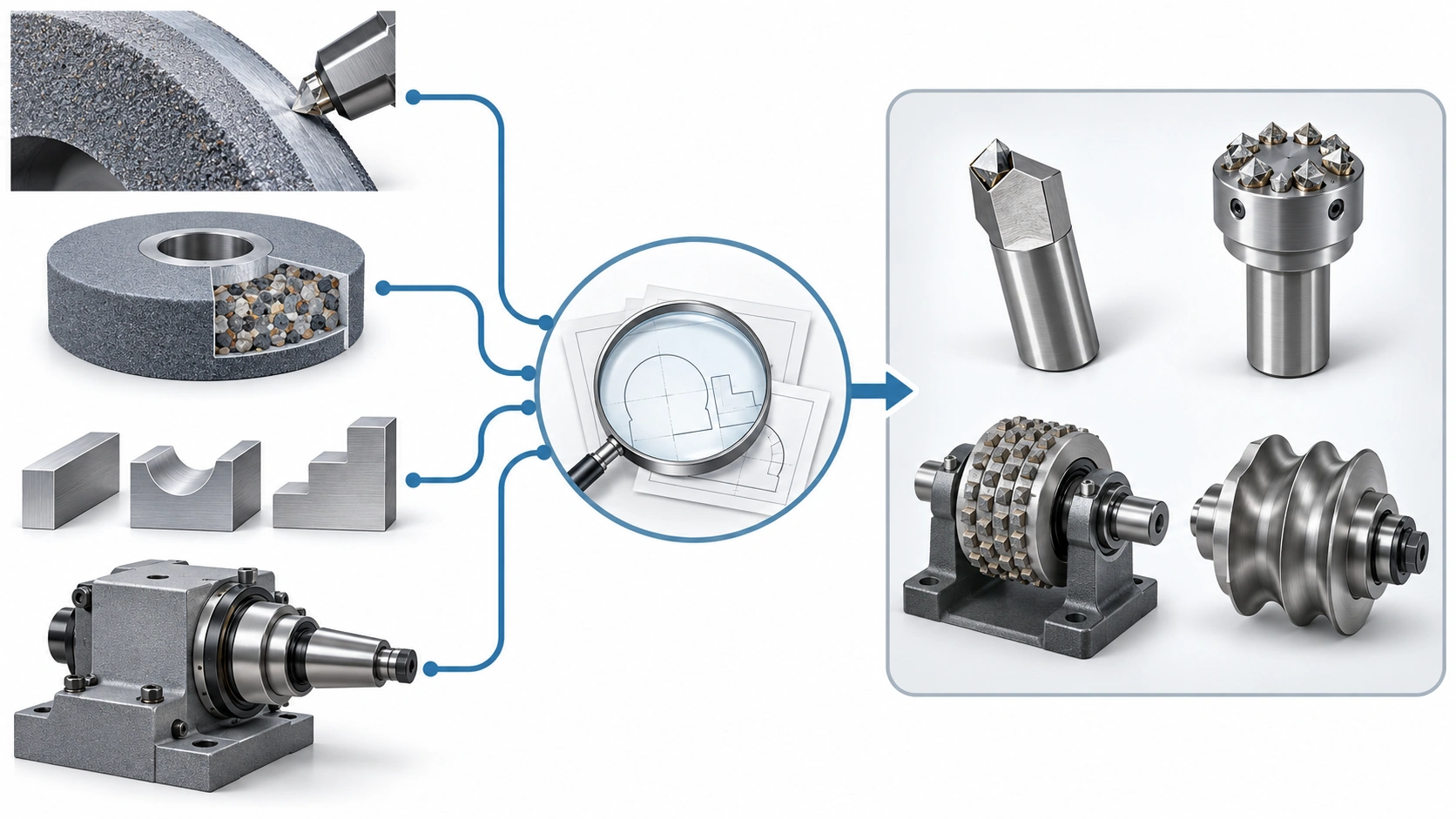
Framework diagram: four inputs on the left — a dressing operation on a grinding wheel, a grinding wheel cut away to show its abrasive structure, a set of machined profile forms, and a machine spindle unit — converge into a single central review, which then opens onto a group of dressing tools.
Several conditions are read together — what the operation has to accomplish, how the wheel is constructed, what profile is required, and what the machine can support — and they converge into one review. That review opens onto a range of dressing tools rather than one answer. This is a framework for narrowing the options, not a fixed compatibility chart that maps one wheel to one dresser.

The objective, stated plainly

Conditioning a surface, correcting geometry and generating a profile are three different jobs. Naming the one that applies narrows the tool category before any product is considered.

Bond and wheel construction

How the abrasive is held decides what a dressing tool can accomplish. Bonded wheels respond to dressing in ways that electroplated single-layer wheels do not share.

Profile requirement

A simple face, a controlled radius or angle, and a formed profile place very different demands on the dressing tool and on how long it holds its own shape.

Machine dressing capability

Stationary holders, dressing units, rotary spindles and form-generation capability are machine features. They bound which approaches are available before preference enters the discussion.

Dresser condition as a tracked variable

A worn dresser changes the wheel surface gradually and invisibly. Recording its condition turns an invisible drift into something that can be reasoned about.

Manufacturer guidance for the wheel

For superabrasive and electroplated wheels especially, the acceptable method follows the specific wheel design and the maker's guidance rather than a general rule.

Before You Inquire

Reviewing the dressing task before the tool

A dressing tool question is easier to answer as a description of the wheel and the objective than as a request for a tool. The items below are what allow the dressing approach to be read against the actual operation.

Dressing objective — Conditioning the surface, correcting geometry, generating a profile, or cleaning a loaded face
Wheel construction — Bond type, abrasive type, and how the wheel is built
Current wheel specification — Marking, dimensions and construction details where readable
Profile requirement — Simple face, controlled radius or angle, or a formed profile
Current dressing tool — Type, condition, and how long it has been in service
Dressing arrangement — How the tool is mounted or held, and whether the machine carries a dressing unit
Machine capability — Whether a rotary dressing spindle or form-generation capability is available
Observed behaviour — What the wheel does after dressing, and how quickly that changes

Where a value is not known, marking it as unknown is more useful than estimating it. The purpose is to establish what the dressing operation has to achieve, not to complete a form.

Send Grinding Details →

FAQ

Common questions about how to choose a grinding wheel dressing tool: single-point, rotary and form dressing

Quick answers to common buyer questions before sending an inquiry.

What is the difference between a single-point and a rotary dresser?

A single-point dresser is stationary and cuts into the wheel face with one diamond as the wheel rotates. A rotary dresser rotates itself and spreads the cutting action across the circumference of a disc or roll. Stationary dressing is usually chosen where simplicity, flexibility and lower cost matter more; rotary dressing is considered where profile repeatability and consistency across long runs matter more — provided the machine can support a rotating unit.

Can the same dresser be used for CBN and conventional grinding wheels?

Not necessarily. Superabrasive wheels and conventional abrasive bonded wheels respond to dressing differently, and applying a conventional wheel's approach to a CBN or diamond wheel may fail to produce the intended conditioning and may damage the wheel surface or profile. The dressing method should be confirmed against the bond, wheel construction, profile, machine and the manufacturer's own guidance.

What is the difference between truing and dressing?

Truing restores the wheel form by correcting deviation from the required geometry, profile or concentricity. Dressing restores the cutting face so the grain cuts again. One operation can do both, but the objectives are not the same, and confusing them can lead to choosing a tool that does not address the actual problem.