Grinding Scratches on Workpiece: Is It the Wheel, Coolant, or Contamination?

Grinding Wheel Knowledge Base

Grinding Scratches on Workpiece: Is It the Wheel, Coolant, or Contamination?

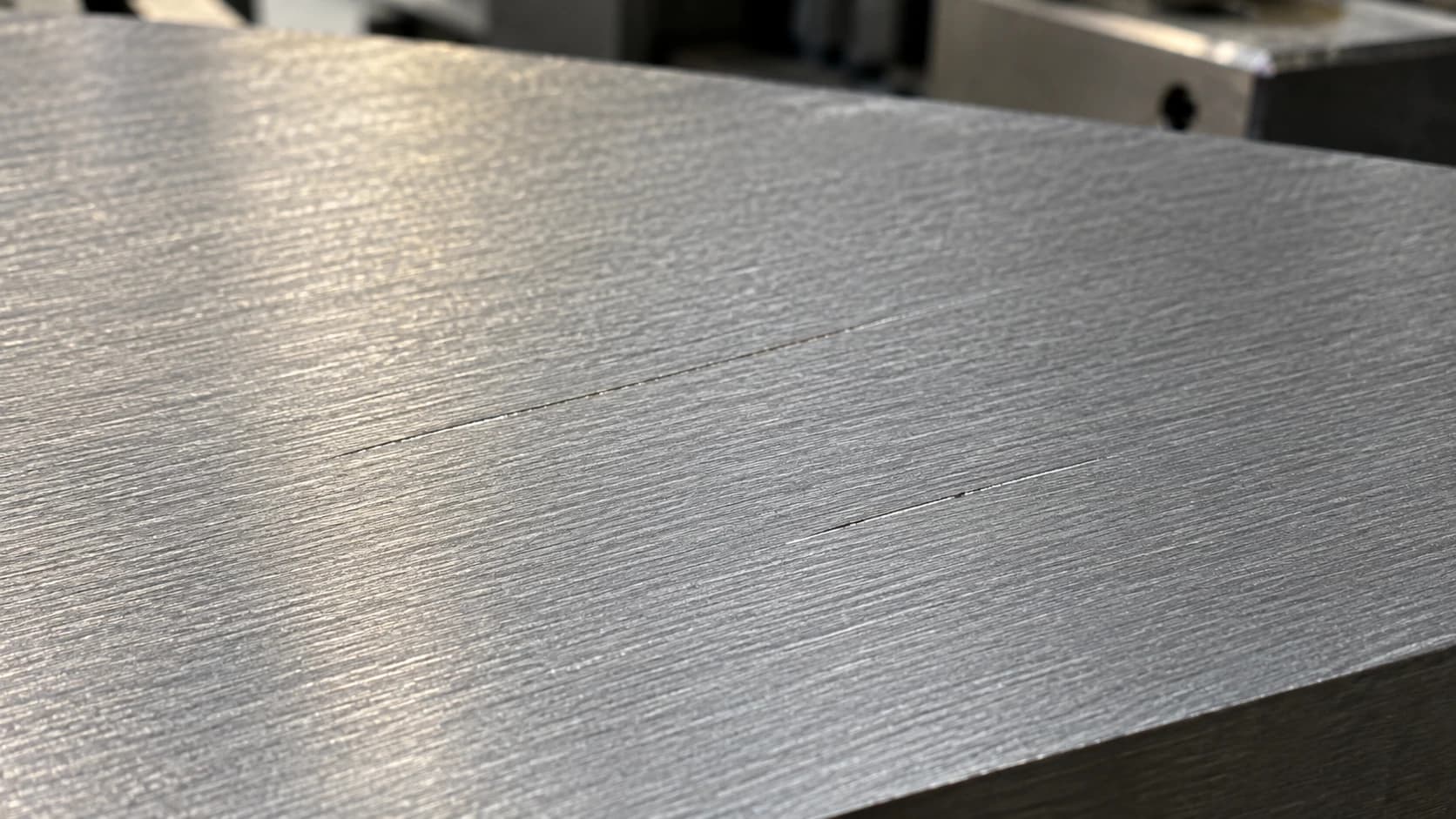
A scratch is evidence, not a conclusion. A single deep line, a scatter of random marks, and a pattern repeating at a regular interval do not come from the same place, and they do not call for the same response. Before changing the wheel, the useful questions are about the mark itself — what pattern it forms, which way it runs, when it first appeared, and whether anything changes after dressing or after the fluid is cleaned.

What pattern does the scratch form — isolated, scattered, or repeating?
Does it follow the grinding direction or cross it?
When did it first appear, and does dressing change it?
Is the wheel still cutting normally apart from these marks?

Overview

About Grinding Scratches on Workpiece: Is It the Wheel, Coolant, or Contamination?

Most scratch troubleshooting starts in the wrong place. The wheel is easy to change, so it gets changed first, and if the marks come back the next day the wheel was never the answer. Starting from the mark costs nothing and rules more out.

The mark carries three pieces of information before you touch anything. Its pattern says whether the cause is discrete or periodic. Its direction says whether the mark was made by something travelling with the wheel, something crossing the work, or the wheel face itself. Its timing — when it started, and whether it responds to dressing or to cleaning — says whether you are dealing with a consumable, a fluid, or something in the machine.

None of those three is conclusive on its own. A random scratch is not automatically a coolant problem, a repeating mark is not automatically a dressing problem, and a scratch that appears after dressing is not automatically a wheel defect. Read together, though, they narrow the field far enough that the next test is worth running.

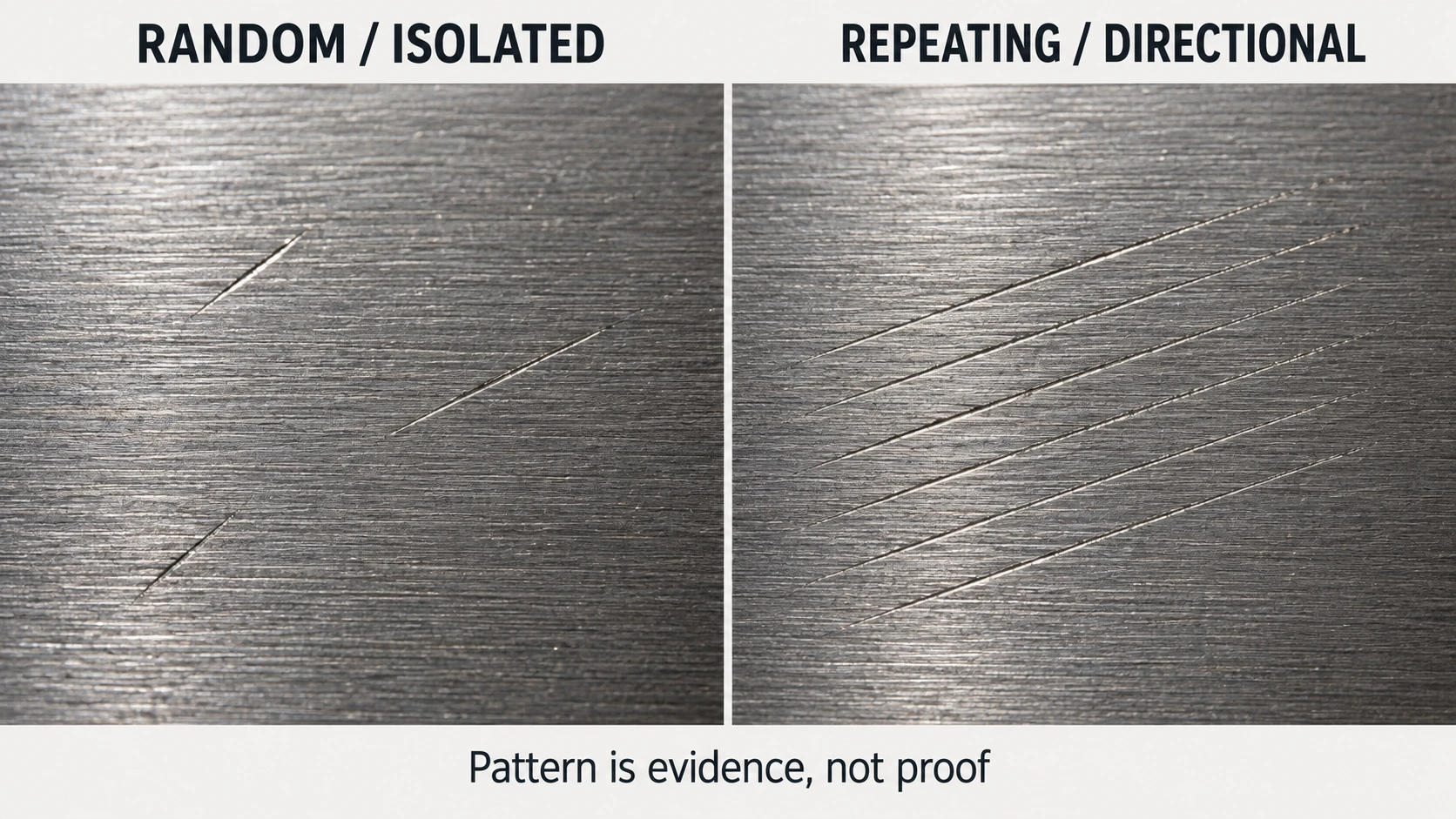
Comparison of an isolated random scratch and a repeating directional mark on a ground surface
Two presentations that send you in different directions: an isolated mark with no repeatable spacing, and a pattern that repeats at a regular interval. The comparison shows how they look, not what caused them.

Random or Isolated Deep Scratches

These are the marks that appear as single deep lines, or as a scatter of marks with no repeatable spacing between them. They are the pattern most often described as random scratches after grinding, and they usually point away from the wheel.

What the pattern suggests

A mark with no repeatable spacing was probably not made by a feature on the wheel, because a wheel feature repeats with the wheel. Something discrete passed through the contact zone, or sat on the surface while the wheel went over it. That is consistent with loose particles rather than with wheel geometry — but it does not yet say where the particles came from.

Loose particles carried back into the contact zone

Grinding produces swarf, and the wheel itself sheds grain and bond fragments as it works. Fluid that is not clean enough to remove them can carry them back into the contact zone, where a hard particle rolled or dragged under the wheel produces a line. Published troubleshooting guidance describes irregular scratches of varying length and size appearing when the fluid is dirty, and the countermeasure given is to clean the tank, lines and guards and to filter the fluid rather than to change the wheel.

Why the average finish can look normal

One controlled study on hardened steel found that scratch count rose as coolant contamination rose, and that the abrasive grains in the fluid contributed more to scratch formation than the chips did. In the same tests the average surface roughness and the grinding forces did not shift measurably. That is worth knowing, because it means a part can show discrete scratches while the roughness reading looks acceptable — the defect is local, not a general finish change.

A contaminated or damaged wheel face

Foreign material can also sit on the wheel face and score the work repeatedly until it is dressed out. The distinction from the case above is whether the marks repeat. Material lodged in the face tends to mark at a spacing tied to the wheel, while particles arriving with the fluid do not.

What this pattern does not prove

Random spacing does not by itself identify the fluid. Debris can enter from a dirty tank, from a guard that has never been flushed, from a previous operation, or from handling between processes. The pattern tells you to look for a discrete particle; finding which one is a separate step.
Repeating or Directional Marks

Marks that repeat at a regular spacing, or that run consistently in one direction across the part, are a different family of problem. Regularity means something periodic made them.

Periodicity is the clue to chase

If the marks repeat, measure the repeat: how many marks appear in one revolution of the workpiece, or how far apart they sit along the feed direction. A published machining reference suggests counting the marks in one revolution and multiplying by the work speed — if the result lands close to the dresser speed or a multiple of it, the dressing system is implicated. The same reference notes that if the ratio of wheel speed to dresser speed is a whole number, the highs and lows line up on every rotation and the dresser's motion is imprinted more strongly.

Dressing is one candidate, not the only one

A dressing system with runout, an unbalanced dressing spindle, or a diamond that is loose, worn or cracked can transfer a periodic pattern to the wheel and then to the part. But a repeating pattern can equally come from unbalance, worn spindle bearings, or a periodic external vibration. One research comparison found dressing-induced waviness and once-per-revolution wheel vibration difficult to tell apart on the surface alone, and used axial waviness to separate them, because dressing effects show a predictable dependence on the dressing parameters while wheel vibration does not.

Feed-track and directional patterns

Marks that run consistently along the feed direction rather than repeating across it often relate to how the wheel face meets the work over the length of the pass — a face that is not parallel to the table axis, or a dressing tool that shifted, heated or wore during the pass. Grinding literature describes these as feed-track or spiral markings and links them to dressing direction and dressing tool condition rather than to the abrasive itself.

Do not stop at the wheel

When a pattern is periodic, it is tempting to dress the wheel, see the marks reduce, and stop there. A reduction after dressing confirms that the wheel face was involved in producing the mark; it does not establish that the wheel face was the origin. If the same spacing returns after a predictable number of parts, the periodic source upstream of the wheel has not been addressed.

Where Loose Particles Can Come From

If the evidence points to discrete particles, the next question is which particles. There are more sources than the obvious one.

Workpiece swarf

The most direct source. Fine chips that are not carried clear of the contact zone can be re-entrained. In bores and confined features this is harder, because the flow that would flush the zone is restricted by the geometry itself.

Wheel grain and bond debris

A working wheel releases dull grain and bond fragments by design. Those fragments are abrasive, and if they recirculate they behave like a secondary abrasive in the fluid. This is the mechanism behind the observation in the controlled study above that grains mattered more than chips.

External and carried-in contamination

Debris also arrives from outside the grinding cycle: casting sand, previous-operation residue, material left on fixtures, and handling between processes. This source is easy to overlook because it does not scale with how dirty the grinding fluid looks.

Filtration that does not match the material

When reviewing the fluid system, it is worth knowing what the separation method can and cannot capture. Magnetic separation is effective on ferrous material, but it does not capture non-ferrous metal or non-metallic abrasive debris. A shop grinding carbide, aluminium or a non-metallic workpiece with magnetic separation as the only stage can therefore be recirculating exactly the particles that cause scratches, while the separator appears to be working correctly. This is a statement about what magnetic separation is suited to, not a claim that it is ineffective — on ferrous work it does its job.

Settling and dead zones

Debris that settles in tanks, pipework, guards and machine pockets can be disturbed back into circulation by a change in flow, a new operation, or a cleaning that only reaches part of the system. A tank that has never been fully cleaned is a reservoir, not just a sump.

When the Wheel Itself Becomes the Suspect

The wheel does cause scratches. The question is how to recognise that case rather than assume it.

The wheel face is dirty, loaded or uneven

If material is packed into the pores or the face has worn unevenly, the wheel is no longer presenting a uniform cutting surface. This is a wheel-face condition, and the diagnostic order for loading and glazing applies — but note that the marks from a loaded face tend to accompany a change in how the wheel cuts, not to appear on an otherwise normal part.

The dressing result was poor

A diamond that has gone flat, is mounted loosely, or is traversed too fast leaves a face that carries its own pattern. Grinding troubleshooting references list isolated deep marks and uneven fine lines as dressing-procedure outcomes, with the countermeasures being to rotate or change the diamond, to keep the diamond moving rather than dwelling, and to wash the wheel after dressing before returning to the part.

Foreign material embedded in the face

Hard debris can lodge in the wheel face and score the work until it is dressed out. This is the case where dressing genuinely removes the cause rather than masking it, which is one reason the before-and-after dressing comparison is worth making properly.

What to hold back

A scratch is not by itself a reason to review the specification. Grit, grade, structure, bond and abrasive type are decisions about the process as a whole, and changing them to chase a discrete mark usually trades one unexplained symptom for another. Those variables come into play when the wheel's general cutting behaviour is implicated, not when a single line appears.

What Changes After Dressing Can Reveal

The before-and-after dressing comparison is the single most informative test available, as long as its limits are respected.

Marks that disappear and stay away

If dressing removes the scratches and the part runs clean afterwards, whatever produced them was carried on or near the wheel face. That is consistent with embedded debris, a face condition, or a dressing artefact. It still does not tell you which of those it was, and it is worth noting what else changed at the same time — a dressing cycle usually also disturbs the fluid and clears the guards.

Marks that disappear and return

This is the most useful outcome, and the most misread. If the scratches come back after a predictable interval, something is being re-established at that interval — debris re-accumulating, a face condition re-forming, or a periodic source re-imprinting. The interval is the evidence. It points at the rate of the underlying process rather than at the wheel as an object, and it is the reason a fixed dressing interval is a poor substitute for reading the interval at which the symptom actually returns.

Marks that do not change at all

If a careful dressing makes no difference, the cause is probably not on the wheel face. That is a strong result, and worth confirming with a second dressing before acting on it — a dressing pass that did not genuinely renew the face will produce the same null result for the wrong reason.

Keep the fluid variable separate

Dressing and cleaning are usually done together, which makes the comparison ambiguous. Where it can be arranged, changing one at a time — dress without cleaning the system, or clean the system without dressing — produces far better evidence than doing both and observing an improvement.

Scratch triage

Reading the Scratch Before Changing the Wheel

Most scratch complaints fall into a small number of presentations, and each one sends you somewhere different first. Work through the triage below before touching the wheel.

Marks with no repeatable spacing

Surface condition: Single deep lines, or a scatter of marks with no consistent gap between them. The roughness reading may still sit inside tolerance.
Possible cause: A discrete particle passed through the contact zone — swarf, released grain or bond debris, or contamination carried in from outside the grinding cycle.
What to inspect: Fluid condition in the tank and settling areas, the state of the guards around the grinding zone, and anything that changed in the process shortly before the marks appeared.
Suggested adjustment: Clean and flush the fluid path first. Change nothing on the wheel until that has been ruled out.

Marks repeating at a measurable interval

Surface condition: Marks spaced evenly across the surface, or a pattern that repeats once per revolution of the work.
Possible cause: Something periodic — dressing-system runout or balance, wheel unbalance, spindle condition, or a periodic vibration reaching the machine.
What to inspect: Count the marks in one revolution and compare that against the dresser and wheel speeds. Check the dressing set-up, diamond condition and balance.
Suggested adjustment: Work back to the periodic source. If the same spacing returns after dressing, dressing was not the origin.

Marks that start with a dressing cycle

Surface condition: Isolated deep marks or fine uneven lines on the first parts after dressing, which may settle as the wheel is run in.
Possible cause: The dressing result rather than the abrasive — a diamond that is flat, loose or cracked, a traverse that is too fast, or a diamond allowed to dwell.
What to inspect: Diamond condition and mounting, traverse rate and direction, and whether the wheel is washed after dressing before the first part is ground.
Suggested adjustment: Rotate or replace the diamond, keep it moving across the face, and wash the wheel before returning to production.

Two families of scratch, two different lines of investigation

Random or isolated marks

  • No repeatable spacing between marks
  • Often single deep lines rather than a field of marks
  • Average roughness may look unchanged
  • Points toward discrete particles: swarf, loose grain, carried-in debris
  • Investigate fluid cleanliness, guards, tank and settling areas first

Repeating or directional marks

  • Marks repeat at a measurable spacing
  • Spacing relates to a rotation, a feed rate or a dressing parameter
  • Often visible as a pattern across the whole surface
  • Points toward something periodic: dressing system, unbalance, machine or process
  • Measure the repeat interval before changing any consumable
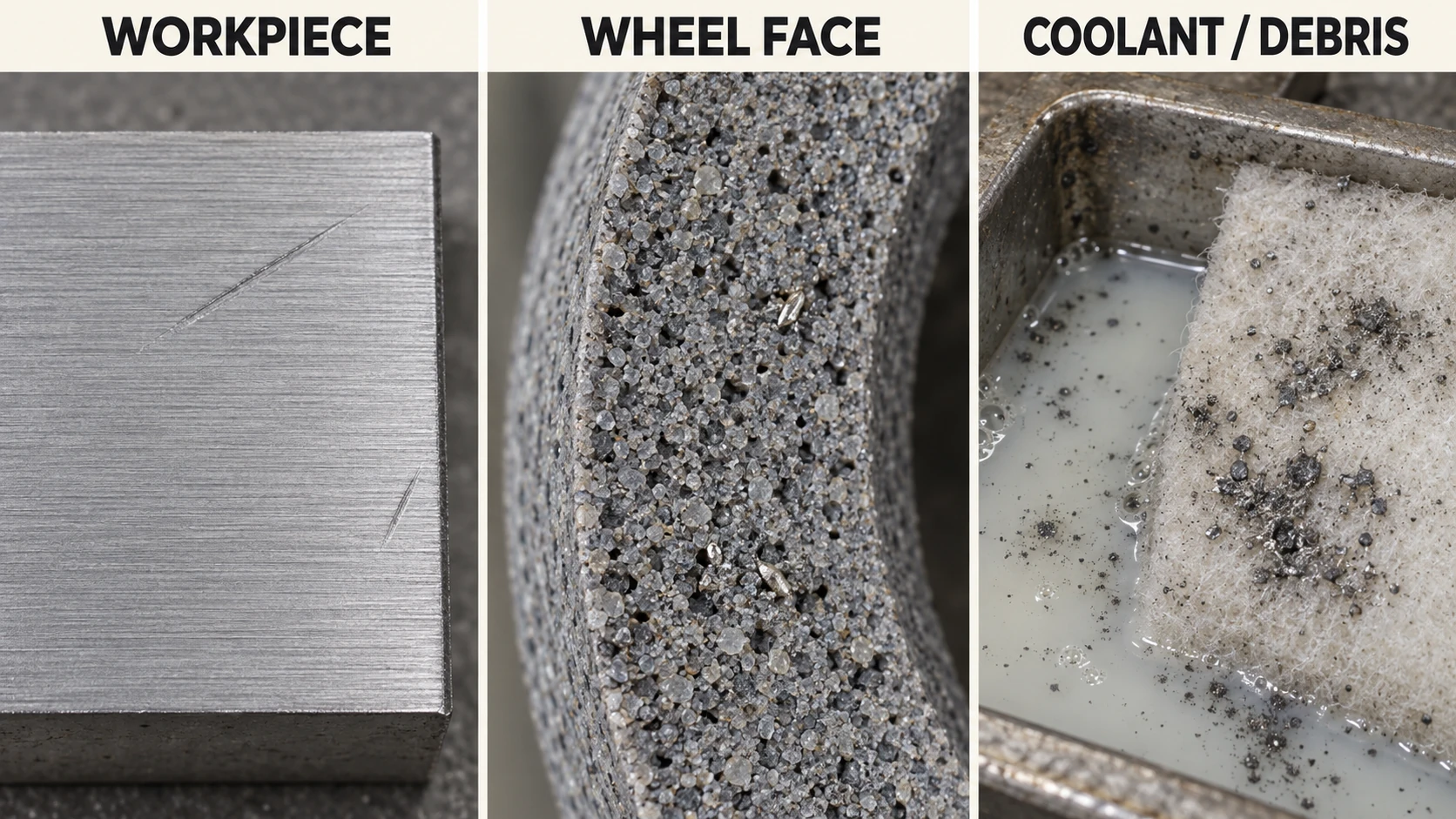
Three scratch evidence views side by side: the workpiece surface, the grinding wheel face, and coolant with settled debris
The three things worth photographing when a scratch appears: the mark on the part, the wheel face, and what the fluid system is carrying.

Photo evidence

What a Scratch Photo Can Tell Us Before We Discuss a New Wheel

When a scratch problem reaches us as a photo, the reading order below is what usually decides whether the conversation is about the wheel at all. It is also the order in which the information is worth collecting, because each step narrows what the next one needs to be.

1. The mark itself, close up

A close view shows whether the mark is a clean line, a torn or smeared groove, or a shallow rub, and whether there is material sitting in it. Depth relative to the surrounding surface is easier to judge from a close view than from a description.

2. The whole part, so the mark has a location

A close-up without context hides the most useful information. A mark that appears at one position on every part is pointing at something that repeats; marks scattered across the surface are pointing at something carried through the process. The wider view is also what shows the direction of the grinding lay for comparison.

3. Direction, measured against the grinding lay

Textbook scratch marks from debris sit roughly parallel to the lay; marks at a clear angle to it were made by something moving differently. This single comparison often separates a fluid-borne particle from a feed or machine effect.

4. Timing — when it started and what changed with it

The most valuable sentence in a scratch enquiry is usually the one about what changed just before the marks appeared: a new batch of material, a fresh wheel, a different operator, a coolant top-up, a machine that was serviced. Timing converts a symptom into a lead.

5. The wheel face

A photo of the face shows whether the surface is open and sharp, packed with material, uneven, or carrying visible debris. Combined with the workpiece photo it either supports or contradicts the wheel-face explanation, which is a useful thing to know before spending a wheel on a trial.

6. The fluid, and what is sitting in the system

The condition of the fluid in the tank, the state of the guards around the grinding zone, and what has settled in the machine tell us more about the recirculation risk than a description of the fluid type does. If the fluid is topped up rather than changed, or if guards have never been flushed, that is part of the picture.

7. The wheel marking, and how the wheel is actually run

A photo of the full marking gives the specification without transcription errors. What the wheel is doing on the machine — operation, dressing method and interval, speed — completes the picture. Only once these are in hand does a specification discussion make sense.

Specification

When a Wheel Specification Review Makes Sense

A specification review is the right step only after the cheaper explanations have been tested. Reaching it early tends to replace an unexplained scratch with an unexplained change.

1. The particle sources have been checked — fluid cleanliness, guards, tank and settling areas, and any contamination carried in from before the grinding operation.

2. The dressing set-up has been reviewed — diamond condition, mounting, traverse, and whether the face is genuinely being renewed.

3. A before-and-after dressing comparison has been made, ideally with the fluid and cleaning variables held still.

4. The marks have been measured rather than described — pattern, direction, location on the part, and repeat interval if there is one.

5. The wheel is behaving poorly in general, not only producing isolated marks — for example cutting hot, loading quickly, or losing form.

6. The marks persist after the face has been dressed back and the fluid system has been cleaned and flushed.

7. Only then review abrasive type, grit size, grade, structure and bond as a set, against the material, the operation, the machine and the finish requirement together.

Before You Inquire

What to Send Before Changing the Wheel

If scratches are the problem, the evidence below usually settles more than a specification discussion would. Send what you have — a partial set is still useful, and the photo pair is the part that matters most.

A close-up photo of the scratch, with something in frame for scale where possible
A wider photo of the same part showing where the mark sits and which way it runs
Whether the marks are random or repeat at a regular spacing — and roughly how many appear in one revolution if they repeat
When the marks first appeared, and anything that changed around that time
Whether the marks change after dressing, after cleaning the fluid system, or not at all
A photo of the wheel face from the working surface
The full wheel marking as it appears on the wheel
Workpiece material and hardness, and the operation being performed
How the wheel is dressed — method, diamond condition, and the interval used
Coolant type, how it is delivered, and what separation or filtration is fitted

We would rather look at the mark with you than quote a second wheel to replace a first one that was never the cause.

Send Grinding Details →

FAQ

Common questions about grinding scratches on workpiece: is it the wheel, coolant, or contamination?

Quick answers to common buyer questions before sending an inquiry.

Does a deeper scratch always mean the grit is too coarse?

No. Grit size influences the general scale of the scratch pattern the wheel produces across the whole surface; it does not explain a single deep line surrounded by otherwise normal surface. An isolated deep mark is more consistent with a discrete particle or something lodged in the wheel face. If the whole surface shows a uniformly coarser pattern than required, that is the case where grit size becomes a fair question.

Do you supply coolant or filtration systems?

No. Youlin Abrasive manufactures grinding wheels and abrasive tools. We can discuss what we see in a scratch photo, including whether the evidence points toward fluid cleanliness rather than the wheel, but the coolant, the filtration equipment and the machine are supplied and maintained separately.