Grinding Coolant Delivery: Why the Wheel Isn't Getting Cooled

Grinding Wheel Knowledge Base

Grinding Coolant Delivery: Why the Wheel Isn't Getting Cooled

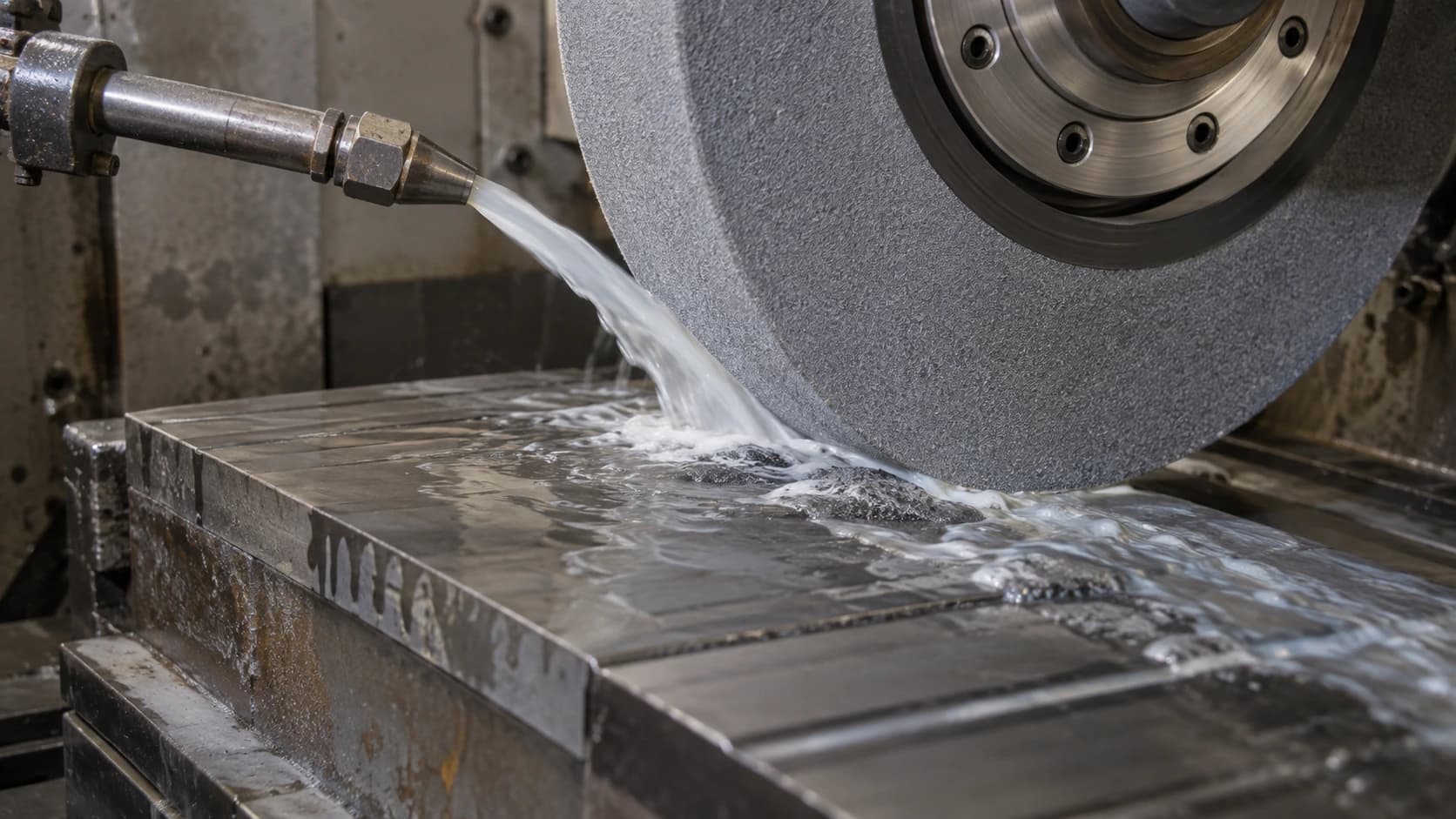
A machine can carry plenty of coolant and still cool the grinding zone badly. The fluid is there, the pump is running, and the part still comes off hot, discoloured, or with a finish that has drifted. What decides the outcome is not whether coolant is present but whether it arrives at the contact in a state that can take heat and swarf away. That depends on where the jet is aimed, whether it survives the air the wheel drags around with it, whether the flow path is clear, and what condition the fluid is in. It also depends on the wheel face, because a loaded or glazed face resists fluid that would otherwise reach the cut.

Coolant in the machine is not the same as coolant at the contact
A wheel running at speed drags an air layer that can deflect a weak or misaimed jet
Nozzle aim, jet condition, flow path and fluid state decide whether cooling happens
A loaded or glazed face blocks fluid that would otherwise reach the cut

Overview

Quick answer

Coolant has two jobs at the contact: carry heat away, and flush swarf out of the cut. Both fail in the same way - not because there is too little fluid in the machine, but because the fluid that arrives is not doing either job.

Three things have to hold for delivery to work. The jet has to reach the contact rather than being thrown off the wheel before it gets there. It has to arrive with enough energy to cross the air the wheel carries and to displace what is already sitting in the cut. And the fluid has to be in a state - clean enough, mixed close enough to what the process expects - that it still takes up heat rather than adding to the debris.

When one of those fails, the symptoms look like wheel problems. Loading appears, heat rises, finish drifts, and the obvious response is to dress more often or change the wheel specification. That response sometimes works, because the two are connected. But where delivery is the constraint, a new wheel shows the same symptoms once the fluid stops reaching it again.

Key takeaways

  • Coolant present and coolant effective are two different states, and only the second one cools the cut.
  • A wheel running at speed carries an air layer that can deflect a jet before it reaches the contact.
  • Flow at the pump is not flow at the nozzle - restrictions downstream of a gauge do not show on it.
  • Dressing separates a wheel-face problem from a delivery problem faster than any other test.
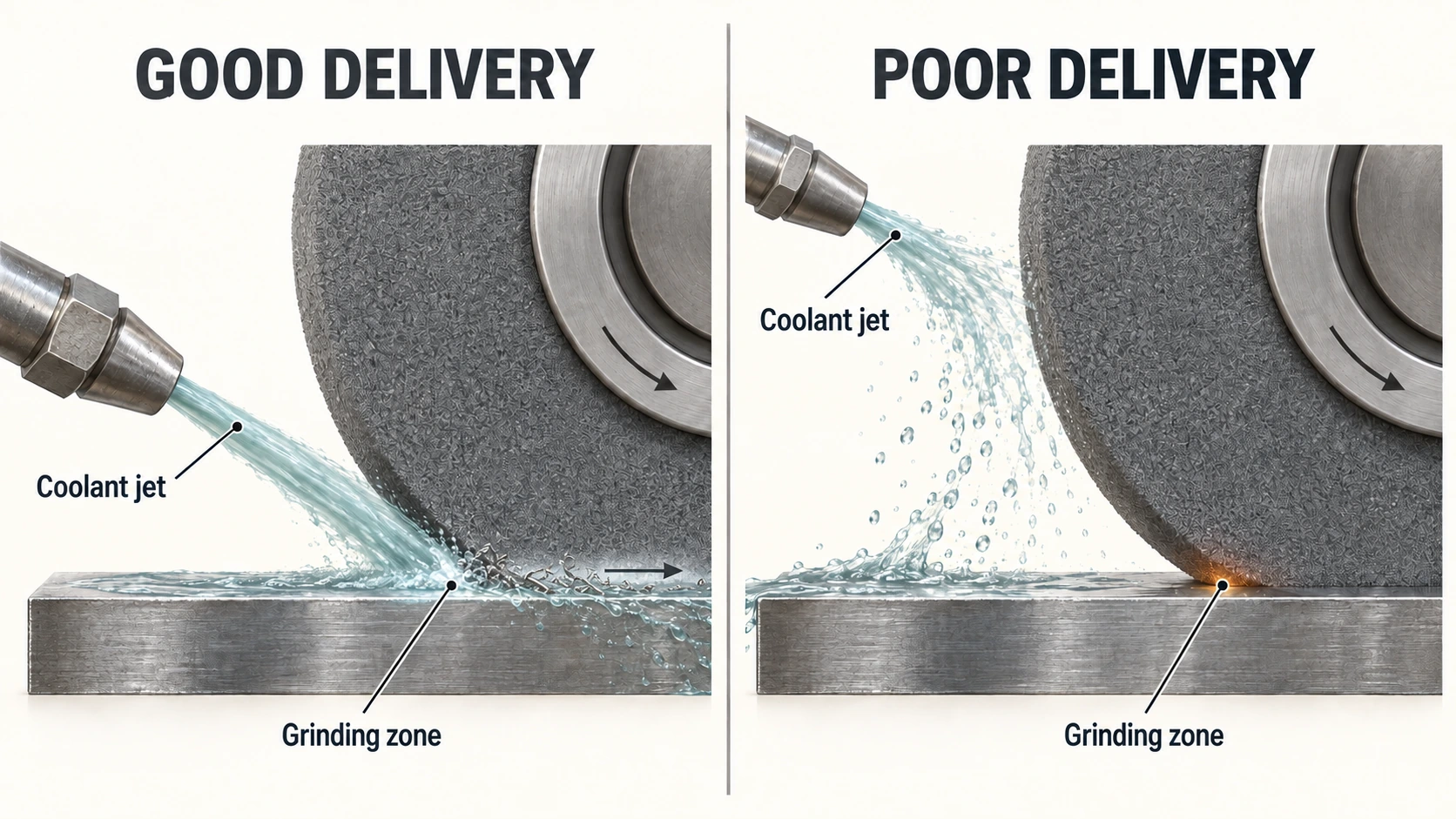
Two-panel comparison: on the left a coherent coolant jet enters the contact between grinding wheel and workpiece, on the right the jet breaks into spray before reaching the contact
Both panels show fluid leaving the same nozzle. On the left the jet stays coherent and enters the grinding zone. On the right it breaks up on the way and never arrives, so the cut runs hot.

Is Coolant Actually Reaching the Grinding Zone?

Watching coolant go into the machine tells you the pump is running. It does not tell you whether any of it reaches the cut.

The contact zone is a small, fast-moving target

Fluid has to arrive in the narrow gap where wheel meets workpiece, during the fraction of a second the material spends under the arc of cut. That gap is closed off by the wheel on one side, the workpiece on the other, and often by the guard or the workholding around it. Access is a geometry question before it is a flow question.

The wheel drags air with it

A wheel running at speed carries a boundary layer of air around its circumference. A jet aimed at the wheel can be broken up or pushed aside by that layer before it ever reaches the contact. What the operator sees is coolant going in. What the cut sees is considerably less of it.

Visible coolant is not the same as useful coolant

Fluid thrown off the wheel, running down the guard, or pooling on the table has already left the job. Useful flow is the part that gets through the gap and does work there, and it is usually a small share of what leaves the nozzle.

Delivery can be unstable rather than absent

A stream can reach the cut on one pass and miss it on the next if the nozzle vibrates, the guard shifts, or the wheel wears and changes the geometry. Intermittent delivery produces symptoms that look random, which is one reason it gets blamed on the wheel.
Signs Coolant Is Not Doing Its Job

None of these proves a coolant fault on its own. They are read together, and against what the wheel face looks like.

Heat where you do not expect it

Workpiece or spark temperature that climbs through a run, or that differs between otherwise identical parts, points at cooling that varies. Heat appearing at the start of a cut and settling afterwards usually means the first contact is taking the thermal load.

Discolouration or burn in a pattern

Burn that appears in a consistent place - one end of a bore, one side of a face, one band across the width - suggests fluid is reaching part of the contact and not the rest. A random pattern points somewhere else.

Loading that recurs at a steady rate

Loading is a chip-clearance condition, and flushing is part of chip clearance. A wheel that loads on a predictable schedule may simply be clearing less swarf than the process produces. That raises the question of where the swarf is going instead.

Finish that drifts within a run

Finish changing part to part, or degrading through a run and recovering after a break, is consistent with the fluid changing rather than the wheel. Mix ratio drifting, fines building up and filtration falling behind all move results in that direction.

Symptoms that move when the nozzle moves

If re-aiming the nozzle changes the symptom, even briefly, delivery is implicated. That single observation is worth more than the others, because it is a test rather than a sign.

Nozzle Position, Jet Stability, Flow and Pressure

These four are usually discussed as a set of numbers to aim for. They are better treated as a chain, because a fault anywhere in it produces the same result - fluid that leaves the nozzle and never arrives.

Where the jet is aimed

Aim decides whether the fluid meets the contact or the wheel. Aiming at the wheel face above the contact relies on the wheel carrying the fluid down into the gap, which a fast wheel does not do reliably. Aiming toward the gap itself, from a position clear of the guard and the workholding, is the intent.

Whether the jet holds together

A coherent stream crosses air far better than a spray. A jet that has already broken up before it reaches the wheel is doing very little by the time it reaches the cut. Nozzle wear, damage to the opening, and air drawn into the supply all break a jet up.

Flow, and the path it takes to get there

Flow at the pump is not flow at the nozzle. Clogged lines, loaded filters, partly closed valves and worn pumps all reduce what arrives, and they do it without moving the gauge if the restriction sits downstream of it. Nozzle cross-section cuts both ways: too small and it clogs, too large and the jet leaves too slowly to be useful.

Pressure is a means, not the goal

Pressure matters because it sets how fast fluid leaves the nozzle, and that speed is what carries it across the air layer. A pressure figure on its own says nothing about whether the jet still arrives with enough energy to work. This is why a system can read normal and still fail at the cut.

Standoff and obstruction

Distance from the nozzle to the contact, and whatever sits between them, both matter. Moving the nozzle closer generally helps a jet survive the trip, but the guard, the workholding and the part geometry limit how close it can go, and a nozzle set too close risks contact during a wheel change or a retract.

Coolant Condition Also Matters

Delivery gets the fluid to the cut. Condition decides whether it does anything useful once it is there.

Mix ratio, where it applies

For water-mixed fluids, the ratio affects both cooling and lubrication, and it drifts in service as water evaporates and drag-out removes fluid. A mix that has moved away from what the fluid supplier specifies will not behave the way the process was set up to expect. The supplier's figure is the reference for that product - it is not a number that transfers between fluids.

Contamination and fines

Ground fines, tramp oil and swarf the filtration has not removed travel with the fluid and arrive at the cut. They reduce how much heat the fluid can take up, and they add abrasive debris to a zone that is already trying to clear debris.

Filtration keeping up at working flow

Filtration is judged by what it removes at the flow the process actually uses, not by its rating on paper. A filter that is adequate when new and loaded a week later produces a slow drift in results that is easy to blame on the wheel.

The temperature the fluid arrives at

Fluid that is already warm has less capacity to absorb heat. A chiller or tank that is not holding temperature shows up as a process that runs hotter later in the shift. That is a system condition, and it is worth measuring rather than assuming.

What this does not mean

None of this argues for changing fluid type in the middle of a problem. Condition faults are corrected by restoring the fluid to what the process was designed around, not by switching products and starting again.

Coolant, Loading, Glazing and Grinding Heat

These are usually described as separate problems. In practice they sit on one chain, and coolant delivery is at the front of it.

The chain, in order

If flushing is weak, debris stays in the cut. Debris in the cut raises the load on the grains and reduces how freely the wheel cuts. A wheel that is not cutting freely generates more heat for the same stock removal. More heat softens the workpiece surface and can dull the grains faster. Each step makes the next more likely.

Where loading fits

Loading is workpiece material occupying the pores and cutting spaces at the wheel face. Flushing is one of the things that keeps those spaces clear, alongside wheel structure and how much stock is being removed. Weak flushing raises loading risk; it does not explain every loading case.

Where glazing fits

Glazing is a different mechanism. The abrasive grains become dull and stay held at the surface, so the wheel rubs instead of cutting. Coolant matters to it mainly through heat rather than through chip clearance, and a smooth, glazed face is also harder to cool because it gives the fluid less to work with.

Why keeping the distinction matters

Loading and glazing lead to different checks. Treating them as one problem sends you to the wrong lever - more flushing for a dulling condition, or a softer wheel for a delivery condition. The wheel face is what tells them apart.

What We Ask When Coolant Is On but the Part Still Burns

"There is plenty of coolant and the part still burns" is one of the most common descriptions we receive, and it usually points at delivery rather than volume. So the first questions are about what the fluid is doing at the contact, not how much of it there is. We ask what the operation and workpiece material are, what the wheel marking says and what speed it runs at, how much stock is coming off per pass, what the coolant is and at what mix, and where the nozzle sits. Then the one that matters most: does the jet visibly reach the gap, or is it thrown off the wheel before it gets there. A short phone video of the zone while it is cutting answers more of that in ten seconds than a paragraph of description, because coolant behaviour is a moving picture.

Where does the burn appear?

A consistent band, or one end of a bore, suggests the fluid reaches part of the contact and not the rest. An appearance that moves around points away from delivery.

Does the jet reach the gap, or leave the wheel first?

This is the single most useful observation, and the reason we ask for video rather than a description. Fluid leaving the wheel before the contact is fluid that is not cooling anything.

What is the coolant, and at what mix?

Type and mix ratio set what the fluid can do. A mix that has drifted, or a fluid that no longer matches the process it was chosen for, changes results with no mechanical fault present.

How much stock is coming off per pass?

Stock removal and contact area set how much heat and swarf the fluid has to handle. A process asking for more than the delivery can support will show it at the cut rather than at the pump.

How long since the last dress, and what changed after it?

The interval itself, and the response to dressing, separate a face problem from a delivery problem faster than anything else we ask.

Diagnosis

What Dressing Tells You About the Cause

A dressing pass is the cheapest test available, and what happens next is more informative than the improvement itself.

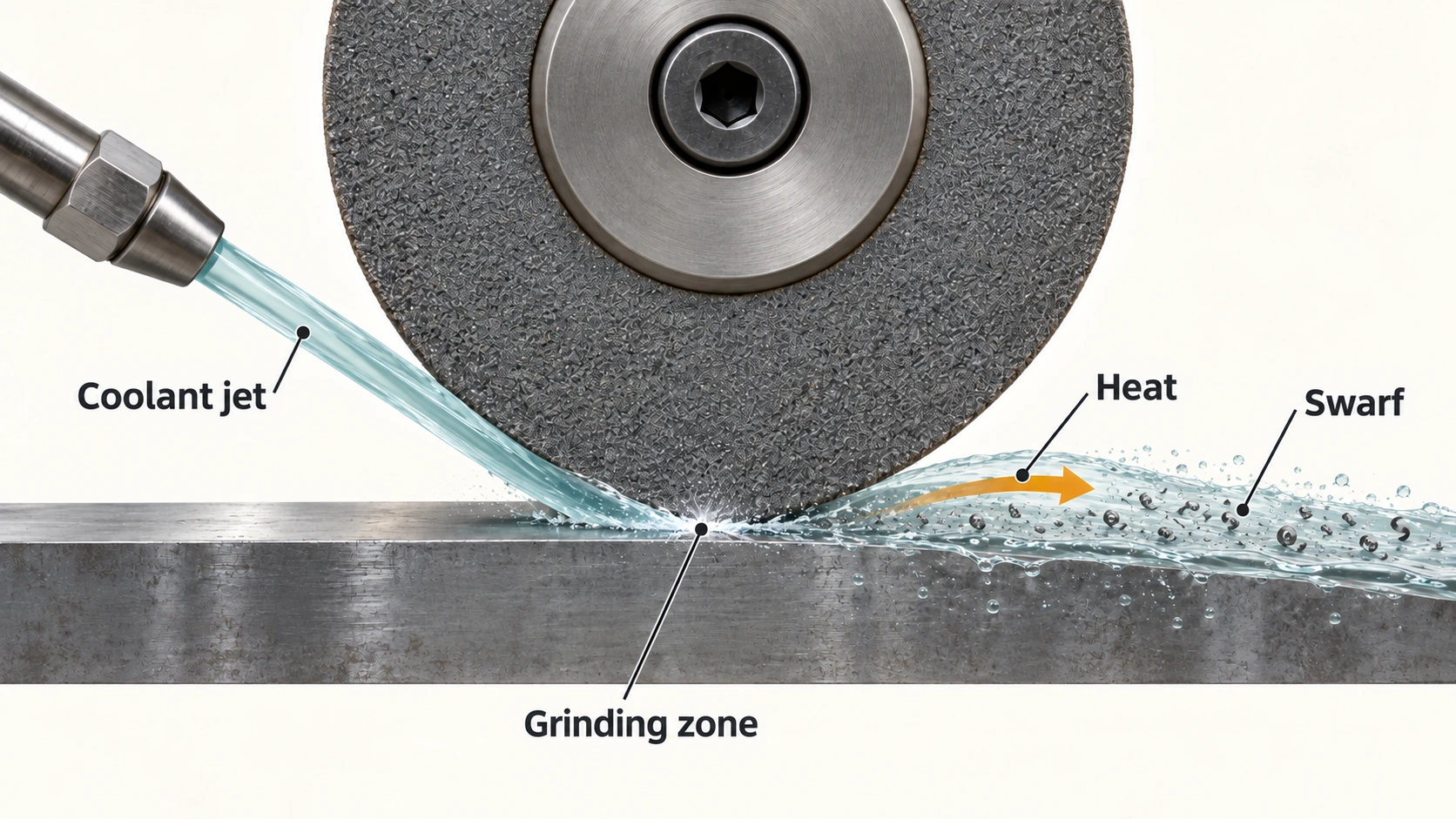
Nozzle directing a coolant stream into the contact between grinding wheel and workpiece, with the fluid leaving the zone carrying heat and swarf
Coolant has to cross the gap, not merely reach the wheel. The path runs from the nozzle into the contact, and out again carrying heat and swarf away from the cut.
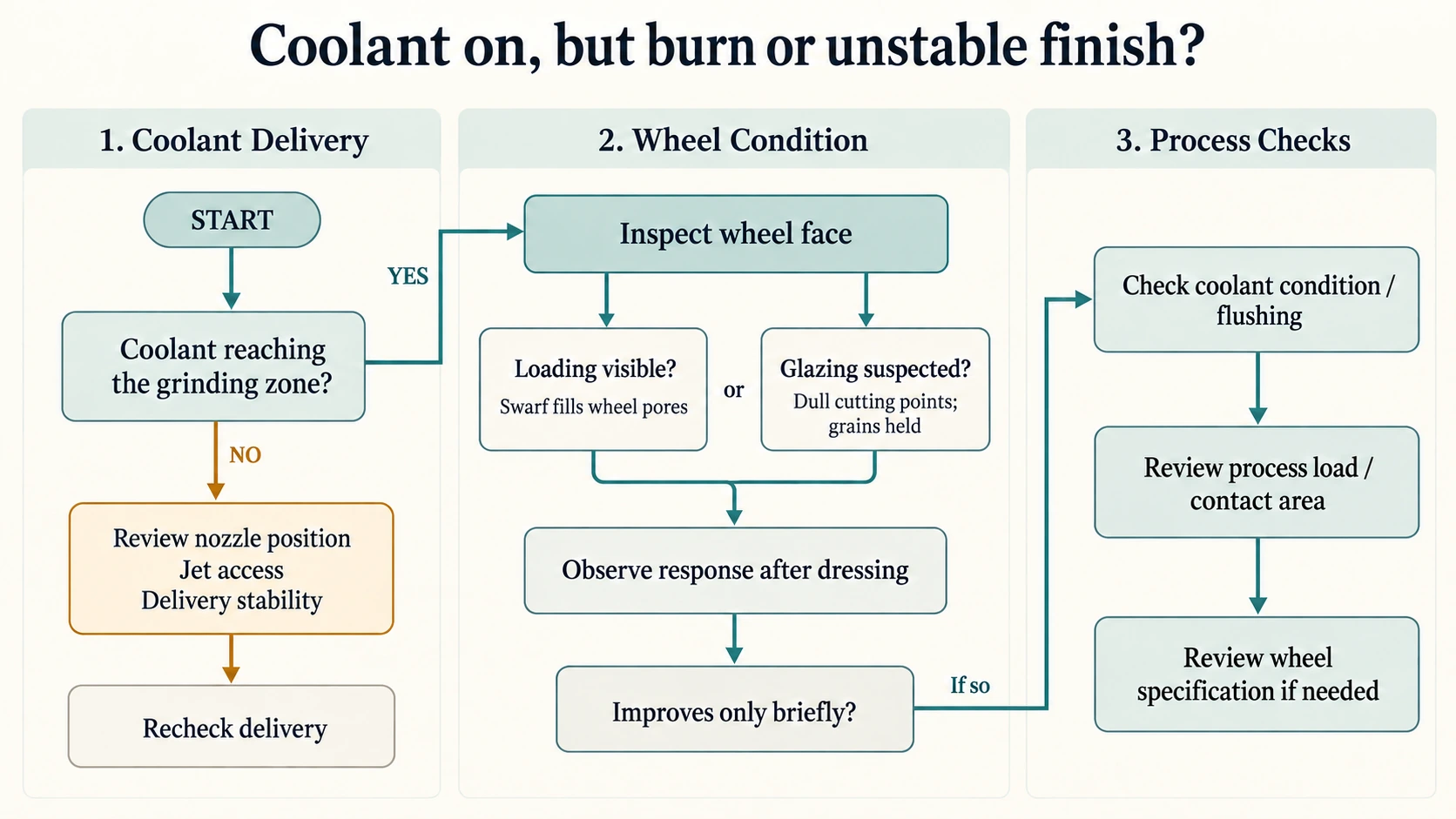
Decision flow chart that checks first whether coolant reaches the grinding zone, then inspects the wheel face, observes the response to dressing, and reviews coolant condition, process load and wheel specification last
Delivery is checked before the wheel. Wheel specification is the last item on the flow, and only when the earlier checks leave it as the remaining variable.

If dressing fixes it, and it holds

The face was the problem. The wheel was overdue, or the previous dressing left a face that could not cut or clear freely. Nothing about coolant delivery has been demonstrated either way.

If dressing fixes it briefly

Something is returning the wheel to the same state quickly. That is the signal to look at what the face is being asked to handle - how much swarf the process produces, whether fluid is reaching the cut to carry it away, and what the fluid is carrying with it.

If dressing changes nothing

When a properly dressed, open face produces the same symptom straight away, the constraint is not the face. Delivery and process conditions are what to examine next, and this is the case where checking the jet and the flow path comes before anything else.

Do not let dressing become the routine

If the dressing interval keeps being brought forward to hold the process, that interval has stopped being a setting and become a symptom. Shortening it further hides the cause and spends wheel life doing it.

Troubleshooting

Troubleshooting Flow: From the Cut Back to the Cause

Work through these in order. Each step narrows what the next one can mean, which is why the sequence matters more than any single check.

1

Start with the cut, not the machine. Photograph the wheel face and note where the symptom appears on the part before changing anything.

2

Check whether the jet reaches the gap. Watch the contact while it is cutting, or record a few seconds on a phone. Aim is the first thing to rule out, before volume.

3

Read the wheel face. Material packed into the pores and dull, polished grains are different conditions with different levers.

4

Dress properly, then watch how long the improvement holds. This separates a face problem from a delivery problem.

5

Walk the flow path: filters, lines, valves, nozzle condition and cross-section, and whether the pump is holding up. A restriction downstream of the gauge does not show on it.

6

Check the fluid itself - mix ratio where it applies, fines and tramp oil, filtration at working flow, and the temperature it arrives at.

7

Only then review process load: stock per pass, contact area, and whether the operation is asking for more heat removal than the delivery can provide.

8

Leave the wheel specification until delivery and process conditions have been ruled out. If the face and the fluid are both doing their job and the symptom persists, a specification review is the right next step.

Before the inquiry

What to Send Before Asking About a Cooling Problem

One package per grinding operation. If two operations run different wheels, materials or coolant setups, send them separately.

Operation and grinding method - surface, cylindrical, internal, centerless, or the specific process
Workpiece material, grade and hardness
Complete wheel marking as printed - abrasive, grit size, grade, structure, bond and dimensions
Wheel speed in use, and the workpiece or table speed where it is relevant
Stock removed per pass and the contact area in use
Coolant type, and mix ratio if known
Nozzle type, position and standoff, and whether the jet visibly reaches the contact
Whether the jet arrives at the gap as a coherent stream or is thrown off the wheel first
Coolant system details where known - pump, filtration, and whether flow or pressure has been measured at the nozzle rather than at the pump
Dressing method, tool condition and interval, and how the symptom responds to dressing
The symptom and where it appears - burn, discolouration, scratches, finish drift or size variation
A photo of the wheel face, and a short video of the grinding zone while cutting

Send the wheel marking, the grinding-zone video and the wheel-face photo through the inquiry form. Values that are genuinely unknown can be marked as unknown; we will say whether the picture is complete enough to work from.

Send Grinding Details →

FAQ

FAQ on grinding coolant delivery

Questions that come up once coolant has been ruled in as a contributor rather than assumed to be working.

Can coolant be present but still fail to cool the grinding zone?

Yes, and it is common. Fluid can leave the nozzle, be deflected by the air the wheel carries, and never reach the gap where cutting happens. It can also arrive in a state that no longer takes up heat well, or at a flow too low to displace what is already in the cut. In each case the machine looks correctly supplied while the contact is under-cooled.

Can poor coolant delivery cause grinding wheel loading?

It can raise the risk. Loading is workpiece material occupying the pores and cutting spaces, and flushing is one of the things that keeps those spaces clear. Where fluid is not reaching the cut, swarf has fewer routes out and more opportunity to stay. That said, structure, stock removal per pass and the workpiece material all act on the same condition, so weak flushing is a contributing cause rather than the only one.

Does more coolant always solve the problem?

No. Volume is only useful if the extra fluid reaches the contact. Raising flow through a nozzle that is misaimed, worn, or too large in cross-section mostly adds fluid that leaves the wheel before the gap. Where the problem is aim, jet quality or a restriction in the flow path, more volume changes little except the mess.

Should nozzle position be checked before changing the wheel?

It is usually the cheaper thing to check first, and it is a test as well as a correction. If re-aiming the nozzle changes the symptom, even briefly, delivery was part of the problem and a new wheel would have faced the same condition. If re-aiming changes nothing at all, that is useful information too, and it moves the review toward the wheel face and the process.

Can contaminated coolant affect grinding stability?

It can. Fines, tramp oil and swarf that filtration has not removed travel with the fluid to the cut. They reduce how much heat the fluid can absorb and add debris to a zone that is trying to clear debris. The effect is usually a slow drift through a shift or a run rather than a sudden change, which is why it is often attributed to the wheel.

Why does the problem return after dressing?

A dressing pass restores the wheel face, so if the symptom comes back quickly, something is returning the face to the same state. Either the process is producing more swarf than the delivery can clear, or the fluid reaching the cut is not doing its job, or the wheel is being asked to remove more than the operation supports. The recovery time after dressing is the measurement that points to which of those it is.