Grinding Wheel Cost Per Part: How to Calculate the Real Cost of Grinding

Grinding Wheel Knowledge Base

Grinding Wheel Cost Per Part: How to Calculate the Real Cost of Grinding

Two wheel offers arrive for the same grinding operation: one at $80 and one at $900. The lower-priced wheel is dressed more often, changed more often, runs a longer cycle and produces more scrap. The comparison only becomes useful when those costs are brought into one number: cost per good part, calculated inside a defined process boundary.

Wheel price is one cost line; dressing, changes, cycle time and scrap often decide the result
Use accepted parts as the denominator, not total starts
Put machine, labour and overhead into one consistent hourly rate
Test a higher-priced wheel only when the machine and process can use it and the measured savings exceed its extra cost

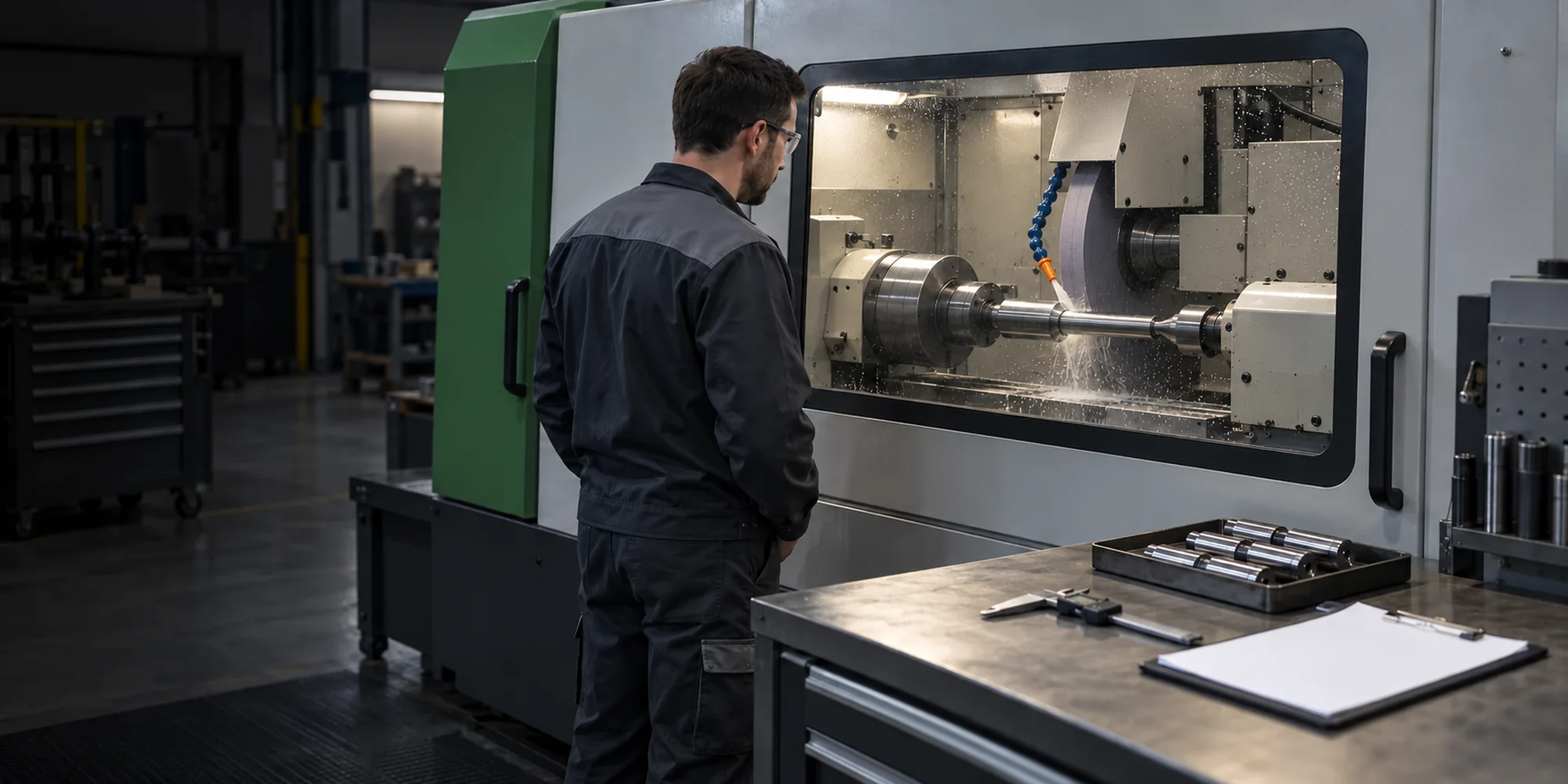
Hero image: AI-generated illustrative industrial scene, not a customer or factory record.

Overview

The number to compare is cost per good part

A wheel price is quoted per wheel. Production pays for wheel consumption, but it also pays for dressing time, wheel changes, the cycle time of every part, and the cost of parts that are scrapped or reworked. Those costs do not scale with the invoice price in a simple way.

The useful comparison uses the same production period, the same quality acceptance and one denominator: good parts. A higher-priced wheel can be cheaper per good part when its usable life, cycle time, dressing demand or scrap performance change the total enough to recover the difference. It can also be more expensive when its life is short, the machine cannot use it, the volume is low, or the problem is not wheel-related. The worked example below is illustrative; replace every input with measured process data.

What to settle before comparing two wheel prices

  • Cost per good part includes wheel consumption, dressing, wheel changes, cycle time and scrap or rework.
  • The denominator is accepted parts. A cost per part based on total starts hides the cost of scrap.
  • Use one combined rate or a separate machine-plus-labour rate, but do not count the same time twice.
  • A premium wheel is a trial candidate, not an automatic saving; the stressed example shows when it loses.

Why the wheel price is not the full cost

A wheel price is quoted per wheel. The production cost includes the time and material around that wheel, and those lines do not scale with the invoice price in a simple way.

The costs around the wheel

Production pays for the wheel, but also for dressing time, wheel changes, the cycle time of every part, and the parts that are scrapped or reworked. A wheel that costs 11 times more but lasts 10 times longer can have a similar consumption cost per part. A wheel that shortens the cycle by 30 seconds can be worth more than its price difference, but only when the machine, coolant, dressing system and part quality support that cycle.

The invoice price is not the usable abrasive

For conventional wheels, the purchase price is usually treated as the wheel cost. For CBN and diamond wheels, the body or core may have residual value, and the usable abrasive layer may be only part of the wheel. If a core is returned, reused or scrapped separately, use the net wheel cost after any credit. If a wheel is retired early for profile loss, damage or a specification change, use the good parts actually obtained from it, not the catalogue life.

Two rules for a valid comparison

Compare the two wheels over the same production period and with the same quality acceptance. Put every relevant cost into the same denominator: good parts. A supplier's claimed wheel life is not a cost result until the buyer states how many good parts were produced, how much time was spent dressing and changing the wheel, and what happened to the parts that did not pass inspection.
Build the cost per good part

The calculation is a small cost model, not a single price comparison. Keep the boundary visible so the result can be checked and reproduced.

The five-line formula

Cost per good part = wheel consumption + dressing cost + wheel-change cost + grinding cycle cost + scrap and rework cost. The denominator is the number of accepted parts produced in the same period. The next modules show the five lines with the illustrative values and the arithmetic.

Define the rate once

The rate R is the cost of one hour of production. It can be a combined shop rate that already includes the machine, operator and normal overhead, or a separate machine rate plus a labour rate. Choose one method and stay with it. If the rate already includes the operator, do not add a separate labour line for the same minutes. If the operator is paid separately for dressing or wheel changes, include that time at the labour rate and keep it out of the machine rate. Convert seconds to hours by dividing by 3,600.

What belongs inside the boundary

Include wheel consumption after any core credit; dressing time, dresser wear and consumables; wheel-change and setup time; grinding cycle time, including load and unload when the machine is occupied; scrapped parts and rework; and inspection, energy, coolant, filtration or disposal costs when they differ materially. Do not add general plant overhead twice, charge the full selling price of a scrapped part when only its value at the grinding stage was lost, or count the wheel price once as a purchase and again as consumption. The wheel-consumption line already reflects wheel material lost during dressing when good parts per wheel are measured; do not add that same wheel loss again in the dressing line.

Use good parts, not starts

If 1,000 parts are started and 20 are scrapped, the denominator is 980 good parts, not 1,000. The wheel, dressing, change and cycle costs were incurred for all started parts; dividing by 1,000 hides the scrap. Starts required = good parts required ÷ (1 − scrap rate). Scrapped parts = starts required − good parts required. Scrap cost per good part = (scrapped parts × cost per scrapped part) ÷ good parts required. If rework is present, add rework time, consumables and extra inspection to the numerator, but do not count the same part as both scrap and rework.

Illustrative comparison: conventional vs CBN

ILLUSTRATIVE EXAMPLE — not a customer case, quotation, benchmark or expected result. Every number is an assumption chosen to show the arithmetic. Replace the inputs with measured data from the actual machine, wheel and part.

The common assumptions

1,000 good parts required; combined machine, labour and normal overhead rate of $60 per hour; value of a part scrapped at the grinding stage of $80 (material plus prior operations, not selling price); the same machine, coolant, fixture and quality acceptance for both wheels. Setup, inspection, energy and floor-space costs are assumed equal and excluded. The currency is USD; the same arithmetic works in any currency when every cost uses the same unit.

The wheel inputs

Conventional: $80 wheel, 400 good parts per wheel, 20-minute change, dressing every 25 good parts, 2-minute dress, $0.50 dresser per dress, 90-second cycle, 2.0% scrap. CBN: $900 wheel, 4,000 good parts per wheel, 30-minute change, dressing every 250 good parts, 4-minute dress, $2.00 dresser per dress, 60-second cycle, 0.5% scrap. The CBN wheel costs 11.25 times more but is assumed to produce 10 times as many good parts. The shorter cycle and lower scrap rate are assumptions to test, not automatic properties of CBN.

The calculated result

The five cost lines are shown in the comparison module. Conventional totals $3.48 per good part; CBN totals $1.66. The CBN wheel's consumption cost is $0.225 versus $0.20, so the 11.25× price does not become an 11.25× consumption cost per part. The large difference is in cycle time ($0.50 per part) and scrap ($1.23 per part); the combined saving from dressing and wheel changes is about $0.12 per part. The total difference is about $1.82 per good part, or $1,824 across 1,000 good parts. Fractional parts in the yield arithmetic are averages; a real order uses whole parts and actual counts.

What the example shows

The result does not prove that CBN is cheaper. It shows where the money is. If the CBN wheel does not deliver the shorter cycle, lower scrap rate or assumed life, the conclusion can reverse. The sensitivity examples below make that reversal explicit.

Sensitivity: when the expensive wheel does not pay

A single favourable example is not a purchasing case. Stress the assumptions that are least certain: wheel price, good parts per wheel, cycle time, dressing interval and scrap rate.

Base, moderate and stressed cases

With the conventional wheel fixed at the base assumptions, the CBN base case gives $1.66 per good part; a moderate case ($1,800 wheel, 2,000 good parts per wheel, 75-second cycle, dressing every 150 parts, 1.0% scrap) gives $3.01; a stressed case ($2,400 wheel, 1,500 good parts per wheel, 80-second cycle, dressing every 100 parts, 1.5% scrap) gives $4.23. The conventional result remains $3.48. The stressed case is the important one: the consumption cost alone is $1.60 per good part, and the shorter cycle and lower scrap no longer recover the price and life penalty.

The decision rule

Test the higher-priced wheel only when the combined savings in cycle, dressing, wheel changes and scrap per good part are greater than the extra wheel-consumption cost per good part. The calculation can show whether the case is promising, but it cannot prove the technical capability of the process.

Technical capability comes first

A CBN wheel run on a machine without the required rigidity, coolant delivery, dressing capability, balance or safe guarding is not a valid cost comparison. It is a different process that has not been proven. Resolve the process conditions and material suitability before treating the price difference as the decision.

Dressing frequency and production cost

Dressing is often treated as a minor routine. In the cost model it has three parts: machine time, operator time and the dressing consumable.

Dressing cost per good part

Dressing cost per good part = (dressing time × rate + dresser cost per dress) ÷ good parts per dress. With the conventional-wheel assumptions, the dressing cost alone is $0.25 at 10 good parts per dress, $0.10 at 25, $0.05 at 50 and $0.025 at 100. The table below keeps those values and states what is included. It does not assume that more frequent dressing improves quality or that a longer interval is safe.

Why the interval changes the total cost

A shorter interval adds wheel consumption and machine time, but it may stabilize the wheel face, reduce heat and protect finish or profile. A longer interval saves dressing time, but if the face loads, glazes, loses profile or raises scrap, the saving can disappear. Record the effect on scrap, cycle time and inspection, not only the dressing minutes.

Temperature control curve and hardness uniformity

The useful evidence is the temperature control curve for the operation: how the grinding-zone temperature and part condition behave through the cycle and across the interval between dresses. A stable curve with controlled finish and acceptable scrap is more useful than a low dressing cost with unstable output. Wheel hardness uniformity and the consistency of the dressing response also matter. If the wheel behaves differently after each dress, the operator may compensate with more frequent dressing, a softer setting or a slower cycle; those compensations have a cost even when the dressing itself looks inexpensive.

What to record

Record good parts between dresses, not just total parts; dressing time and dresser cost; scrap and rework between dresses; any change in cycle time or inspection burden; and the wheel-face condition before and after dressing. The existing pages on grinding wheel dressing frequency, frequent dressing and performance after dressing cover the diagnostic side; use those observations as cost inputs here.

When a more expensive wheel is worth testing

A price comparison usually arrives with two unit prices and little else. The first question is not which wheel is cheaper; it is whether both prices describe the same scope.

Same scope first

Confirm the same wheel size and usable layer, the same machine, the same coolant and dressing method, and the same quality acceptance. A higher-priced wheel is worth a controlled trial when most of the following are true: the current process has a repeatable limitation after coolant, dressing, mounting, machine condition and parameters have been checked; the candidate wheel is technically suitable for the material and operation; the machine can support it safely; the higher price buys usable abrasive, useful life or a measurable process benefit; volume or part value makes the per-part difference material; and the buyer can measure good parts, scrap, rework, cycle, dressing and changes against a stable baseline.

When not to test

Do not start a premium-wheel trial when the current problem is unstable coolant, a worn dresser, poor mounting, an unsuitable machine or a part specification that has not been fixed. A more expensive wheel will not make an unstable process comparable. Material compatibility is a separate decision; use the CBN vs conventional guide rather than treating price as evidence.

Questions before the trial

Ask for the exact specification and usable abrasive layer; the recommended dressing method and what changes from the current process; any required speed, coolant pressure, filtration, balance or guarding change; the trial quantity and acceptance method; the cost lines that will be measured and who records them; and the result that would cause the buyer to reject the wheel. A supplier that cannot answer these questions has not supplied a comparison, only a price.

What to record during a grinding wheel trial

A trial that records only wheel life cannot answer the cost question. Record the process and the economics together, then calculate the same formula before and after the change.

Record process and economics together

Record the part ID, material, heat treatment and hardness; machine and spindle condition; operation and contact area; wheel specification and marking; wheel dimensions, usable layer and core credit; dressing method, tool, frequency, time and cost; coolant type, delivery, filtration and condition; wheel speed, work speed, infeed, traverse and cycle time; starts, good parts, scrap and rework; wheel changes, mounting, balancing and restart time; finish, tolerance, profile and burn observations; and operator notes or wheel-face photos. The checklist below turns these into the data set for the calculation.

Keep the acceptance criteria constant

Use the same acceptance criteria for both wheels. If the trial changes wheel, speed, coolant and dressing method at the same time, it is a process comparison, not a wheel comparison; record it as such and do not attribute the whole result to the wheel. A useful trial has a baseline period, a trial period and a decision meeting.

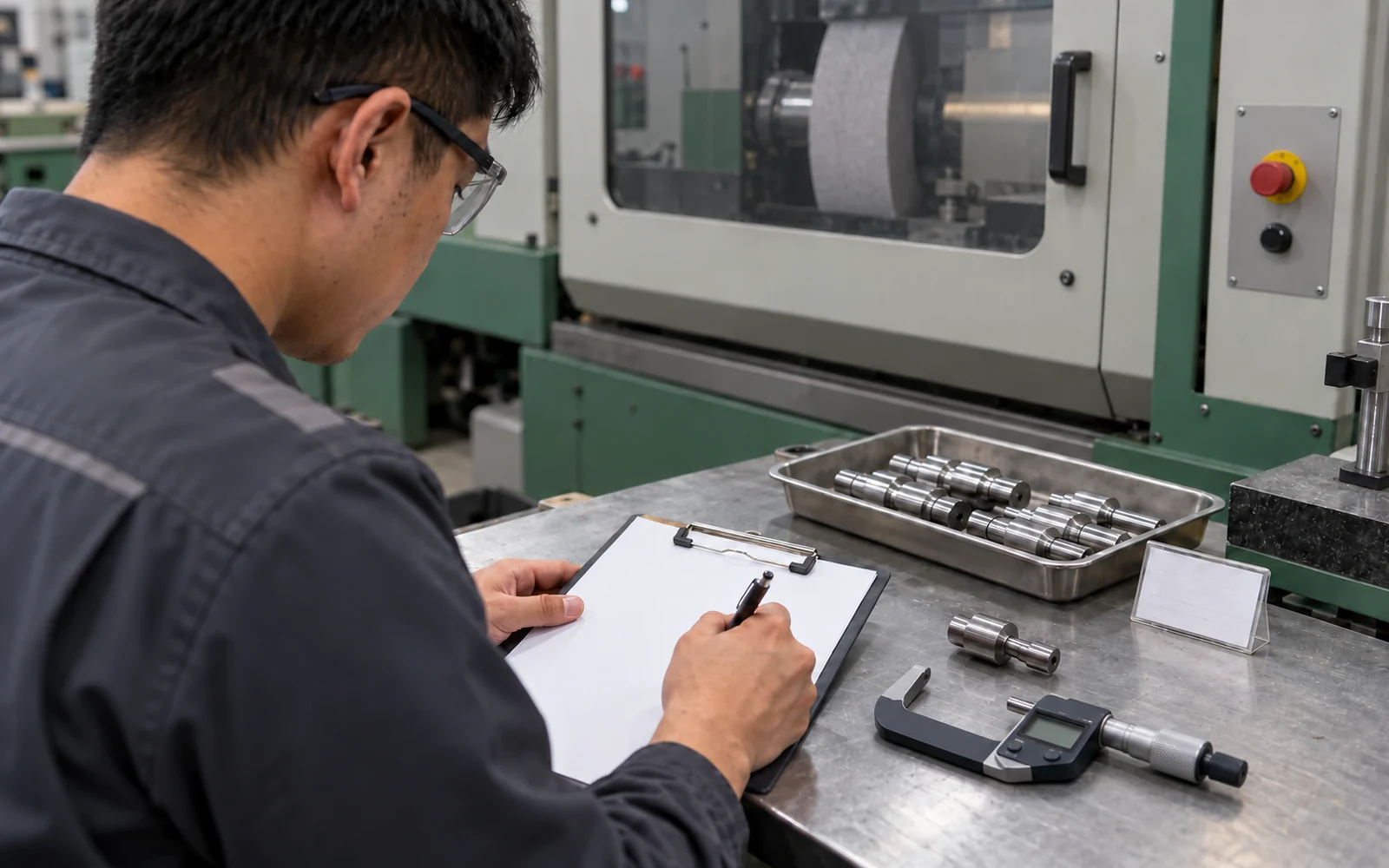
Grinding operator recording wheel marking and part measurements during a controlled grinding wheel trial
Illustrative trial record — AI-generated industrial scene, not a customer or factory record. Wheel life alone is not enough; good parts, cycle time, dressing, changes and scrap must be recorded together.

Where the calculation matters

Production situations that change the wheel decision

The cost model is most useful where wheel price, cycle time, dressing or scrap interact. These are review contexts, not automatic wheel recommendations.

High-volume precision grinding

Cycle time, wheel life and scrap at scale

Build the calculation from a stable production period, not from one favourable cycle

CBN evaluation on hardened steel

Wheel price versus life, cycle and dressing

Run the stressed case as well as the favourable case before approving a trial

Dressing-heavy operations

Dressing minutes, dresser cost and stability between dresses

Record good parts per dress and the quality response, not only the dressing time

Scrap-sensitive parts

Scrap rate, rework and the cost of a rejected part

Use accepted parts as the denominator and value scrap at the grinding stage

Illustrative Cost Review

Cost comparison, sensitivity and trial decision

Read the five cost lines, the conventional-versus-CBN arithmetic, and the trial decision in one place. The values are illustrative and must be replaced with measured process data.

These modules use the illustrative example from the article. They are a structured way to review the arithmetic, not a quotation, benchmark or recommendation.

Cost line

Grinding cycle

Conventional

$1.50

CBN

$1.00

Calculation basis

90 s vs 60 s at $60/h

Cost line

Dressing

Conventional

$0.10

CBN

$0.024

Calculation basis

2 or 4 min, dresser cost, parts per dress

Cost line

Wheel consumption

Conventional

$0.20

CBN

$0.225

Calculation basis

$80 ÷ 400; $900 ÷ 4,000

Cost line

Wheel change

Conventional

$0.05

CBN

$0.0075

Calculation basis

20 or 30 min at $60/h, divided by parts per wheel

Cost line

Scrap and rework

Conventional

$1.63

CBN

$0.40

Calculation basis

2.0% vs 0.5% scrap at $80 per scrapped part

Cost line

Total per good part

Conventional

$3.48

CBN

$1.66

Calculation basis

Sum of the five cost lines

Fast diagnostic flow

Before testing a higher-priced wheel

  1. 1

    Is the limitation repeatable after process checks?

    If no, fix coolant, dressing, mounting and machine conditions first.

  2. 2

    Is the wheel suitable for the material and operation?

    If no, stop; price is not evidence of suitability.

  3. 3

    Can the machine support the candidate safely?

    If no, stop; a different process is not a valid cost comparison.

  4. 4

    Is there a measurable cost case at the expected volume?

    If no, keep the current wheel or revisit the specification.

  5. 5

    Run a controlled trial and calculate cost per good part.

    Adopt, reject, or collect more data.

Dressing frequency: illustrative cost per good part

Dressing time and consumable only. The table excludes any effect on quality, scrap, cycle time or wheel life; those must be measured in the same trial.

10

Dressing cost per good part
$0.25
Included
2 min at $60/h + $0.50 dresser
Not included
Quality, scrap, cycle effects

25

Dressing cost per good part
$0.10
Included
2 min at $60/h + $0.50 dresser
Not included
Quality, scrap, cycle effects

50

Dressing cost per good part
$0.05
Included
2 min at $60/h + $0.50 dresser
Not included
Quality, scrap, cycle effects

100

Dressing cost per good part
$0.025
Included
2 min at $60/h + $0.50 dresser
Not included
Quality, scrap, cycle effects
Good parts per dressDressing cost per good partIncludedNot included
10$0.252 min at $60/h + $0.50 dresserQuality, scrap, cycle effects
25$0.102 min at $60/h + $0.50 dresserQuality, scrap, cycle effects
50$0.052 min at $60/h + $0.50 dresserQuality, scrap, cycle effects
100$0.0252 min at $60/h + $0.50 dresserQuality, scrap, cycle effects

Wheel price: $80 vs $900

The CBN wheel costs 11.25 times more at purchase. That is the start of the comparison, not the answer.

  • 11.25× purchase price
  • 10× assumed good parts per wheel
  • Illustrative only

Wheel consumption: $0.20 vs $0.225

The higher price and longer assumed life nearly cancel in the wheel-consumption line. The remaining difference is small compared with the other cost lines.

  • $0.20 conventional
  • $0.225 CBN
  • Same denominator: good parts

Cost per good part: $3.48 vs $1.66

In the base example, cycle time and scrap dominate the difference. In the stressed example, the same CBN wheel becomes more expensive than the conventional option.

  • Base: CBN lower
  • Stressed: CBN higher
  • Result depends on measured inputs

What to record

Trial record checklist

Use the same list for the baseline and the trial. The calculation is only as useful as the counts behind it.

1. Part ID, material, heat treatment and hardness

2. Machine and spindle condition

3. Operation and contact area

4. Wheel specification and marking

5. Wheel dimensions, usable layer and core credit

6. Dressing method, tool, frequency, time and cost

7. Coolant type, delivery, filtration and condition

8. Wheel speed, work speed, infeed, traverse and cycle time

9. Starts, good parts, scrap and rework

10. Wheel changes, mounting, balancing and restart time

11. Finish, tolerance, profile and burn observations

12. Operator notes and wheel-face photos

What to send

Review your grinding cost per part

Share the wheel, workpiece, process and cost inputs you can provide. We can review whether a customized wheel is worth testing; we cannot promise a fixed saving before the trial.

  • Current wheel marking and dimensions

    include the usable abrasive layer, core credit if any, and the current specification

  • Workpiece material and acceptance

    material, hardness or heat treatment, finish, tolerance and the inspection stage

  • Machine and operation

    machine, spindle, operation, contact area, coolant and available guarding

  • Dressing practice

    method, tool, frequency, time, dresser condition and the reason dressing is performed

  • Cycle data

    cycle time, load/unload time if included, and the current production rate

  • Good and scrap counts

    starts, accepted parts, scrap, rework and the cost value at the grinding stage

  • Wheel prices

    current and proposed wheel prices, or the cost inputs you can share

  • Trial scope

    trial quantity, baseline period, acceptance method and the single process variable to compare

  • Cost boundary

    the hourly rate or machine-plus-labour rates you use, and which overhead is already included

  • Decision target

    the limitation, cost question or maximum acceptable cost per good part you need to review

Review your grinding cost per part

Share your current wheel specification, workpiece material, dressing frequency and production requirements. We can review whether a customized grinding wheel is worth testing. Youlin Abrasive supplies grinding wheels and abrasive tools; we do not supply machines, workpieces or machining services, and we do not promise a fixed cost reduction before the trial.

Send Grinding Details →

FAQ

Questions about grinding cost per part

Short answers for buyers comparing wheel price, wheel life and total production cost.

What is grinding wheel cost per part?

It is the total relevant grinding cost divided by the number of accepted parts. It normally includes wheel consumption, dressing, wheel changes, cycle time and scrap or rework. The wheel price alone is not the cost per part.

Is a more expensive grinding wheel always cheaper per part?

No. A higher-priced wheel can be cheaper per good part when it lasts longer or reduces cycle time, dressing, downtime or scrap enough to recover its price. It can be more expensive when its life is short, the machine cannot use it, the volume is low or the process problem is not wheel-related.

Which costs should be included?

Include every cost that changes between the two options: net wheel consumption, dressing time and consumables, wheel-change time, grinding cycle time, scrap, rework, and any material difference in inspection, energy, coolant or disposal. Use the same boundary for both wheels.

How should scrap and rework be counted?

Use accepted parts as the denominator. Calculate scrap from started parts minus good parts, and value the scrapped part at its cost at the grinding stage, not at its selling price. Add rework time and consumables, but do not count the same part as both scrap and rework.

How do I compare conventional and CBN wheels fairly?

Use the same part, machine, coolant, acceptance criteria and production period. Measure actual good parts per wheel, cycle time, dressing time, wheel-change time and scrap. If CBN requires a different speed, dressing method or coolant, record the whole process change and do not attribute the result to the wheel alone.

What information should I send for a cost review?

Send the current wheel marking and dimensions, workpiece material and hardness, operation, machine, coolant and dressing practice, cycle time, good and scrap counts, and the cost inputs you can share. Mark unknown values clearly. We can review whether a custom wheel is worth testing; we cannot guarantee a fixed saving without the trial.