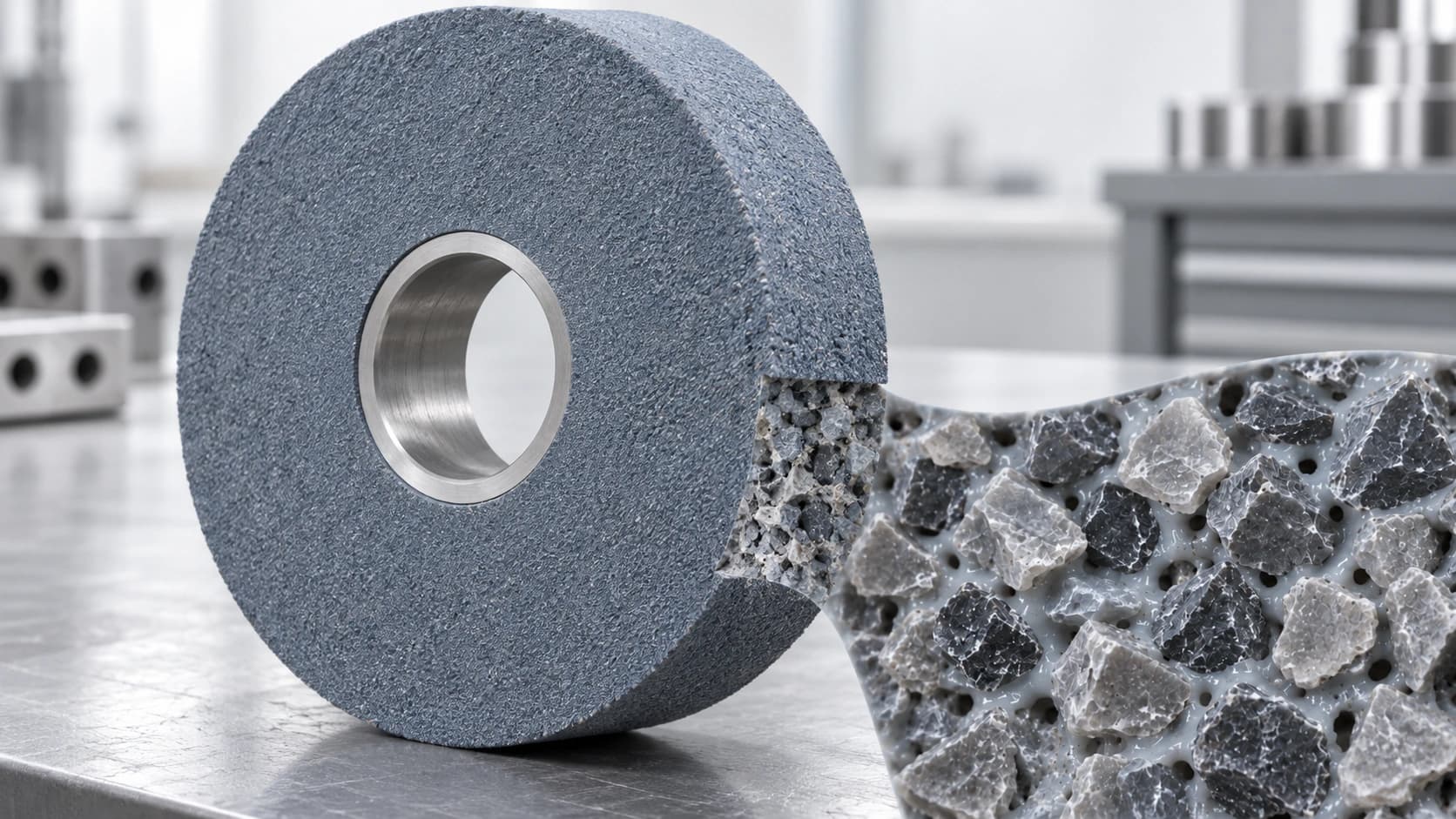
Grinding Wheel Structure and Porosity: How to Choose Between Open and Dense Structures

Grinding Wheel Knowledge Base

Grinding Wheel Structure and Porosity: How to Choose Between Open and Dense Structures

Structure is the part of a wheel specification that describes how much space sits between the abrasive grains. It is also the parameter most often changed on a hunch, because the effect of a more open or a denser wheel only shows up together with grit size, grade, bond, dressing and the grinding operation itself.

Separate grit size, wheel grade and structure before comparing two wheels
Compare an open and a dense direction against the actual grinding symptom, not against a general rule
Record how the wheel face changes between dresses, because dressing changes the surface that grinds
Send the full readable wheel marking, the grinding operation and the result that has to be held

Overview

Quick answer

A grinding wheel carries three parameters that are often mixed together: grit size, which describes the abrasive grain; grade or hardness, which describes how firmly the bond holds those grains; and structure or porosity, which describes how much space sits between them. Structure is the relationship between abrasive volume and pore volume inside the same wheel. An open structure leaves more space between grains and a denser structure leaves less.

That space is what removed material has to pass through and what coolant and air move through on the way to the contact zone. Changing it changes chip clearance, the number of grains in contact, the strength of the wheel body, the heat generated in the contact zone and how the face behaves between dresses, usually more than one of these at once. There is no universally better direction. This guide separates the three parameters, compares open and dense directions against real grinding symptoms, and shows what to record before asking for a wheel recommendation. Youlin supplies grinding wheels, abrasive tools and grinding wheel solutions. The workpiece materials and grinding operations described here are customer application contexts. Final suitability may require a sample or a controlled trial on the machine that will run the job.

What to hold on to before comparing wheels

  • Structure describes grain spacing and pore space. It is not grit size and it is not wheel grade.
  • An open structure is not automatically better, and a denser structure is not automatically more stable or more precise.
  • Loading, burn, finish and profile retention usually respond to structure together with grade, bond, coolant and dressing.
  • Dressing changes the surface that actually grinds, so a wheel can behave more open or more closed than its marking suggests.
  • Structure notation is tied to a manufacturer and a specification system, so a number on its own does not transfer between wheels.
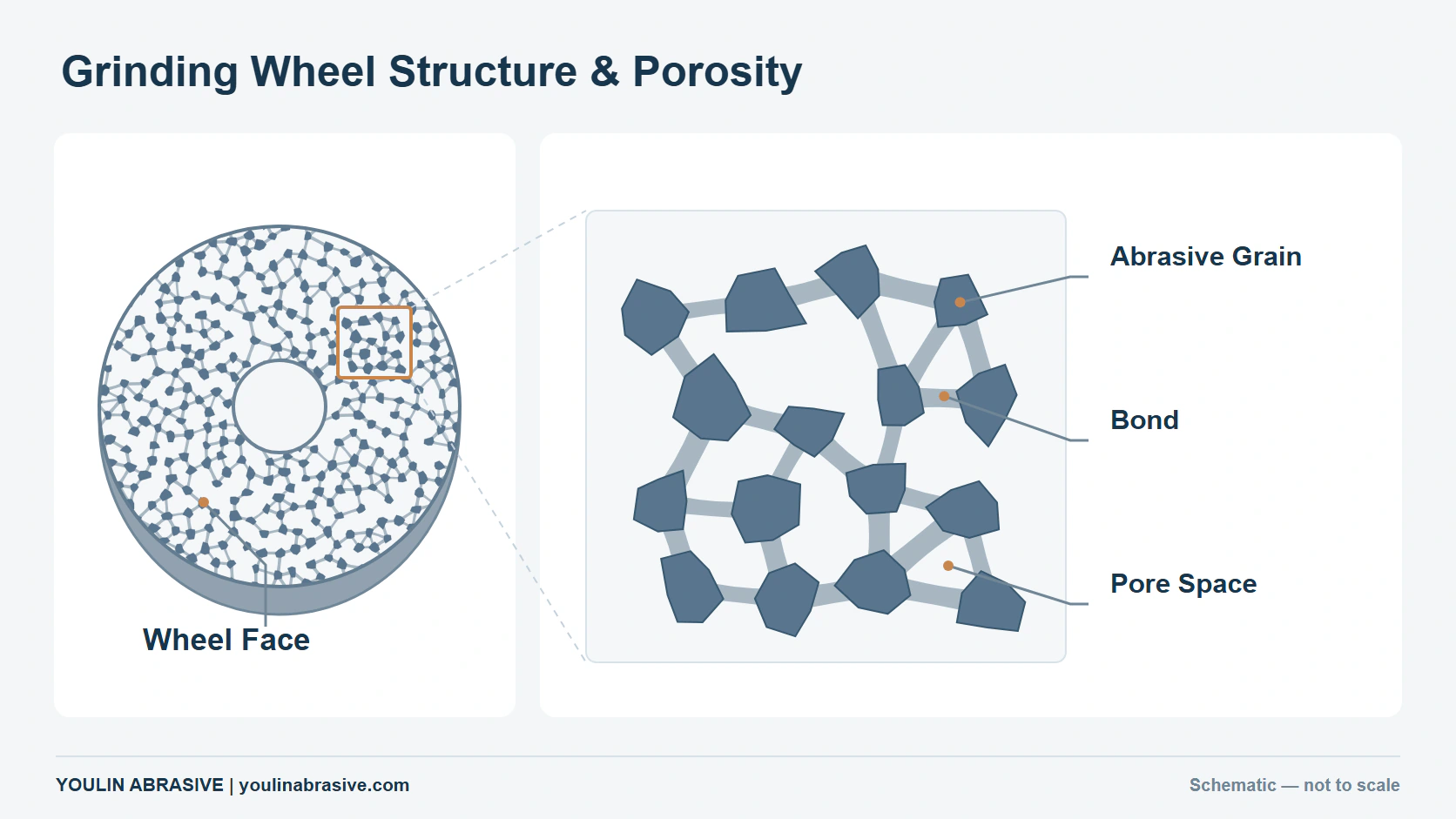
Grinding wheel schematic showing abrasive grains, bond and pore space for structure and porosity review
Conceptual view of abrasive grains, bond and pore space. Not to scale.

What wheel structure actually describes

Structure sits between the abrasive and the bond. It describes how the grains are spaced and how much pore space the wheel contains.

Grain spacing

In a wheel with more space between grains, each grain carries a larger share of the grinding load and removed material has more room to clear. In a wheel with less space, more grains share the same contact area. Grain spacing is set during manufacture from the abrasive, the bond and the pore-forming components, and it is not something that is adjusted on the machine.

Pore space and what moves through it

Pore space is what gives removed material somewhere to go and what lets coolant and air reach the contact zone. A wheel with more pore space generally offers more room for fluid and chips. A wheel with less pore space presents a more continuous abrasive surface to the workpiece.

Why the description stops there

Structure on its own does not tell you the finish, the material removal behaviour or how long the wheel will last. It is one entry in a specification that also contains abrasive type, grit size, grade and bond, and, in superabrasive wheels, abrasive-layer construction and concentration. Read it with the rest of the marking rather than in place of it.
Structure, grit size and wheel grade are three different things

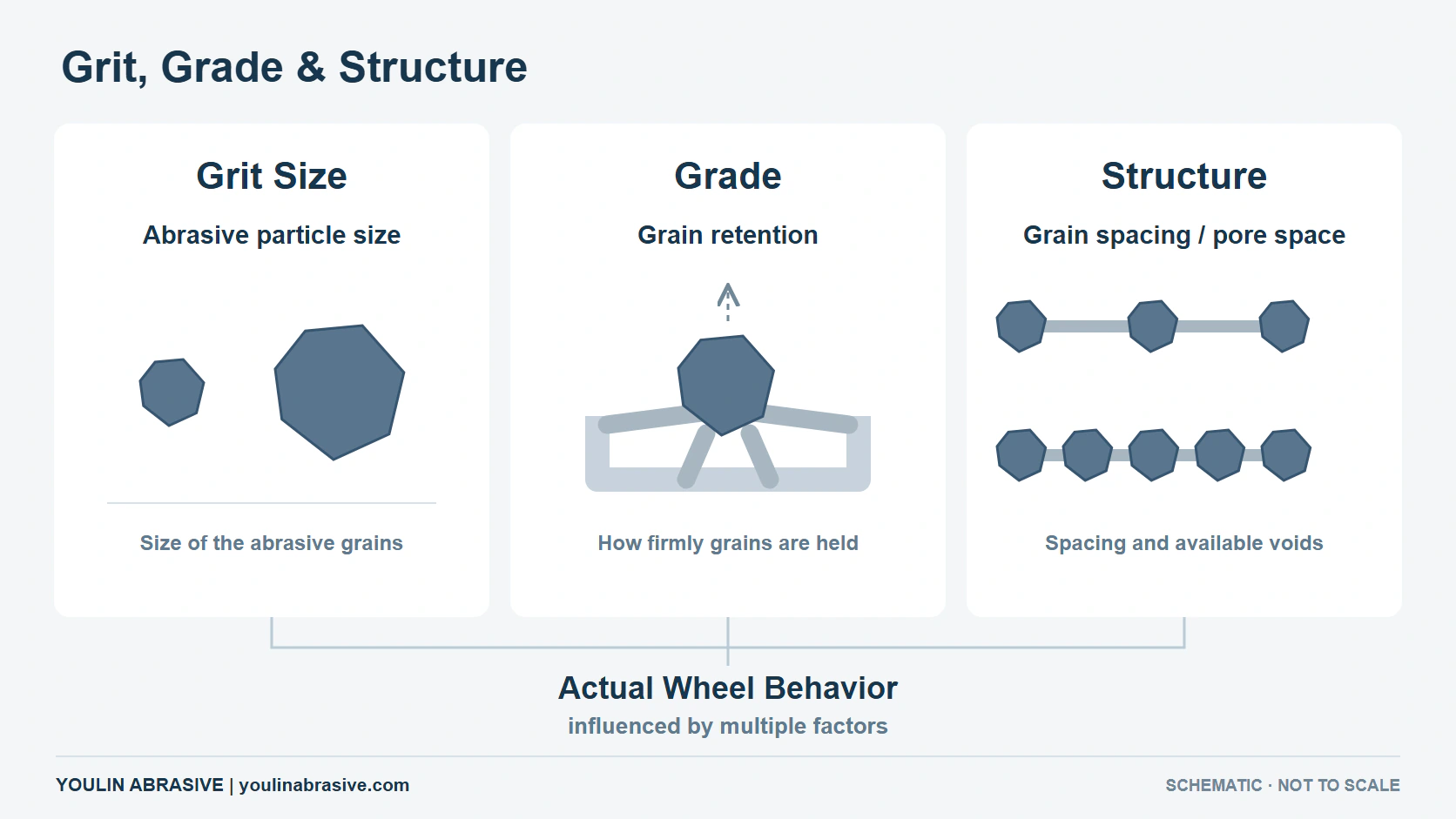
These three parameters are often used as if they were interchangeable. They describe different parts of the same wheel.

Grit size — the abrasive grain

Grit size describes the size of the abrasive grain. A coarser grit produces larger individual scratches and more room around each grain; a finer grit produces more, smaller contact points. Grit size is a property of the abrasive itself.

Wheel grade — how firmly grains are held

Grade, sometimes called hardness, describes how strongly the bond retains the abrasive grain. A softer grade releases dull grain sooner; a harder grade holds it longer. Grade says nothing about how much pore space the wheel contains.

Structure — how much space is between grains

Structure describes grain spacing and pore volume. Two wheels can share the same abrasive, the same grit size and the same grade and still differ in structure, and they will behave differently because of it.

The notation belongs to a system

Manufacturers print structure in different ways and on different scales, and some specifications record porosity as a separate value from structure. A structure number, letter or code only means something inside the specification system printed on that wheel. A marking from another manufacturer is a separate specification, not a like-for-like number to carry across.

Structure and wheel loading

Loading is workpiece material adhering to the wheel face. Chip clearance is one of the factors that influences it.

Where structure enters the picture

When the space between grains fills, the face can no longer present fresh abrasive to the workpiece. More pore space gives removed material somewhere to go, and this is one reason a more open direction is reviewed when loading appears.

What has to be checked at the same time

Loading can also follow from a grade that holds dull grain too long, from a bond that is too hard for the work, from coolant that does not flush the face, from a wheel speed or feed that keeps the face closed, or from dressing that is not restoring the face. Review these alongside structure rather than treating structure as the single cause.

How to read the result

Photograph the face before and after dressing, note how long the wheel runs before loading appears and record the workpiece material. That record shows whether the face is closing because of the wheel, the process around it or the dressing.

Structure, heat and grinding burn

A more open wheel face can hold more coolant near the contact zone and keep grain sharper for longer. That does not make an open structure a guaranteed cure for burn.

How structure relates to heat

Heat in the contact zone comes from friction and from the energy used to remove material. A face with more space between grains can carry more fluid close to the contact and can keep abrasive sharper over the cycle, which may reduce the energy that reaches the workpiece.

Why burn is not a structure problem by default

Burn also follows from coolant type, delivery and aim, from infeed and wheel speed, from stock allowance and contact length, from wheel grade and from dressing condition. Changing structure without checking these can move the symptom instead of removing it.

Record before changing anything

Note where the burn sits on the workpiece, which stage of the cycle produces it and what the wheel face looks like at that moment. Burn that appears late in a cycle points to different checks than burn on the first part after a dress.

Structure and profile retention

On a formed or profiled operation, the wheel has to hold a shape as well as remove material.

What structure contributes

More pore space generally means less abrasive and bond material in the same volume, which can change how a dressed form wears during the cycle. A denser wheel presents more material to the form, but that alone does not guarantee the profile holds, because grade, bond, dressing method and the profile demand of the workpiece all act on the same result.

What decides profile retention in practice

The dressed form, the dresser type and condition, the dressing path, the grade and bond of the wheel, the contact length and the stock being removed, and the number of parts run between dresses all influence how long a profile lasts. None of them can be read from the structure value alone.

An application example

Bearing raceway grinding is one operation where profile retention is central, because the groove form is a toleranced feature produced by the wheel face and the dressing path together. The same reasoning applies to any formed or profiled grinding operation where the shape, not only the surface, is inspected.

Dressing changes the effective wheel surface

The surface that grinds is the surface left by the last dress, not the surface the marking describes.

The dress sets the working face

Dress depth, dresser type and condition, dress speed and the number of passes decide how much bond is removed and how much grain is exposed. A wheel can be left noticeably more open or more closed than its nominal structure suggests, and it will behave accordingly.

A sharp dress and a closed dress behave differently

A dress that exposes fresh grain and clears bond from between the grains leaves a face that removes material freely. A light dress that removes little bond can leave a face that rubs, heats and loads sooner, even when the wheel itself has not changed.

Why this matters for a structure decision

Before a structure change is proposed, the dressing practice that produced the current result has to be described. If the face was already being left closed or loaded by the dress, changing structure may not be the shortest route to the result being asked for.

When a more open direction may be worth reviewing

This is a review direction, not a rule. It becomes worth discussing when the recorded symptoms point at chip clearance or at fluid access to the contact zone.

Signals that raise the question

Loading that returns quickly after a dress, a face that fills with workpiece material, burn that appears despite coolant being present, or a contact zone the fluid does not seem to reach. These are the situations where a more open direction is usually put on the table.

What has to be checked first

Coolant type, concentration, filtration, nozzle position and aim; the dressing method and dress depth in use; wheel grade and bond; wheel speed and infeed; and the contact length of the operation. Any of these can produce the same symptom without the structure changing.

What an open direction can cost

More pore space generally means less abrasive and bond in the same volume, which can change how the wheel holds a form, how it wears and how the operation behaves at the same settings. Those effects have to be measured on the operation, not assumed.

When a denser direction may need review

The same caution applies in the other direction. A denser wheel is not automatically stronger, more accurate or longer lasting.

Signals that raise the question

A form that drifts sooner than the operation needs, a face that seems to break down quickly, or a finish that changes more across a batch than the tolerance allows. These are the situations where a denser direction is normally discussed.

What has to be checked first

The dressed form and the dresser condition, the grade and bond of the wheel, the stock being removed and the contact length, the number of parts run between dresses, and the machine and work-holding condition that carries the form. Dressing practice in particular can account for profile loss that is attributed to the wheel.

What a denser direction can cost

Less pore space means less room for removed material and for fluid at the contact. On an operation already close to loading or to burn, that can make both worse. A denser direction is reviewed against the recorded symptoms of a specific operation, never as a general improvement.

Diagnostic reading

Grinding signals, first checks and how the two directions compare

Record the signal before choosing a direction. Each entry lists what else to check at the same time, because structure is rarely the only factor acting on the result.

These are the signals that most often bring wheel structure back into question. In every case, the other factors listed are checked first, and structure is reviewed alongside them rather than instead of them.

Face filling with workpiece material

What the operation shows: Material builds on the wheel face soon after a dress and returns quickly.
What else to check: Chip clearance, coolant flushing, wheel grade or bond, or dressing that is not restoring the face.
What to record: Time to loading, face photos before and after dressing, workpiece material and coolant condition.
Direction to review: Review chip clearance and coolant flushing first. A more open direction is one option among several.

Burn while coolant is present

What the operation shows: A heat-affected mark or discoloration appears even though fluid is flowing.
What else to check: Fluid may not be reaching the contact zone. Infeed, wheel speed, stock allowance and dressing condition act on the same result.
What to record: Where the mark sits, which cycle stage produces it, nozzle position and aim, and the face condition at that moment.
Direction to review: Check fluid delivery, infeed and wheel speed first. A more open face is one route into the contact zone.

Finish drifting across a batch

What the operation shows: Roughness or appearance changes as the batch runs without any specification change.
What else to check: Face condition changing between dresses, dressing consistency, coolant cleanliness or machine condition.
What to record: Ordered results, the measurement method, parts since the last dress and the position in the cycle.
Direction to review: Check dressing consistency and coolant cleanliness before changing the wheel specification.

Form or profile drifting

What the operation shows: The dressed form stops holding the shape within the tolerance that applies.
What else to check: Dressed form, dresser condition and dressing path, grade and bond, contact length, stock removed or parts between dresses.
What to record: Drawing tolerance, measured form over a batch, parts per dress and the first visible sign of drift.
Direction to review: Check the dressed form and dresser condition first. A denser direction is one option, not a guarantee.

Face breaking down early

What the operation shows: The wheel face loses its working condition sooner than the operation expects.
What else to check: Grade and bond, wheel speed and infeed, or the balance between abrasive volume and pore space in the wheel.
What to record: Measured wear during grinding, separated from material removed by dressing, plus the settings in use.
Direction to review: Check grade, bond, speed and infeed before reviewing the balance of abrasive and pore space.

Dressing called more often than expected

What the operation shows: The interval between dresses shortens while the operation itself has not changed.
What else to check: Grade, bond and structure together with coolant condition, dress parameters and the demand of the form being produced.
What to record: Parts between dresses, what triggers the dress and what changes in the result afterwards.
Direction to review: Treat the interval as a symptom. Review grade, bond, structure, coolant and dress parameters together.

Fast diagnostic flow

A practical order for reviewing wheel structure

  1. 1

    Describe the operation and the result required

    Record the grinding operation, the workpiece material and hardness, the feature being produced and the tolerance or finish that has to be held.

  2. 2

    Write down the current wheel in full

    Copy the complete readable marking, including abrasive, grit size, grade, structure and bond, plus measured dimensions and the working face condition.

  3. 3

    Record the symptom and its timing

    Note what the problem is, where it appears, which stage of the cycle produces it and how long after a dress it starts.

  4. 4

    Check the non-wheel factors first

    Coolant type, delivery and aim, dressing method and dress depth, wheel speed, infeed, stock allowance, contact length, machine and work-holding condition.

  5. 5

    Change one item and measure

    Agree the inspection method first, change one factor at a time and compare against a written baseline. Final suitability may need a sample or a controlled trial.

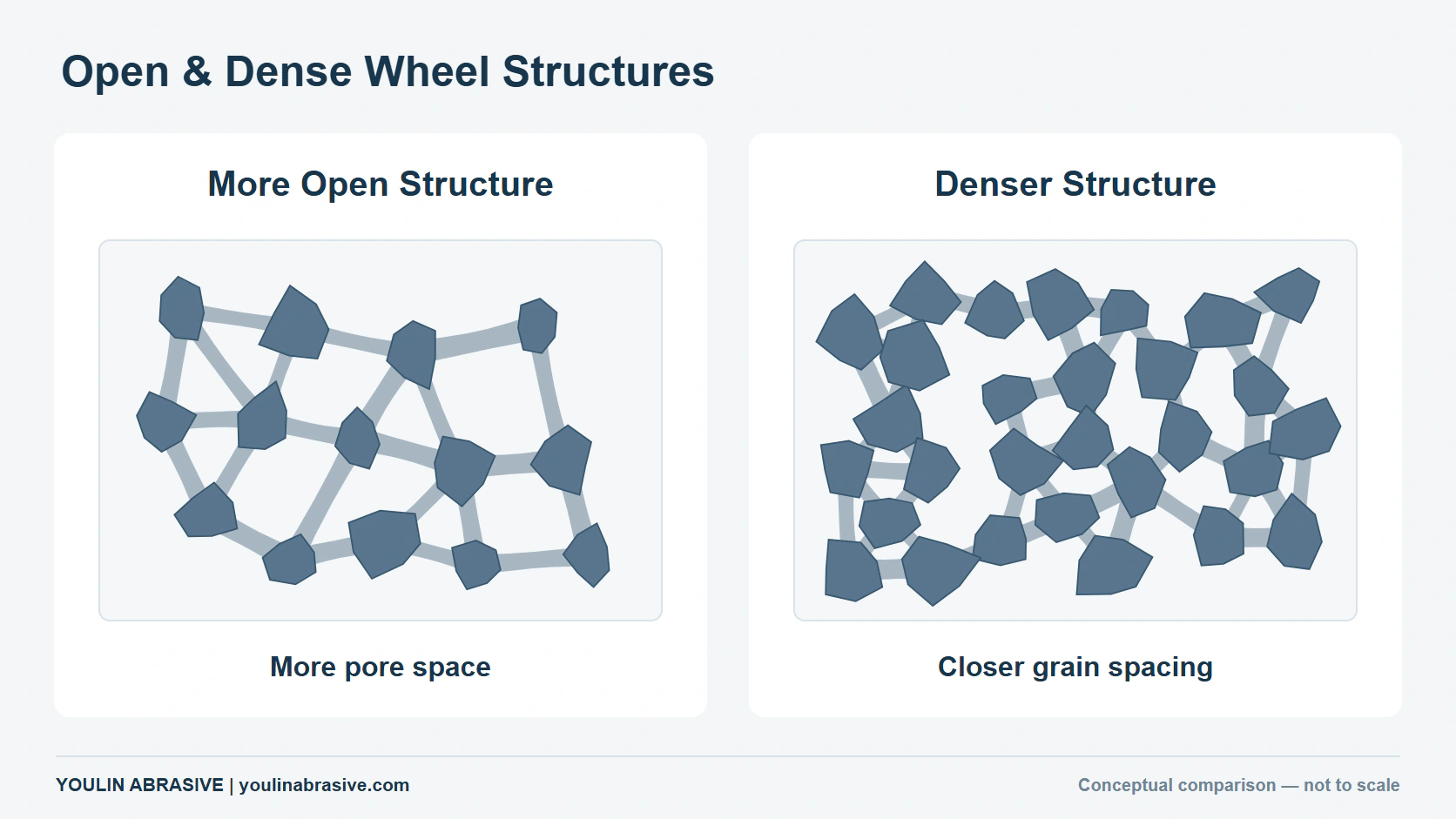
Comparison of more open and denser grinding wheel structures showing differences in grain spacing and pore space
Conceptual comparison of grain spacing and pore space. Actual wheel behavior depends on the complete specification and grinding condition.
AspectWhat a more open direction generally offersWhat a denser direction generally offers
Chip clearance at the contactMore space between grains gives removed material more room to clear the contact zone.Less space presents a more continuous abrasive surface, with less room for material to pass.
Fluid access to the contact zoneMore pore space offers more room for coolant to reach the contact and pass through it.Less pore space leaves less room for fluid at the contact, so delivery and aim matter more.
Abrasive and bond in the same volumeMore pore space means less abrasive and bond material in the same wheel volume.Less pore space means more abrasive and bond material in the same wheel volume.
How the dressed form behavesAn open face can wear the dressed form sooner in some operations.A denser face presents more material to the form, which on its own does not guarantee the form holds.
Heat at the contactMore room near the contact can carry more fluid and keep abrasive sharper over the cycle.A more continuous face can rub rather than remove if the settings or the dress leave it closed.
What it can cost at the same settingsForm retention, wear and the behaviour of the operation can change at the settings already in use.Loading and heat can become worse on an operation that is already close to either.
Diagram explaining the difference between grinding wheel grit size, grade and structure
Grit size, grade and structure describe different wheel characteristics and should be reviewed together.

Structure record

Check the structure record before requesting a wheel

A complete record shows which questions still need an answer before a structure direction can be reviewed.

1

The complete wheel marking is recorded as printed, with the abrasive, grit size, grade, structure and bond kept separate from each other.

2

The grinding operation, the workpiece material and the measured hardness are stated, and anything unknown is marked as unknown.

3

The symptom is written with its location, its timing in the cycle and the method used to inspect it.

4

The wheel face condition before and after dressing is recorded, with photos where possible.

5

Coolant, dressing and machine condition describe the same setup that produced the symptom.

6

The result the operation has to hold is written next to the measurement method used to check it.

Before the inquiry

What to send before asking for a wheel structure review

Prepare one package per grinding operation. If two operations use the same wheel marking but behave differently, send them separately.

Operation — The grinding operation and the feature being produced, such as surface, cylindrical, internal, form or profile grinding
Workpiece material — Material grade as stated on the drawing or certificate, plus heat-treatment condition
Hardness — Measured value, scale and the location where it was taken
Current wheel marking — Abrasive, grit size, grade, structure and bond as printed, with each entry identified
Wheel dimensions — Measured outside diameter, bore and width, plus the working face width and form where relevant
Wheel photos — Complete wheel, label, working face, and the face before and after dressing
Machine details — Machine model, spindle arrangement, overhang and work-holding or support condition
Process settings — Wheel speed, workpiece speed, feed, infeed, stock allowance and cycle stages in use, where known
Coolant — Fluid type, measured concentration where available, filtration state, nozzle position and whether flow reaches the contact zone
Dressing — Method, dresser type and condition, dress depth, parameters, parts between dresses and the reason a dress is called
Result required — Finish, form, size or roundness requirement from the drawing, and the method used to inspect it
Current problem — The symptom, where it appears, when it appears in the cycle and how it has changed over time
What has been tried — Changes already made to wheel, coolant, dressing or settings, and what followed each one
Trial context — Sample quantity available, expected demand if the process is confirmed, and the parts of this record still unknown

Send the wheel marking, the operation details, the machine and coolant information and the recorded symptom. We will review whether the information is sufficient for a grinding wheel recommendation.

Send Grinding Details →

FAQ

FAQ on grinding wheel structure and porosity

Questions that come up before a wheel structure direction is compared or changed.

Is an open structure always better than a dense structure?

No. An open structure offers more room for removed material and for coolant to reach the contact zone, which helps in some operations. A denser structure presents more abrasive and bond material in the same volume, which matters in others. Which direction suits an operation depends on the workpiece, the contact, the grade and bond, the coolant, the dressing practice and the result that has to be held.

Does a higher structure number always reduce loading?

No. Structure notation is tied to a manufacturer and a specification system, and loading also follows from wheel grade, bond type, coolant delivery and condition, wheel speed and feed, and whether dressing is restoring the face. Review the whole record rather than the structure value alone.

Should structure be changed before or after grit size and grade?

They describe different things and they interact. Grit size is a property of the abrasive grain, grade describes how firmly the bond holds it, and structure describes grain spacing and pore space. Changing more than one at a time makes the result hard to attribute, so agree a baseline and change one item per comparison.

Does a denser wheel always hold a profile better?

Not by itself. Profile retention depends on the dressed form, the dresser type and condition, the dressing path, the grade and bond of the wheel, the contact length, the stock being removed and the number of parts run between dresses. A denser wheel presents more material to the form but does not guarantee the form holds.

Can an open structure stop grinding burn?

Not on its own. Burn also follows from coolant type, delivery and aim, infeed and wheel speed, stock allowance and contact length, wheel grade and dressing condition. A more open face can carry more fluid near the contact and keep grain sharper, which may help, but the other factors have to be checked as well.

How does dressing affect the structure I am running?

The surface that grinds is the surface left by the last dress. Dress depth, dresser type and condition, dress speed and the number of passes decide how much bond is removed and how much grain is exposed, so a wheel can behave more open or more closed than its marking suggests. Describe the dressing practice alongside the wheel marking.

How do CBN or diamond wheels fit into a structure decision?

In superabrasive wheels the abrasive layer also carries a concentration value and a layer construction, and concentration is not the same as structure or porosity. CBN and diamond are reviewed as separate directions alongside conventional wheels rather than as automatic improvements, and diamond is not treated here as a normal recommendation for hardened steel.

Will a review confirm the right structure before we buy?

An initial review identifies missing information and the wheel directions worth comparing. Final suitability may require a sample or a controlled trial on the machine that will run the job, measured against the same inspection criteria used in production.