CBN Grinding Wheels vs Conventional Grinding Wheels: When Should You Consider Changing?

Grinding Wheel Knowledge Base

CBN Grinding Wheels vs Conventional Grinding Wheels: When Should You Consider Changing?

CBN grinding wheels are not automatically better for every grinding application. A change is worth reviewing when the workpiece material, production stability, dressing demand, heat control, profile retention, machine condition, and total grinding cost support the move—not simply because CBN has a higher purchase price or is described as a superabrasive.

Conventional grinding wheels remain suitable for many general, flexible, and lower-volume grinding conditions
CBN may be worth reviewing for hardened steel and stable precision production when dressing or profile retention limits the process
Purchase price alone does not show dressing time, wheel changes, process stability, or total grinding cost
The decision must include machine rigidity, coolant delivery, dressing capability, contact area, and trial evidence

Overview

Quick answer: change only when the process case is clear

The practical question is not whether CBN is generally better. It is whether the current conventional grinding wheel is limiting a defined, repeatable process and whether the machine, dressing system, coolant delivery, and operating conditions can support a CBN specification. For hardened ferrous materials and stable precision production, CBN may hold its grinding behavior and profile for longer intervals and may reduce dressing demand. Those benefits remain conditional on the complete application.

A conventional grinding wheel may still be the more appropriate choice when the current process is stable, production is mixed or lower in volume, the machine or dresser is not prepared for CBN, the operation needs frequent specification flexibility, or the total process case does not justify the change. Review where time and wheel volume are actually being lost—during grinding, dressing, wheel changes, rejected output, or process adjustment—before comparing wheel types.

Decision points to keep in view

  • CBN is a conditional process option, not an automatic upgrade for every application.
  • Hardened ferrous material, repeatable production, profile demand, and dressing loss can strengthen the case for a CBN review.
  • A stable conventional-wheel process may remain technically and economically suitable.
  • Compare total grinding cost and process evidence, not purchase price or wheel life in isolation.
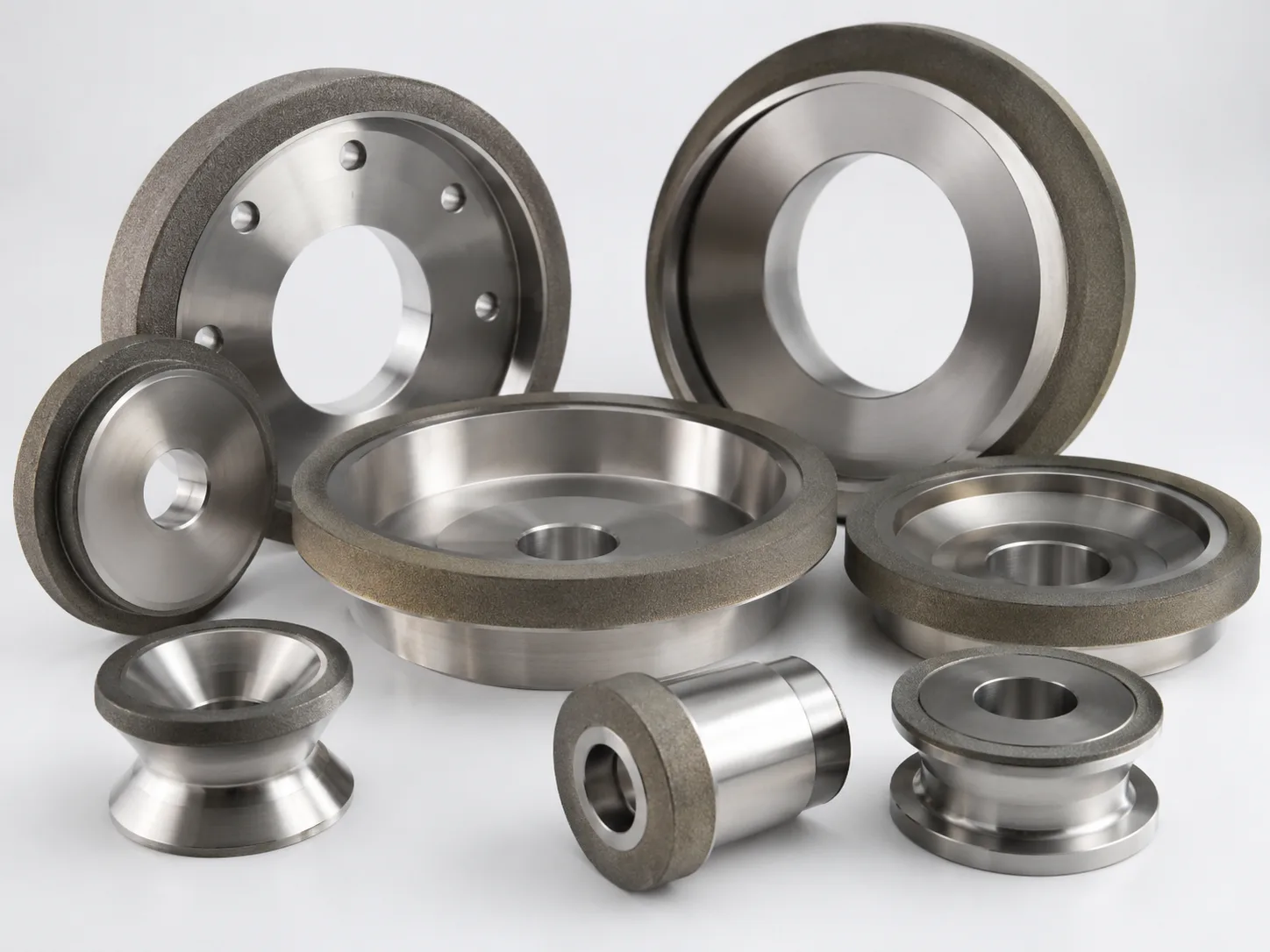
Technical comparison of a conventional grinding wheel body and a CBN grinding wheel with a metallic core and abrasive rim, with dressing, profile, coolant, and stability review icons
The wheel constructions differ, but the useful decision still depends on material, dressing, profile demand, coolant, machine support, and production stability.

What is the real difference between CBN and conventional grinding wheels?

The difference affects wheel construction, grain behavior, dressing, machine requirements, and process economics. It cannot be reduced to one claim about wheel life.

Conventional wheels renew through the abrasive-and-bond system

Aluminum oxide and ceramic conventional grinding wheels are available across a broad range of grades, structures, bonds, and shapes. Their ability to release or fracture worn grains can support general grinding, flexible production, and applications where the wheel is regularly dressed or changed.

CBN uses a superabrasive grain for ferrous material applications

CBN grain resists wear and is chemically suitable for many hardened ferrous materials. Dressable CBN wheels commonly use an abrasive layer on a core, so usable layer depth, truing, dressing, mounting, and machine capability must be reviewed differently from a conventional wheel.

The process system determines whether the difference is useful

A durable abrasive does not correct poor coolant access, unstable mounting, weak machine rigidity, unsuitable dressing, excessive contact, or uncontrolled parameters. The change only has value when the full process can use the CBN wheel consistently.

When conventional grinding wheels may still be suitable

Keeping a conventional wheel is a valid technical decision when it delivers the required result and the process does not present a clear CBN justification.

General or variable grinding work

Mixed materials, short runs, frequent setup changes, and general-purpose operations may benefit from the broad specification range and familiar dressing behavior of conventional grinding wheels.

The current result is stable

If finish, tolerance, profile, heat, dressing interval, and wheel consumption remain controlled, changing abrasive type may add trial and machine requirements without solving a defined problem.

Machine or dressing capability is limited

A machine that cannot support the required wheel speed, core mass, rigidity, mounting, coolant delivery, or CBN dressing method may not be ready for the change. The wheel should not be selected separately from the equipment.

When CBN may be worth considering

These conditions can justify a controlled CBN review, but none of them is an automatic selection rule or a fixed outcome.

Hardened steel or difficult-to-grind ferrous material

CBN is commonly considered for hardened steel and other demanding ferrous materials when a conventional abrasive loses sharpness, glazes, or cannot sustain the required process. Exact material, hardness, heat treatment, contact, and stock still matter.

Repeatable precision production

A stable, higher-volume process can make longer intervals between dressing or wheel changes more valuable. Production quantity alone is not enough; the machine, measurement method, coolant, dressing, and cycle must also be repeatable.

Profile retention, finish stability, or heat control limits output

CBN may support profile retention and consistent grinding behavior in suitable conditions. If heat or burn is the concern, first confirm coolant access, wheel-surface condition, contact area, stock, and parameters rather than treating CBN as an automatic thermal fix.

Decision Scenarios

Situations that justify a closer wheel-type review

Start from the observed process limit. Each scenario needs evidence before it supports keeping the conventional wheel, correcting the process, or testing a CBN specification.

Frequent dressing interrupts a stable cycle

Confirm why dressing occurs: dullness, loading, glazing, profile correction, or a fixed schedule. Aggressive dressing can create the apparent consumption problem.

Review CBN only if reduced dressing demand would have process value and the machine can dress the selected CBN system correctly.

Profile retention limits precision output

Check local contact, dresser path, mounting, vibration, wheel grade, and stock. A specification or process issue may be correctable without changing abrasive type.

Consider CBN when the profile demand is repeatable, the workpiece material is suitable, and stronger form retention would reduce real process loss.

Heat or burn risk remains after process checks

Verify coolant delivery, filtration, nozzle position, dressing, wheel surface, contact area, speed relationship, feed, infeed, and stock first.

A CBN review may be relevant for suitable hardened ferrous materials, but it must be tested as part of the complete thermal system.

Purchase price dominates the discussion

Purchase price does not show dressing time, changeovers, wheel consumption, profile loss, finish drift, or the cost of an unstable trial.

Compare a defined production period using the same quality requirements and record every source of process time and wheel loss.

Decision Inputs

Conditions that decide whether a wheel-type change is justified

Do not select CBN or a conventional grinding wheel from material, wheel price, or one symptom alone. The useful choice comes from the complete grinding system and the result that must be held.

Material, hardness, and heat treatment

Record the exact workpiece material and hardness. CBN is primarily reviewed for hardened ferrous materials, while material name alone is not enough to determine wheel type.

Production volume and repeatability

Record batch size, cycle stability, setup frequency, and measurement consistency. A repeatable process can make dressing and profile stability more valuable than in mixed short-run work.

Contact area, stock, and profile

Contact width or arc, interrupted contact, stock allowance, edge load, and required profile affect force, heat, wear, and the value of form retention.

Machine, mounting, and dressing readiness

Confirm spindle speed, power, rigidity, mounting space, guard condition, balancing, truing, and the available dressing system before specifying a CBN wheel.

Coolant, finish, and process stability

Coolant delivery, filtration, wheel-surface condition, finish, tolerance, burn risk, and parameter stability must be reviewed under the same operating condition.

Practical Comparison

CBN vs conventional grinding wheels: compare the process, not one feature

Use the table to define what each wheel type may contribute and what evidence must be checked before a change. The final specification remains application-specific.

Technical infographic showing purchase, dressing, wheel changes, profile retention, process stability, and process support as parts of total grinding cost
A useful comparison includes the wheel purchase, dressing, changes, profile retention, stability, and process support required under the same quality target.
Review factorConventional grinding wheelCBN grinding wheelDecision question
Material and application rangeBroad specification range for many general grinding applications, including flexible and mixed production.Primarily considered for hardened ferrous materials and demanding precision grinding conditions.What is the exact material, hardness, heat treatment, and grinding operation?
Dressing behaviorFamiliar dressing methods and regular surface renewal may fit flexible production.May allow longer intervals in suitable stable processes, but truing and dressing requirements differ by bond system.Why is dressing performed, and can the machine dress the proposed CBN wheel correctly?
Profile and wheel wearCan provide controlled self-renewal; profile retention depends on grade, structure, dressing, and load.May support profile retention and lower wear when the material and process are suitable.Is loss uniform, caused by dressing, or concentrated at an edge or profile?
Heat and burn riskCan grind stably when specification, dressing, coolant, contact, and parameters are matched.May support thermal stability in suitable hardened-steel applications; it does not eliminate burn by itself.Have coolant access, wheel surface, contact area, stock, and parameters been verified first?
Machine and process readinessOften compatible with existing conventional-wheel spindles and dressing practice.May require different speed, core support, rigidity, mounting, guarding, coolant, and dressing capability.Can the machine and operator support the complete proposed CBN process safely and consistently?
Economic reviewLower purchase price may be appropriate when output is stable and dressing or changes do not limit production.Higher purchase price may be justified when measurable process time, wheel consumption, or stability improves under trial conditions.What is the total grinding cost under the same output and quality requirement?
Six-step application review flow covering material, machine, coolant, dressing, current grinding result, and a controlled comparison trial before keeping, correcting, or testing CBN
Review the existing evidence first. The valid outcome may be to keep the conventional wheel, correct the process, or run a controlled CBN trial.

Total Grinding Cost Review

What belongs in the cost comparison

Use one stable production period and the same quality requirement. Do not convert supplier claims or one successful cycle into a fixed saving.

1. Wheel purchase and usable abrasive

Record purchase price, usable abrasive layer or wheel volume, remaining stub or core handling, and how much wheel is lost before replacement.

2. Dressing and truing time

Record dressing triggers, frequency, passes, compensation, dresser wear, and machine time. CBN may reduce dressing demand in suitable applications but also needs an appropriate dressing method.

3. Wheel changes and setup

Include mounting, balancing, alignment, warm-up, trial pieces, and time needed to restore a stable process after a wheel change.

4. Profile, finish, and dimensional stability

Track how long the wheel holds the required profile, finish, tolerance, and dimensional trend—not only how long the wheel remains on the machine.

5. Coolant, filtration, and process support

Include any nozzle, pressure, filtration, dressing, guarding, spindle, or operator changes needed to run the proposed CBN process correctly.

6. Controlled trial evidence

Compare wheel loss, dressing loss, cycle stability, quality, heat, and interruptions under documented conditions. Avoid changing several process variables at once.

Controlled Change Review

What to check before changing from a conventional wheel to CBN

Use this sequence to separate a true wheel-type limitation from a specification, dressing, coolant, machine, or parameter issue. Do not change wheel type and several process variables at the same time.

1. Copy the complete current grinding wheel specification and record wheel size, shape, abrasive, bond, grit, grade, structure, and operating speed when known.

2. Confirm workpiece material, hardness, heat-treatment condition, batch consistency, grinding position, contact area, stock, and required profile.

3. Document the current problem: dressing reason and frequency, wheel wear, profile loss, finish drift, dimensional variation, heat, burn marks, loading, or glazing.

4. Check machine speed, power, rigidity, mounting, guarding, balancing, vibration, and whether suitable CBN truing and dressing equipment is available.

5. Review wet or dry grinding, coolant type and condition, filtration, pressure, nozzle position, flow, and chip removal at the grinding zone.

6. Define the comparison period and record wheel use, dressing time, wheel-change time, cycle stability, finish, tolerance, profile, and interruptions under the same requirement.

7. If a trial is justified, change one controlled factor at a time and review the complete result before confirming a production specification.

Application Review Information

What to provide before reviewing a change to CBN

Provide confirmed information and mark unknown items clearly. The purpose is to review the grinding wheel condition and application details together, not to select CBN from wheel size, material name, or purchase price alone.

  • Material and hardness

    Exact grade when known, heat-treatment condition, coating or scale, and any recent material change

  • Wheel size and shape

    Outside diameter × bore × thickness, plus wheel profile and abrasive-layer dimensions where applicable

  • Photos or drawing

    Current wheel, label, grinding wheel surface before dressing, workpiece surface, and a dimensioned wheel drawing when available

  • Current wheel specification

    Abrasive, bond, grit, grade, structure, shape, concentration, and operating speed when known

  • Machine and grinding position

    Manufacturer and model when available, spindle speed, power, mounting, balancing, rigidity, guarding, vibration, grinding position, contact area, stock, cycle stages, and any concentrated edge or profile load

  • Coolant condition

    Wet or dry grinding, coolant type and condition, filtration, pressure, nozzle position, delivery, and chip-removal observations

  • Dressing and truing condition

    Tool, tool condition, method, depth, feed, passes, compensation, trigger, frequency, and reason for each dressing event

  • Grinding parameters

    Wheel speed, work speed, feed, infeed or depth, traverse, stock-removal stages, and cycle information when known

  • Current problem

    When it appears, including frequent dressing, rapid wear, profile loss, finish drift, dimensional variation, heat, burn marks, loading, or glazing

  • Finish and tolerance requirements

    Required surface finish, tolerance, profile, roundness, flatness, or other acceptance requirement when available

  • Production volume and trial quantity

    Current output, setup frequency, expected trial quantity, measurement method, and preferred contact method if clarification is needed

Share workpiece and grinding wheel surface photos, material and hardness, grinding wheel size, current wheel specification, dressing condition, coolant condition, and basic grinding parameters so we can review the grinding wheel condition and application details.

Send Grinding Details

Industrial Grinding Contexts

Where this wheel-type decision may arise

These are grinding application contexts only. Youlin Abrasive supplies grinding wheels, abrasive tools, and grinding wheel solutions; it does not supply bearings, hydraulic parts, molds, automotive parts, machine components, precision parts, or customer workpieces.

Bearing grinding application contexts
Hydraulic component grinding application contexts
Automotive component grinding application contexts
Hardened mold and die grinding application contexts
General precision grinding application contexts

FAQ

Questions before changing wheel type

Use these answers to frame an application review rather than treating CBN as an automatic replacement for a conventional grinding wheel.

Are CBN grinding wheels always better than conventional grinding wheels?

No. CBN may be valuable for suitable hardened ferrous materials and stable precision production, but conventional grinding wheels remain appropriate for many general, flexible, and lower-volume applications. Machine capability, dressing, coolant, contact, quality demand, and total grinding cost determine whether a change is justified.

When may a conventional grinding wheel still be the better choice?

A conventional wheel may remain the better choice when the current process is stable, the work is mixed or short-run, frequent specification flexibility is needed, or the machine and dressing system are not prepared for CBN. Keeping a process that already meets finish, tolerance, profile, and cost requirements is a valid decision.

Can a CBN grinding wheel reduce dressing frequency?

It may reduce dressing demand in suitable, stable applications because CBN can retain grinding behavior and profile for longer intervals. The result depends on material, bond system, wheel specification, dresser, machine rigidity, coolant, contact, and parameters. CBN wheels may also require a different truing and dressing method.

Will changing to CBN eliminate grinding burn?

No wheel type can guarantee that. CBN may support thermal stability in suitable hardened-steel applications, but burn can also come from coolant delivery, a closed or loaded wheel surface, large contact, excessive stock, speed relationship, feed, infeed, or machine instability. Check those conditions before changing wheel type.

How should total cost be compared?

Compare the same production period and quality requirement. Include wheel purchase and usable abrasive, dressing and truing time, dresser use, wheel changes, setup, profile and finish stability, rejected output, coolant or machine changes, and interruptions. Do not use purchase price or one cycle result as the whole economic case.

What information is needed before changing from a conventional wheel to CBN?

Provide material and hardness, grinding wheel size and complete current specification, clear wheel and surface photos, machine model and speed, grinding position and contact, wet or dry condition, coolant delivery, dressing tool and frequency, basic grinding parameters, current problem, required finish or tolerance, production volume, and expected trial quantity.
WhatsApp Inquiry