Creep Feed Grinding Wheel Selection: What Changes with Stock Removal, Coolant and Dressing?

Grinding Wheel Knowledge Base

Creep Feed Grinding Wheel Selection: What Changes with Stock Removal, Coolant and Dressing?

A wheel that holds its form and finishes well in shallow-pass grinding is not automatically the right wheel once the engagement gets deep and the contact between wheel and workpiece gets long. Creep feed grinding takes the allowance in one or a few slow, deep passes instead of many fast shallow ones, so any given region of the wheel face stays in contact with the material far longer. That single change propagates outward — into chip accommodation, coolant access, grit, grade, bond and dressing. This guide is about how wheel selection has to be reviewed under that condition. It is not an introduction to the process.

Creep feed removes the allowance in one or a few deep, slow passes, so the wheel stays in contact with the work far longer than in reciprocating grinding
The longer contact raises chip accommodation, heat removal and coolant access demands at the same time, not one after another
A specification that worked in shallow-pass grinding is being asked a different question, not a harder version of the same one
Structure, grit, grade and bond interact — changing one moves the others
Coolant reaching the grinding zone and coolant being switched on are two different conditions

Overview

About Creep Feed Grinding Wheel Selection: What Changes with Stock Removal, Coolant and Dressing?

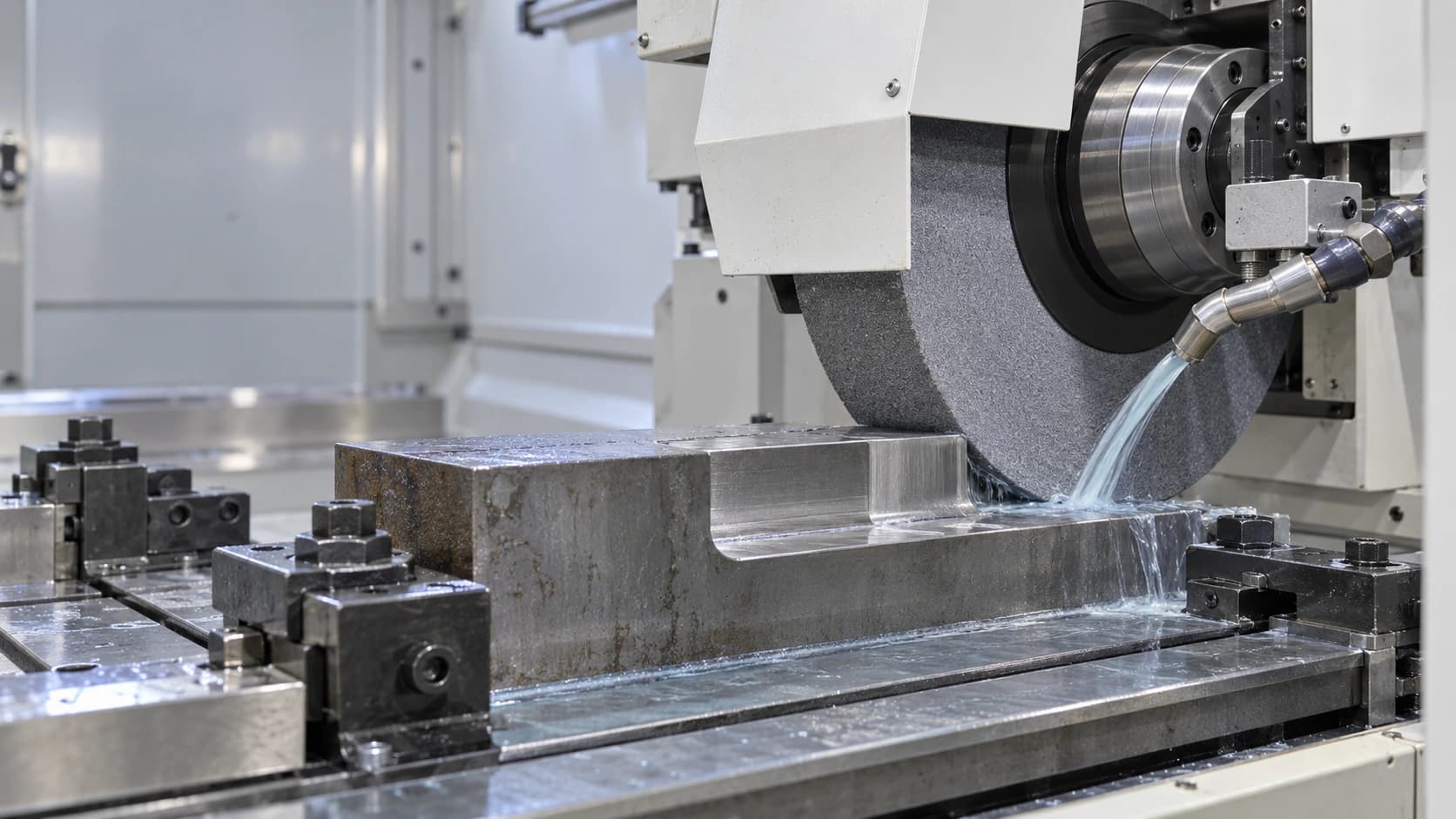
In creep feed grinding the wheel is set to a deep engagement and the workpiece is fed slowly past it, so the full allowance comes off in one pass or a few. Reciprocating grinding works the other way round: many fast, shallow passes. These are not two difficulty levels of one operation. They place the wheel in contact with the material for very different lengths of time, and most of what follows in this guide traces back to that difference.

That difference turns wheel selection into a system review rather than a sequence of settings. A longer contact means more abrasive is cutting at once, more material has to be cleared along the contact, and more heat is generated inside a zone that also has to be kept supplied with coolant. Address one of those and the others move. This is why a creep-feed wheel question is rarely answered well by changing a single value in an existing specification.

General wheel selection, general structure and porosity selection, coolant troubleshooting and dressing are each covered in their own guides. This one is narrower: what the creep-feed condition changes about the review, and which parts of an existing specification stop being reliable.

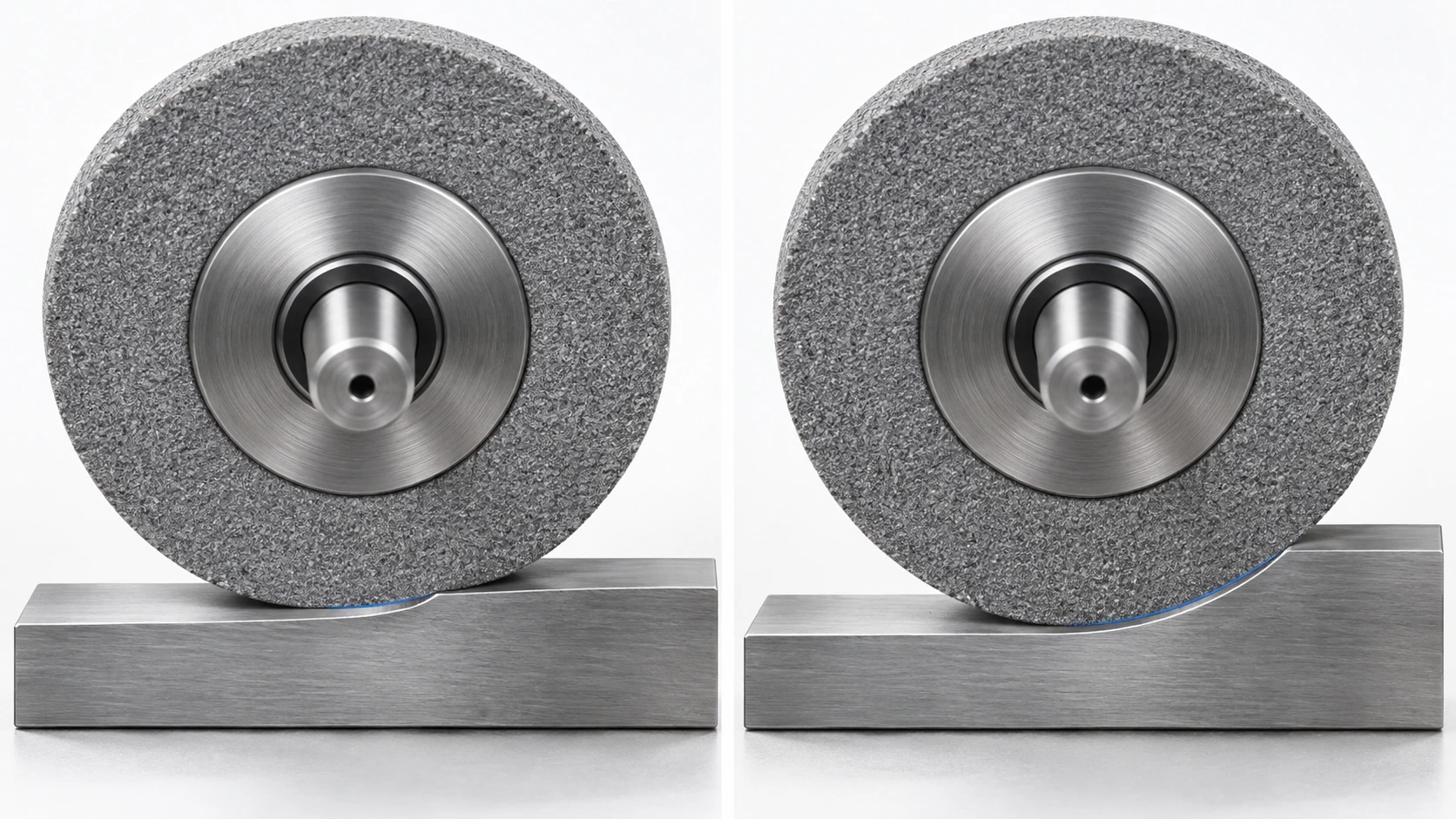
Side-by-side comparison of grinding wheel engagement: on the left the wheel makes shallow contact with a steel block, on the right the same wheel sits deeper in the block with a visibly longer contact arc.
The same wheel and the same block in both panels — the difference is how deep the wheel sits and how long the contact runs, not which one is better. A shallow engagement and a deep one suit different classes of grinding operation.

What a creep-feed contact asks of the wheel

Creep feed is defined by the relationship between how deep the wheel engages and how fast the work moves past it. It is not defined by a number on a settings page.

The process shift, stated plainly

In creep feed grinding the wheel takes a deep engagement at a slow workpiece feed and removes the allowance in one or a few passes. Reciprocating grinding does the opposite — many fast, shallow passes. The consequence that matters for wheel selection is contact time: with a deep engagement, each part of the wheel face stays engaged with the material much longer, and so does each part of the workpiece.

Why contact time is the consequential part

A longer contact changes how chips form and how they clear, how heat is generated within the zone and how much of it can be carried away, and how much of the wheel face is working at any instant. These are not independent problems. They are consequences of the same geometric change.

The demands arrive together

Chip accommodation, coolant access and heat removal all become more demanding at the same time. A wheel change made to improve one of them alters the others. That is the reason this is treated as a system review rather than a list of settings to optimise separately.

What the process does not decide on its own

It is worth being explicit about what creep feed does not determine. It does not name an abrasive, a bond, a grit, a grade or a structure. It changes the questions those choices have to answer. Two creep-feed jobs in different materials, on different machines, with different profile requirements, can reasonably arrive at different specifications — and often do.
What carries over from an existing wheel specification, and what does not

Most creep-feed wheel questions arrive as a change to a process that already runs. Separating the parts of the current specification that stay meaningful from the parts that were answering a different question makes the review much shorter.

What tends to carry over: material compatibility

The relationship between an abrasive and a workpiece material does not change because the engagement got deeper. If a superabrasive is chemically wrong for a material in shallow-pass work, it is still wrong in creep feed — the incompatibility is a property of the abrasive–workpiece pair, not of the depth of cut. This is the most reliable thing to carry across.

What tends to carry over: the reasoning behind the abrasive route

The factors that led to a conventional or a superabrasive choice — material hardness and condition, volume, machine capability, cost per part — still apply. Creep feed changes what the wheel is asked to do. It does not change what the part is made of or what the machine can support.

What does not carry over: structure and grade chosen for short contact

This is where transfer breaks down most often. A structure and grade that suited many brief, fast passes were answering a question about load per cutting edge and chip clearance over a short engagement. A deep engagement with a long contact poses that question differently. The existing values are a reasonable starting point for review — they are not a baseline to preserve.

What does not carry over: grit chosen around finish alone

In profile creep-feed work, grit size is frequently governed by the smallest form radius the wheel has to reproduce rather than by the finish target alone; wheel manufacturers commonly state the relationship that way. Where form radius is the binding constraint, carrying a grit over from a finish-driven shallow-pass specification can produce a wheel that cannot hold the form.

What does not carry over: the cooling assumption

A coolant arrangement that was adequate for short engagements is not evidence that coolant reaches the zone in a longer one. This is treated separately below, because it is the factor most often assumed rather than verified.

Why the separation is worth doing explicitly

Naming what transfers keeps the review from turning into a full re-specification every time. In practice the material and abrasive-family decisions usually stand, and the review concentrates on structure, coolant access, grit, grade and how the wheel will be kept in condition.

Chip space and wheel structure: why they come up first, and what they trade away

Structure is usually the first wheel property raised in a creep-feed discussion, and it is also the one most often stated as a rule. The underlying reason is sound. The rule is not.

The reason structure is raised

A longer contact puts more abrasive into the cut at once and removes more material along that contact. The wheel needs somewhere for chips to go and a path for coolant to reach the working face. Pore space in the wheel provides some of both, which is why open, high-porosity structures are widely reported as a direction used in creep-feed wheels.

Why it is not a rule

Pore space is not free. In general terms, a more open structure carries less bond and abrasive in the volume doing the work, and that bears on wheel strength, on how well the wheel holds a profile, and on the finish it produces. A more open wheel is not automatically a better creep-feed wheel. It is a different set of trade-offs.

The trade-offs have to be weighed against the job

Where a form has to be held tightly across a long run, or where the form radius is small, the cost of extra openness can outweigh the coolant and chip-clearance benefit. Where the operation is a deep, straight slot in a material that is difficult to grind, the balance can move the other way. Which way it moves depends on the application, not on the process name.

Why "creep feed requires a porous wheel" is the wrong rule

Stated as a rule, that sentence skips the part that decides the outcome — what the pore space is being asked to do, and what is being given up to get it. It also converts a direction into a requirement, and implies one answer where the useful output is a reasoned balance.

Boundary

What wheel structure and porosity are, and how structure differs from grit size and grade, is covered in the dedicated structure and porosity guide. The point here is narrower: creep-feed conditions are one of the situations in which structure stops being a background setting and becomes an active decision.

Coolant access is a wheel-selection input, not a machine afterthought

Coolant is often treated as a machine setting that gets settled once the wheel has been chosen. In creep-feed work that order tends to be wrong.

The distinction that matters

Coolant being present at the machine and coolant reaching the grinding zone are two different conditions. A system can be running, at pressure, with clean fluid, and still not be delivering effectively to the interface where the work is happening — because of where the jet is aimed, what sits between the nozzle and the contact, and how stable the delivery is through the pass.

Why the creep-feed condition raises the stakes

With a long contact and a deep engagement, more heat is generated inside the zone and there is a longer contact to keep supplied. How much of that heat the coolant can carry away depends first on whether it arrives at all. Manufacturers of creep-feed grinding systems are consistent on this point: coolant has to be directed at the work–wheel interface, and the consequences of it not being are immediate rather than gradual.

Why this belongs to wheel selection

The wheel and the coolant arrangement are not independent choices. Pore space and structure affect how fluid moves into and through the contact; the delivery arrangement decides whether the fluid gets there. A structure chosen for coolant transport is of limited use if delivery never reaches the face. This is why structure and coolant are reviewed together rather than in sequence.

What this section does not cover

Diagnosing a coolant system that is present but ineffective — nozzle position, jet stability, flow and pressure, fluid condition — is a troubleshooting subject with its own guide. The point here is only that coolant access has to be established while the wheel is being selected, rather than assumed and corrected afterwards.

The variables involved

Delivery position, how the jet is aimed relative to the contact, whether delivery stays stable through the pass, and whether the machine can support the arrangement the wheel needs are all part of the selection picture. None of them can be settled from a general rule; they depend on the machine and the operation.

Why changing grit or grade alone tends to mislead

When a creep-feed job underperforms, the reflex is often to move one setting — usually grit or grade. That is the change least likely to explain the result, because both properties are entangled with structure and bond.

Grit: what it is actually doing

Grit size sets the scale of the cutting edges and the amount of space between them. It interacts with how much material is being removed, the workpiece material, the contact condition, the finish requirement and the smallest radius the wheel has to reproduce. Moving grit alone changes the chip space as well as the cutting edge, which is one reason the outcome of a one-value change is hard to attribute.

Grade: what it is actually doing

Grade describes how firmly the bond holds the abrasive. Together with the rest of the specification it governs how the wheel behaves as grains dull — whether they release and expose fresh edges or stay in place. Because a long contact spreads the work across many more cutting edges at once than a shallow pass does, the load carried by each edge is a different question than it was. That is a reason to re-reason about grade. It is not a reason to assume a direction.

Why one-variable changes are hard to read

Grit, grade, structure and bond are not four independent dials. Structure and grit together set how much space exists between cutting edges; grade and bond together set how firmly the abrasive is held. Change grit and the effective chip space changes with it. Change structure and the material carrying the profile changes. A single-variable change produces a result that cannot be credited to that variable.

What to do instead

The more useful move is to state what the wheel is failing at — losing form, loading, burning, missing finish, wearing out early — and then ask which combination of specification areas could produce that behaviour. That keeps the change matched to the observation rather than to a habit.

Why no grit number or grade letter is given here

There is no dependable mapping from "creep feed" to a grit number or a grade letter. The answer moves with the workpiece material, the machine, the profile, the coolant arrangement and the accuracy required. A figure quoted without those conditions attached is not transferable, and treating it as a starting point is how the wrong wheel gets ordered.

Where dressing and machine capability bound the answer

Two constraints sit outside the wheel specification but decide whether it can work at all: how the wheel is kept in condition, and what the machine can actually support.

Dressing as a process variable, not a maintenance task

In creep-feed work the wheel face condition is part of the process, because the wheel stays in contact with the work for a long time. Whether the face keeps cutting or progressively dulls across the engagement bears directly on force, heat and the result. How the wheel is dressed, and how often, therefore belongs to the selection picture rather than to the period afterwards.

Continuous dressing

Continuous dressing — dressing while grinding, so the face is kept sharp through the pass — is a documented strategy in creep-feed production. It changes what the wheel is being asked to do, because the face is continuously renewed instead of holding its condition on its own across the whole engagement. It also requires a machine that supports it. Where it is available, it widens the range of wheel specifications worth considering; where it is not, the wheel has to hold its condition for longer unaided.

The dressing boundary

This guide does not cover how often to dress, which dressing tool to use, or why a wheel can perform differently after dressing. Those are separate subjects with their own guides. What matters here is that dressing capability is an input to wheel selection in creep-feed work, because a specification that assumes continuous renewal needs a machine that can supply it.

Machine capability is not a footnote

Creep-feed grinding places demands on spindle stiffness, machine power, feed capability, the coolant system, the dressing system and overall process stability. A specification that would perform on a suitably equipped machine may be unusable on one that is not. Machine capability is one of the conditions the wheel is selected against, not an implementation detail to sort out later.

Why no machine figures are given

Required power and stiffness follow from the material, the contact, the removal rate and the wheel being used. Quoting a number without those conditions attached would mislead rather than inform.

Conventional or superabrasive: evaluate, do not assume

Creep feed is sometimes treated as a superabrasive application by default. In production the more common position is the opposite.

The default is still conventional

Conventional abrasive wheels remain widely used in creep-feed grinding, largely because the cost per wheel is far lower than for a superabrasive wheel of comparable size, and because a conventional wheel can often do the job. Where the operation allows it, starting conventional and moving to a superabrasive only if wear, form-holding or heat damage justify the change is a common production sequence.

When a superabrasive becomes worth evaluating

CBN is evaluated where the material is hard or difficult enough to warrant it, and where the machine can actually use it — adequate stiffness and power, a truing or dressing arrangement that suits the wheel, appropriate coolant, and a process stable enough to show the benefit. Those conditions are the reason to evaluate CBN. The fact that the operation is creep feed is not.

The diamond boundary

Diamond is not used on ferrous work. At grinding temperatures diamond reacts chemically with iron, so a diamond wheel cutting steel wears through a mechanism that has nothing to do with how hard diamond is. Diamond belongs to non-ferrous and non-metallic work — carbide, ceramics, glass and similar — and that boundary does not move because the engagement is deeper.

The chemical boundary is a property of the pair

The same logic applies to conventional abrasives. Silicon carbide is not the right abrasive for nickel-based alloys, because of how it behaves chemically with those materials at grinding temperature. These are material-pair constraints, and process conditions do not override them.

Why the process name is not a selection criterion

Neither "creep feed" nor "high production" selects an abrasive on its own. The abrasive follows from the workpiece material and its condition, the machine, the wheel construction, the accuracy and form requirements, the coolant arrangement and the economics of the operation. Engineered ceramic abrasives, for instance, are reported to match or exceed superabrasive performance in some operations — which is an argument for testing the assumption in both directions, not for preferring either.

When both look plausible

Where a conventional wheel and a superabrasive both seem reasonable, the deciding factors are usually cost per part, the consequences of wheel wear on the form, whether the machine can exploit the harder abrasive, and whether the process will run long enough to justify the change.

Reviewing a creep-feed application in practice

A short note on how this reads in application review work, offered as practical experience rather than as a rule.

Read the conditions together

When a creep-feed application is reviewed, the wheel specification should not be changed from one variable alone. The drawing and the form it requires, the current wheel and how it is behaving, the workpiece material and its condition, the stock to be removed, the finish requirement, the coolant arrangement, the dressing setup and the machine all need to be read together before a direction is chosen. Any one of them can turn out to be the binding constraint.

Start from the observation, not the setting

It also helps to begin from what the process is actually doing — where the wheel is losing form, whether the surface is acceptable, how the face looks after a pass, how the coolant is arriving — rather than from a specification value to adjust. The observation usually narrows the field faster than a change does, and it avoids replacing a specification area that was never the constraint.

Advantages

What the process change actually alters

Creep feed does not change what a grinding wheel is. It changes the conditions the wheel is chosen against. These are the areas where that shows up.

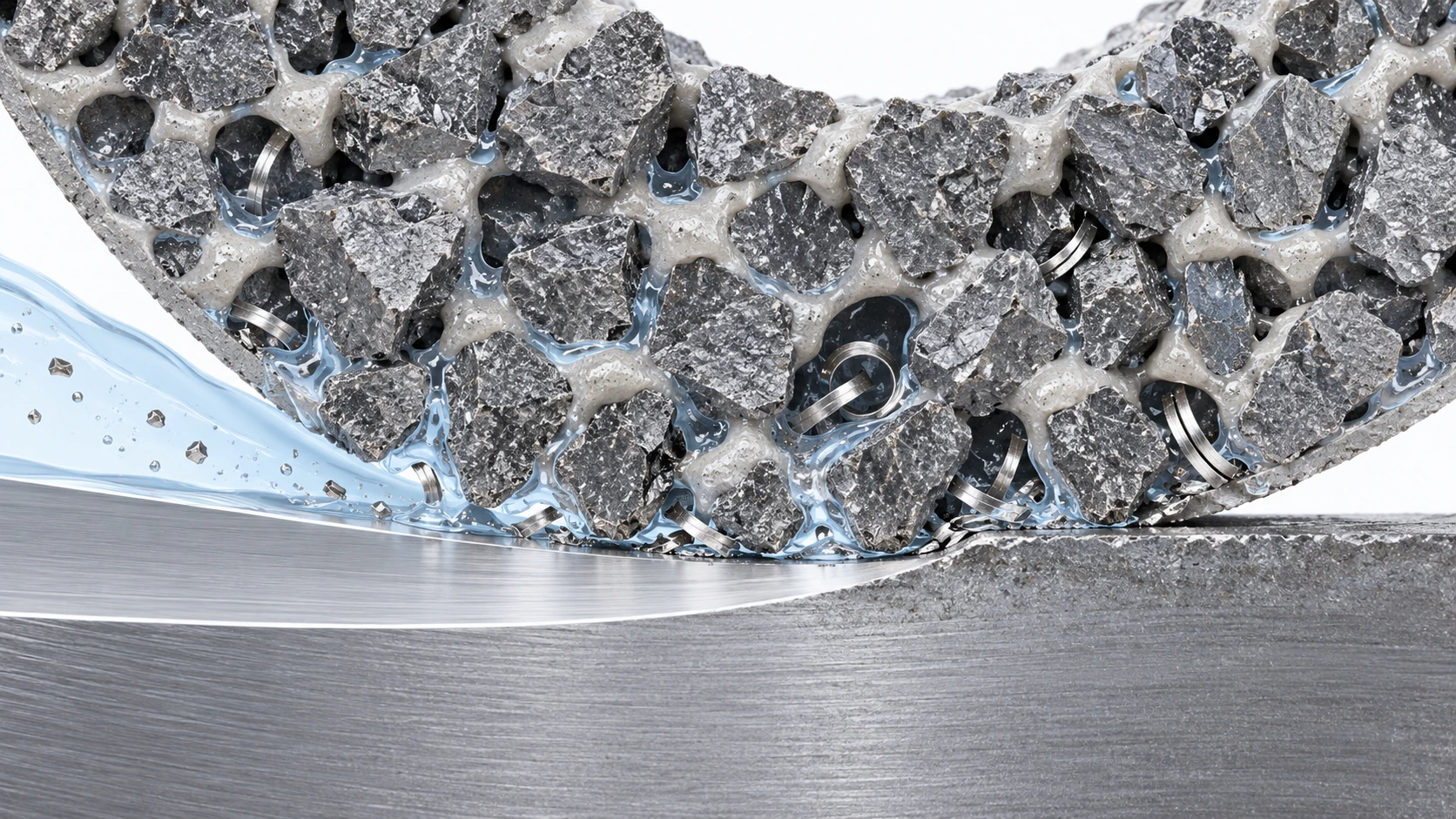
Magnified cutaway of a grinding wheel at the point of contact, showing angular abrasive grains held in bond, pore space between them, metal chips in the voids, and coolant moving through the structure.
A magnified conceptual view, not to scale. Pore space gives chips somewhere to go and gives coolant a path to the working face, which is why structure comes up in creep-feed work. How open a wheel should be is a trade-off against wheel strength, profile retention and finish — not a value to maximise.

Chip accommodation

More abrasive in the cut at once, and more material removed along the contact, place a different demand on the space available for chips.

Coolant access to the contact

A longer contact has to be kept supplied, and the fluid has to reach the interface rather than merely be present at the machine.

Load per cutting edge

A long contact spreads the work across many more edges than a shallow pass does, which changes the question grade is answering.

Form and profile retention

Where the wheel carries a form, the trade-offs in structure and grit are constrained by the smallest radius that has to be reproduced.

Wheel condition through the engagement

Because the wheel stays in contact for longer, whether the face keeps cutting across the pass becomes part of the process rather than a maintenance interval.

Before You Inquire

Reading the conditions before changing the specification

A creep-feed wheel question is easier to answer as a description of the part, the machine and the current behaviour than as a request for a specification. The items below are what allow a direction to be read against the actual operation.

Workpiece material and condition — Material grade and hardness, and whether the part is already heat-treated
Part drawing or profile — The form the wheel has to reproduce, including the smallest radius
Current wheel specification — Marking, dimensions and construction details where readable
Stock removal requirement — How much material is being removed, and in how many passes
Finish and accuracy requirement — The surface and dimensional requirements the operation has to hold
Machine details — Spindle power and stiffness, feed capability, and what the machine can support
Coolant arrangement — How coolant is delivered, where it is aimed, and whether delivery is stable through the pass
Dressing setup — Whether the machine dresses continuously or between passes, and with what
Current behaviour — What the wheel is doing now: form loss, burning, loading, finish, or life

Where a value is not known, marking it as unknown is more useful than estimating it. The purpose is to establish what the process is asking of the wheel, not to complete a form.

Send Grinding Details →

FAQ

Common questions about creep feed grinding wheel selection: what changes with stock removal, coolant and dressing?

Quick answers to common buyer questions before sending an inquiry.

What grinding wheel is used for creep feed grinding?

There is no single specification. Conventional abrasive wheels remain widely used in creep-feed grinding, largely because they cost far less than a superabrasive wheel of comparable size and can often do the job. Where a superabrasive is justified, it is justified by the workpiece material and its condition, and by whether the machine can support it — not by the process name. The specification follows from the material, the machine, the profile, the coolant arrangement and the accuracy required.

Does creep feed grinding require an open-structure wheel?

Open, high-porosity structures are widely reported as a direction used in creep-feed wheels, because a longer contact needs somewhere for chips to go and a path for coolant to reach the face. But it is a trade-off rather than a requirement. Pore space carries less bond and abrasive in the volume doing the work, which bears on wheel strength, profile retention and finish. How much openness is right depends on the form being held, the form radius, the material and the coolant arrangement.

Why is coolant delivery more important in creep feed grinding?

A deep engagement with a long contact generates more heat inside the grinding zone and leaves a longer contact to keep supplied. How much of that heat the coolant can carry away depends first on whether it reaches the work–wheel interface at all. Coolant being present at the machine, at pressure and clean, is not evidence that it arrives where the grinding is happening — which is why delivery is established during wheel selection rather than assumed and corrected afterwards.