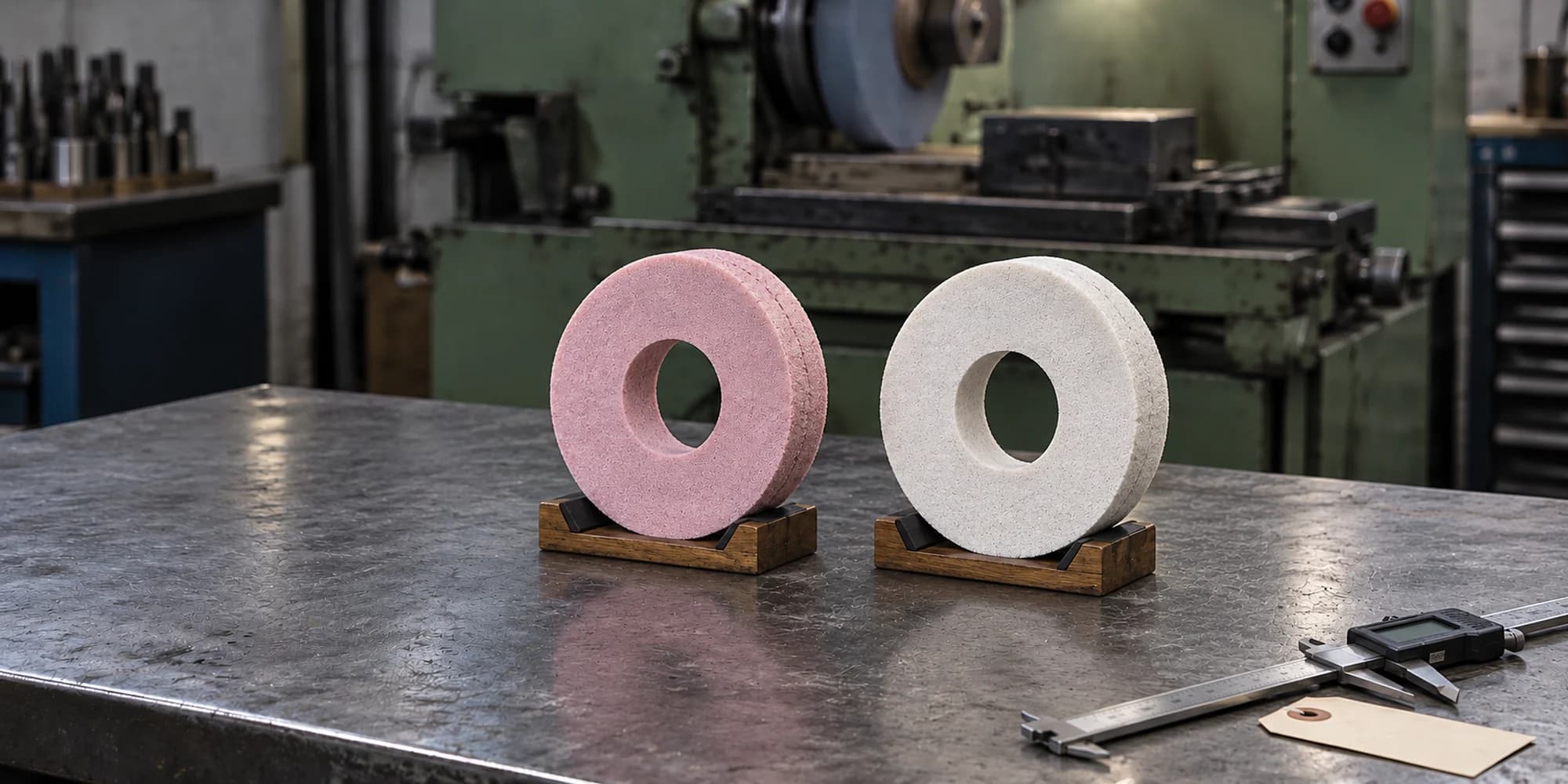
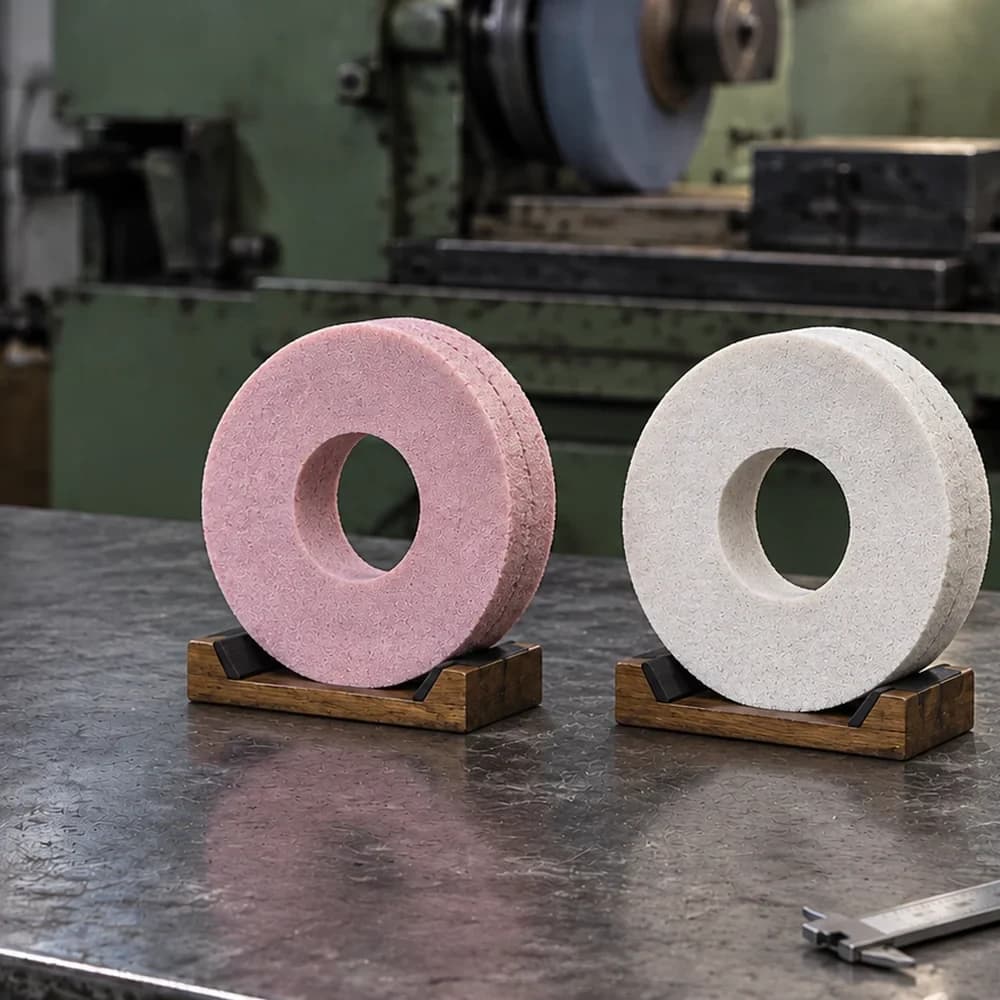
Pink and white vitrified aluminum oxide grinding wheels side by side on an industrial workbench for abrasive selection comparison.

Grinding Wheel Knowledge Base

Pink vs White Aluminum Oxide Grinding Wheels: How to Choose for Precision Grinding

Pink and white vitrified aluminum oxide grinding wheels side by side on an industrial workbench for abrasive selection comparison.

For example, two wheel markings can look almost identical: PA 46 K and WA 46 K, same dimensions, same grit, same grade letter. The price difference may be small. The color is the only obvious difference — and it is the least reliable part of the decision. This guide separates the grain difference from the wheel specification, then sets out a controlled trial. It does not claim that pink is universally longer-lived, more precise, or cheaper than white.

WA tends to be more friable and can cut cooler, but may wear faster.
PA tends to be tougher and may hold form or edge longer, but can dull or burn in the wrong grade.
Grain toughness and wheel grade are different properties; the grade letter decides grain retention.
Read the full marking and compare both wheels under the same acceptance criteria.

Illustrative industrial scene — AI-generated, not a customer or factory record. Color is not a complete wheel specification.

Overview

Color is a clue, not a specification

White aluminum oxide (WA) and pink aluminum oxide (PA) are both fused alumina grain families. The useful difference is not the color itself. It is how the grain fractures under load, how strongly the bond holds it, and what the wheel does at the contact zone.

The same “PA” or “WA” label can hide different purity, chromium content, grain shape, bond, grade, structure, and manufacturing history. Those differences can change finish, burn risk, dressing frequency, form retention, and cost per good part. A color comparison without the full wheel marking is not a specification comparison.

What to settle before comparing pink and white wheels

  • Color is a supplier clue; the wheel marking and full specification decide what is actually being compared.
  • Friability is a grain property; wheel grade is how strongly the bond retains the grain.
  • A softer grade is not a universal correction; it can increase wear or lose profile.
  • Use a controlled trial with the same acceptance criteria; do not choose from color alone.

Start with the wheel marking, not the color

A grinding wheel marking is a compact specification. It usually identifies the abrasive type, grit size, grade, structure, and bond. The color is a supplier clue, not a controlled classification.

What the marking can tell you

“PA” and “WA” are common grain designations, but they are not a single global standard. One manufacturer’s PA may have a different chromium content, grain shape, or toughness than another’s. Even an alphanumeric code such as 57A can mean different grains at different suppliers. Ask for the grain designation, grit, grade, structure, bond, dimensions, and the supplier’s technical data.

What the marking cannot tell you

The marking does not tell you whether the wheel will glaze on your workpiece, how much coolant reaches the contact zone, or whether the machine can support the wheel. It also does not reveal the exact chemistry behind a color. If the marking is missing or unreadable, treat the color as a starting clue, not a specification.

The manufacturing side

In vitrified wheel manufacturing, the temperature control curve and bond process can affect bond development and how uniform the finished wheel hardness is. That manufacturing curve is not the grinding-zone thermal trend. Two wheels with the same PA grain but different bond, grade, and manufacturing history are not the same wheel.

Friability is a grain property; wheel grade is a bond decision

Friability describes how easily an abrasive grain fractures under grinding force. A friable grain breaks down and presents new sharp edges. A tougher grain resists fracture and stays in the bond longer.

White grain tends to fracture more readily

White aluminum oxide is generally the more friable of the two. It is often chosen where the wheel needs to keep cutting freely and avoid excessive heat. The trade-off is faster grain breakdown and potentially faster wheel wear. A fine WA grit in a hard grade can still glaze, and a poorly dressed WA wheel can rub and burn.

Pink grain tends to resist fracture longer

Pink aluminum oxide is generally tougher. In many products it is white fused alumina modified with chromium oxide; supplier formulations vary. It may hold form and edge longer than white grain in a comparable wheel, which can reduce dressing frequency or improve profile retention. It can also keep dull grain in the cut too long if the bond is too hard or the coolant cannot control the heat.

The grade can reverse the expected behavior

Grain toughness is a property of the abrasive. Wheel grade is how strongly the bond retains the grain. A WA grain in a hard grade may not release when it dulls; a PA grain in a soft grade may release before its toughness helps. A softer grade is not a universal correction either: it can increase wear, lose profile, or change the grinding response. Use it only when the evidence points to excessive grain retention.

Grain behavior: fracture and retention

Conceptual comparison of white aluminum oxide grain fracturing more readily and pink aluminum oxide grain resisting fracture longer; color alone does not determine wheel performance.

WA

White aluminum oxide

More friable

  • grain fractures more readily
  • fresh cutting edges are exposed
  • tends to cut cooler
  • may wear faster or lose form sooner
  • selection is conditional on grade, bond, structure, coolant and contact.
PA

Pink aluminum oxide

Generally tougher

  • often white fused alumina with chromium oxide
  • resists fracture longer
  • may hold form and edge longer
  • can dull, load or burn if grade/coolant are wrong
  • supplier formulation varies.
Not a universal ranking. Grain toughness and wheel grade are different properties. Read the full wheel marking and test under the same acceptance criteria.

Where white aluminum oxide tends to fit

WA is often the first direction when the limiting problem is heat or glazing after the dressing and coolant have been checked. Its friability helps the wheel face renew itself, which can keep cutting forces lower and reduce burn risk on heat-sensitive work.

Heat-sensitive hardened and tool steels

WA is commonly considered for hardened tool steels, high-speed steel, and finishing operations where burn risk and surface integrity matter. It can be a useful starting point for light-to-medium stock removal when a free-cutting wheel is more important than maximum form retention.

Wide or continuous contact

A wide or continuous contact area concentrates heat. A cooler-cutting grain may help, but the grade, structure, coolant delivery, and machine condition still decide the result. WA is not automatically better for finish; a fine grit in a hard grade can glaze, and a wheel that is not dressed sharply can rub.

When WA may not be the direction

If the wheel wears too fast or loses form, a more friable grain may make the problem worse. The useful question is whether the wheel is dulling before it releases grain, or releasing grain too quickly. If it glazes and the finish drifts, WA may be worth reviewing after grade and dressing are checked.

Where pink aluminum oxide tends to fit

PA is often considered when the wheel needs more edge or form retention than WA, but the application still suits a conventional abrasive rather than CBN or diamond.

Higher-tensile and tool steels

PA may be worth testing on higher-tensile alloy steels, tool steels, and some pre-hardened mold steels where wheel wear, dressing frequency, or profile loss drives the cost. Its toughness can help in form and profile grinding where the wheel must hold shape through the cycle.

When dressing frequency is the cost driver

If the current WA wheel meets the finish but wears or needs dressing too often, PA may be a candidate. The extra toughness can improve form retention or extend the dressing interval, but only if burn, finish, and dimensional results stay inside the acceptance limits.

When PA may not be the direction

A tougher grain in a hard wheel can increase rubbing and burn. A pink wheel can load if the structure is too dense or the coolant does not clear the contact zone. PA does not replace a sharp dress, a stable machine, or the right grit. Do not treat “pink” as a precision guarantee or a roughing grade by default.

Match the grinding condition before choosing the grain

Conditional seven-row selection matrix comparing WA and PA tendencies and the process factors that also decide the choice.

Conditional seven-row selection matrix comparing WA and PA tendencies and the process factors that also decide the choice.
Grinding conditionWA tendencyPA tendencyWhat else decides
Hardened tool steel / HSS, heat-sensitive, light-to-medium stockPA tendencyCandidate when form/edge retention is the limitWhat else decidesGrade, grit, dressing, coolant, burn limit
Alloy / high-tensile steel, moderate stockPA tendencyOften a candidate when wheel life or form retention drives costWhat else decidesContact area, machine rigidity, coolant, finish
Pre-hardened mold steel, precision surfacePA tendencyCandidate where profile retention and dressing interval matterWhat else decidesFinish, tolerance, wheel grade, dressing
Large contact / wide surfacePA tendencyMay hold form; heat risk rises if grade is hardWhat else decidesContact width, coolant delivery, spark-out, machine
Small contact / form grindingPA tendencyOften considered for form retentionWhat else decidesProfile tolerance, bond, grade, dresser condition
High stock removalPA tendencyColor is not the main variableWhat else decidesGrit, structure, grade, machine power, coolant
Fine finish / low stockPA tendencyCandidate if finish holds without burnWhat else decidesGrit, balance, dressing, machine, inspection
These are starting tendencies, not wheel recommendations. A PA or WA wheel must be verified with the actual marking, workpiece lot, machine, coolant, dressing method and acceptance criteria.

What can outweigh the color

In a real grinding process, several variables can matter more than the grain family. A color swap without a process check often produces a temporary change and a new problem.

Bond, grade, grit and structure

A hard vitrified wheel in either grain can burn. A soft wheel in either grain can wear rapidly. Grit size can change stock removal and finish more than the PA/WA difference, and a dense structure can restrict chip clearance and coolant flow. Review the wheel as a system, not as a color sample.

Dressing, coolant and machine

A dull diamond, a wrong dress depth, or a dress that closes the wheel face can make either grain cut hot. If the fluid does not reach the contact zone, the grain difference is secondary. Spindle condition, rigidity, balance, runout, fixture support, and wheel mounting can dominate finish and chatter.

Contact, stock and acceptance criteria

A wide contact patch, an interrupted cut, or a heavy stock allowance can change heat and wheel wear more than the grain family. Define the finish, tolerance, edge condition, and inspection method before changing the wheel. If the current wheel burns, start with the wheel face, dressing, coolant, grade, and contact conditions.

Reading the failure signal before changing color

The same visible defect can come from the grain, the bond, the dressing, the coolant, or the machine. Use the symptom to decide what to inspect first. The table below is a diagnostic guide, not a color-selection chart.

Burn, loading and glazing

Burn can come from a hard grade, a dull dress, poor coolant delivery, excessive contact, or a cycle that generates more heat than the part can absorb. Loading usually points to chip clearance, structure, or material compatibility; aluminum oxide is generally a poor match for ductile non-ferrous work. Glazing points to grain retention and dressing. Color is a hypothesis, not a diagnosis.

Size drift and rapid wear

Size drift can come from thermal growth, wheel wear, dressing, or machine repeatability. Rapid wear can come from a grade that is too soft, aggressive dressing, heavy stock, or a friable grain that releases too quickly. A tougher PA grain may hide a grade or parameter problem; fix the process before treating color as the cause.

Poor finish and chatter

Finish and chatter are often dominated by grit, balance, dressing, machine rigidity, and wheel mounting. A change from WA to PA will not correct an unbalanced wheel or a flexible setup. Check the machine and dressing before spending a trial on the grain.

Read the failure signal before changing color

The same visible defect can come from the grain, the bond, the dressing, the coolant, or the machine. Use the symptom to decide what to inspect first.

Read the failure signal before changing color
What you seeFirst evidence to checkWhat it can suggestWhere PA/WA may fitCaution
Burn, bluing, or heat marksWheel face, dress quality, coolant delivery, grade, contact, cycleHeat is entering the part faster than it can be removedWA may run cooler; PA may hold form but can increase rubbingA softer grade or better coolant may matter more than color
Loading or smeared poresWorkpiece material, chip clearance, structure, coolantChips are not leaving the contact zoneNeither color solves loading on a ductile non-ferrous materialCheck abrasive family and structure before changing PA/WA
Glazing or loss of sharpnessWheel-face shine, dressing response, grade, finish trendGrain is dulling or being retained too longWA may self-sharpen more readily; PA may hold a dull edgeCheck grade and dress first
Size drift or taperThermal growth, wheel wear, dressing, machine repeatabilityThe process is moving during the cycleColor is secondaryFix the process before a grain trial
Rapid wheel wearGrade, dress aggressiveness, stock, contact, wheel speedThe wheel is releasing grain too quicklyPA may retain form longer; WA may wear fasterA tougher grain can hide a grade or parameter problem
Poor finish or chatterGrit, balance, dressing, machine rigidity, wheel mountingThe wheel is not cutting cleanly or the system is vibratingColor is not the primary variableCheck machine and dressing before a PA/WA change

Burn, bluing, or heat marks

First evidence to check
Wheel face, dress quality, coolant delivery, grade, contact, cycle
What it can suggest
Heat is entering the part faster than it can be removed
Where PA/WA may fit
WA may run cooler; PA may hold form but can increase rubbing
Caution
A softer grade or better coolant may matter more than color

Loading or smeared pores

First evidence to check
Workpiece material, chip clearance, structure, coolant
What it can suggest
Chips are not leaving the contact zone
Where PA/WA may fit
Neither color solves loading on a ductile non-ferrous material
Caution
Check abrasive family and structure before changing PA/WA

Glazing or loss of sharpness

First evidence to check
Wheel-face shine, dressing response, grade, finish trend
What it can suggest
Grain is dulling or being retained too long
Where PA/WA may fit
WA may self-sharpen more readily; PA may hold a dull edge
Caution
Check grade and dress first

Size drift or taper

First evidence to check
Thermal growth, wheel wear, dressing, machine repeatability
What it can suggest
The process is moving during the cycle
Where PA/WA may fit
Color is secondary
Caution
Fix the process before a grain trial

Rapid wheel wear

First evidence to check
Grade, dress aggressiveness, stock, contact, wheel speed
What it can suggest
The wheel is releasing grain too quickly
Where PA/WA may fit
PA may retain form longer; WA may wear faster
Caution
A tougher grain can hide a grade or parameter problem

Poor finish or chatter

First evidence to check
Grit, balance, dressing, machine rigidity, wheel mounting
What it can suggest
The wheel is not cutting cleanly or the system is vibrating
Where PA/WA may fit
Color is not the primary variable
Caution
Check machine and dressing before a PA/WA change

After dressing: renewal, retention and the late-interval risk

Conceptual three-stage illustration of white and pink aluminum oxide wheel behavior after dressing, showing that wear, form retention and heat risk change with the full wheel specification rather than color alone.

Conceptual behavior only

Freshly dressed

WA
PA

Both wheels start sharp; the difference is small.

Steady cutting

WA
PA

WA may renew its face more readily; PA may retain form/edge longer.

Late interval

WA
PA

WA may wear or lose form; PA may dull, load or burn if grade/coolant are wrong.

Equal-length lines identify WA and PA; they are not measured values.

Conceptual behavior only. Actual results depend on wheel grade, bond, structure, grit, machine, coolant, dressing and workpiece. Do not use this chart as a dressing-interval recommendation.

A fair PA/WA trial

A color comparison becomes useful only when the rest of the process is held constant. The goal is not to prove that one color wins. The goal is to find out whether a specific PA wheel improves the accepted result or the cost per good part compared with the current WA wheel.

Define the decision and acceptance criteria

Write down the required finish and measurement method, dimensional tolerance and profile, freedom from burn, cracks, chatter and edge damage, minimum good-part count or production period, maximum acceptable dressing time or wheel wear, and the cost per good part you are trying to improve. Do not use “looks better” as the acceptance criterion.

Record the baseline and hold the process constant

Record the current wheel marking, measured dimensions, grain, grit, grade, structure, bond, and supplier. Add the workpiece lot, material, hardness and heat treatment, machine, spindle condition, coolant type and delivery, dressing tool and method, cycle time, and current problem. Use the same machine, lot, coolant, dressing method, wheel geometry, and acceptance criteria for both wheels. Before mounting either wheel, confirm its marked maximum operating speed, flanges, and guarding.

Measure what the decision needs

Record good parts, starts, scrap and rework; cycle time; dressing events, time, tool and reason; wheel wear by diameter, width, weight or profile; surface roughness and dimensional results; burn, chatter, edge condition and wheel-face photos; and operator notes. Use the same measurement method and inspection stage for both wheels.

Compare cost per good part and set a stop rule

A PA wheel may cost more per wheel and still be cheaper per good part if it reduces dressing, changes, cycle time or scrap. Use the cost-per-good-part method rather than comparing wheel prices alone. Stop the trial for burn, chatter, finish loss, dimensional failure, or an unsafe condition. Adopt the candidate only when it meets the acceptance criteria and improves the cost or a defined process constraint; otherwise keep the baseline or isolate one variable and retest.

A controlled PA / WA trial

Controlled trial decision flow for comparing pink and white aluminum oxide grinding wheels under the same acceptance criteria, including a stop rule.

  1. Define acceptance: finish, tolerance, burn, profile, cost per good part.

  2. Record baseline: wheel marking, workpiece, machine, coolant and dressing.

  3. Hold lot, machine, coolant, dressing and acceptance criteria constant.

  4. Run trial: good parts, dressing, wear, Ra, dimensions, burn, photos.

  5. Compare cost per good part, not wheel price alone.

  6. Decide: adopt, keep baseline, or isolate one variable and retest.

Stop rule — apply throughout the trial

Return to the same acceptance criteria
If grade or bond changes, record a system comparison; do not attribute the result to color alone.

What to record

Trial record: what to capture

Use the same record for the baseline and the trial. A comparison is only as useful as the counts and measurements behind it.

1. Wheel marking and measured dimensions — grain, grit, grade, structure, bond and supplier

2. Workpiece lot, material, hardness and heat treatment

3. Good parts, starts, scrap, rework and value at the grinding stage

4. Cycle time and load/unload time if included

5. Dressing events, time, tool, method and reason

6. Wheel wear — diameter, width, weight or profile

7. Surface roughness, dimensional results and inspection method

8. Burn, chatter, edge condition and wheel-face photos

9. Operator notes — loading, noise, sparks, mounting or handling issues

What to send

Send the details for a PA/WA review

Send the wheel marking, workpiece, machine, coolant, dressing practice, finish requirement and current problem. Photos of the wheel face, part and coolant delivery point are useful. Mark unknown values clearly instead of filling them with assumptions.

  • Workpiece material, grade, hardness and heat treatment

  • Current wheel marking and dimensions

    grain, grit, grade, structure and bond

  • Machine, spindle, wheel speed and mounting condition

  • Coolant type, delivery, filtration and nozzle position

  • Dressing tool, method, frequency and the reason dressing is triggered

  • Required finish, tolerance, profile and inspection method

  • Current problem

    burn, loading, glazing, wheel wear, size drift, chatter or poor finish

  • Trial quantity and the acceptance criteria you will use

Not Sure Whether Pink or White Fits Your Application?

Send your workpiece material and hardness, current wheel marking and dimensions, machine, coolant, dressing practice, finish requirement and current grinding problem. We can review whether a PA or WA trial is worth running and what to record so the result is comparable. Youlin Abrasive supplies grinding wheels and abrasive tools; we do not supply machines, workpieces or machining services.

Send Grinding Details →

FAQ

Questions about pink vs white aluminum oxide wheels

Short answers for buyers and engineers comparing grain color, wheel grade and trial results.

Is pink aluminum oxide always better than white?

No. Pink grain is generally tougher, but the result depends on the bond, grade, structure, grit, machine, coolant and workpiece. A PA wheel can be better when form retention or dressing interval is the limit; a WA wheel can be better when cool cutting and burn control are the limit.

Does the color tell me which grain I have?

Not reliably. Color is a supplier clue, not a specification. Formulations, purity, chromium content, grain shape and manufacturing vary. Read the wheel marking and ask for the grain designation, grit, grade, structure and bond.

Is PA harder than WA?

The grains can have similar hardness, but PA is generally tougher. Wheel hardness is a separate property: it describes how strongly the bond retains the grain. A PA wheel in a soft grade can release grain quickly; a WA wheel in a hard grade can hold dull grain.

Which one is better for hardened steel?

Both can be considered. WA is often a starting point for heat-sensitive hardened steel and light-to-medium grinding; PA may be worth testing where the wheel loses form or needs frequent dressing. Hardness, stock, contact, finish, coolant and machine condition still decide. For high-volume hardened steel, CBN may also need a cost comparison.

Can I use PA or WA on stainless steel or aluminum?

Both are conventional aluminum oxide grains intended mainly for ferrous work. Stainless steel can be ground with either, but heat, loading and coolant control become critical. Aluminum, copper and other ductile non-ferrous materials tend to load aluminum oxide wheels; a different abrasive family may be more appropriate.

How do I compare the cost of two wheels?

Compare cost per good part, not price per wheel. Include wheel consumption, dressing time and consumables, wheel changes, cycle time and scrap or rework. The grinding wheel cost-per-part guide shows the calculation and boundary conditions.