How to Choose Grinding Wheel Hardness for Different Grinding Conditions

Grinding Wheel Knowledge Base

How to Choose Grinding Wheel Hardness for Different Grinding Conditions

Grinding wheel hardness describes how strongly the bond holds abrasive grains in the wheel. It does not describe the inherent hardness of the abrasive grain itself. A practical grade decision therefore starts with the complete grinding condition—not the workpiece material name alone.

A harder grade retains abrasive grains longer; a softer grade releases worn grains more readily
Too hard may contribute to glazing, heat, burn marks, and weak cutting action
Too soft may lead to rapid wheel wear, poor profile retention, and frequent dressing

Overview

What grinding wheel hardness actually means

In a conventional grinding wheel specification, hardness—often called wheel grade—is the bond system's relative ability to retain abrasive grains under grinding force. A softer wheel grade releases grains with less force, allowing new cutting points to appear sooner. A harder wheel grade resists grain release and can support wheel life and profile retention when the rest of the application permits it.

This is different from abrasive mineral hardness. Two wheels can use the same abrasive type and grit size while behaving differently because their bond, grade, structure, porosity, dressing condition, and operating conditions are different. Grade should therefore be reviewed with material and workpiece hardness, contact area, machine rigidity and available power, coolant delivery, dressing practice, grinding parameters, profile demand, and the symptom observed on the wheel and workpiece.

Key selection principles

  • Wheel grade describes grain retention by the bond, not the hardness of the abrasive mineral.
  • A direction toward softer or harder should be treated as an application review, not a material-only rule.
  • Glazing, heat, and burn may point toward excessive grain retention, but coolant, dressing, contact, and parameters must also be checked.
  • Rapid wear, profile loss, and frequent dressing may point toward insufficient grain retention, but dressing loss and process severity must first be separated.
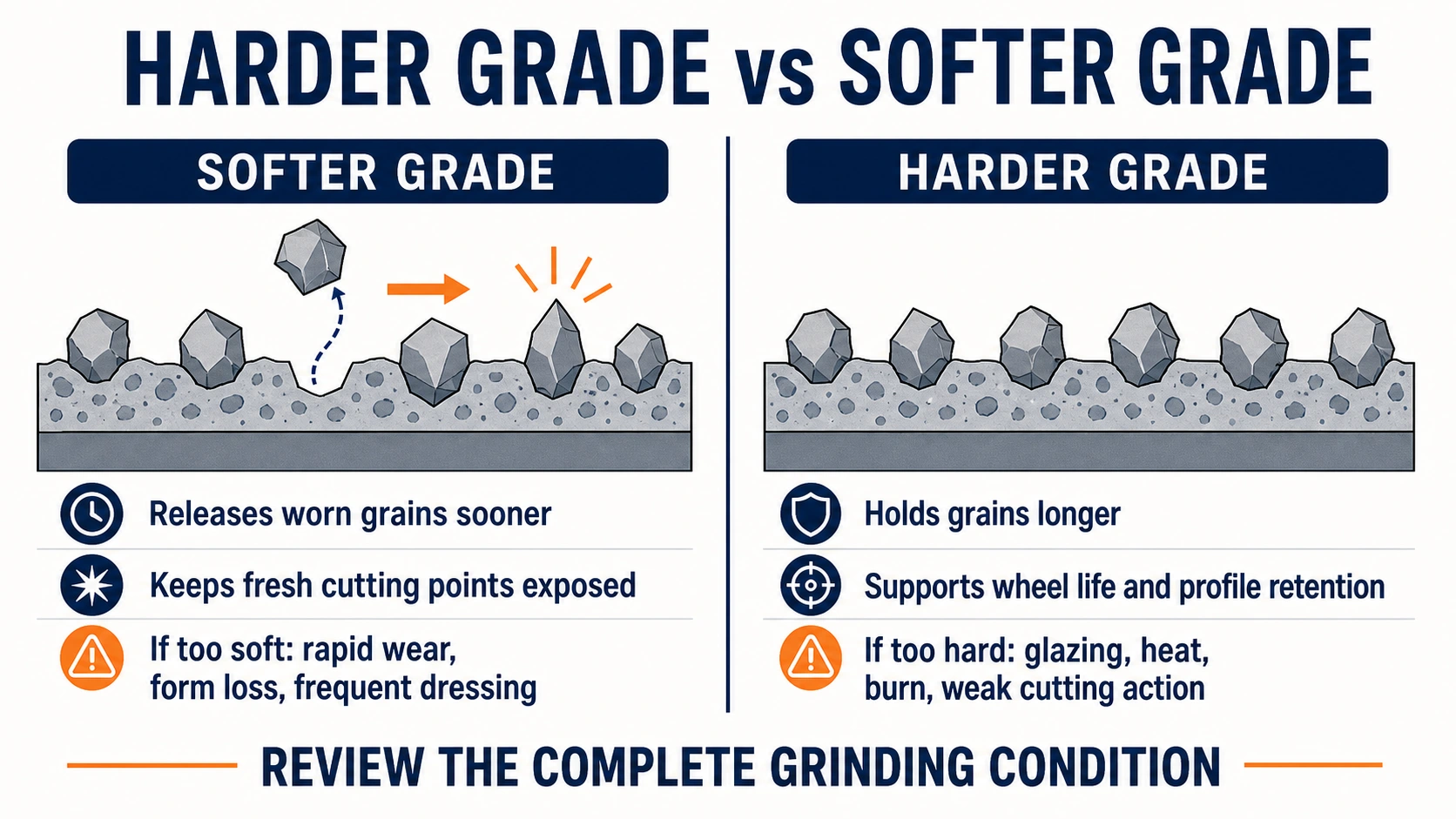
Technical comparison showing how a softer grinding wheel grade releases worn abrasive grains sooner while a harder grade holds grains longer
Softer and harder are grain-retention directions, not measures of abrasive mineral hardness. The correct balance depends on the complete grinding condition.

Wheel grade controls grain retention—not abrasive hardness

Read the grade as one part of the complete wheel specification. The observed cutting behavior also depends on bond type, structure, porosity, dressing, coolant, and the mechanical conditions at the grinding zone.

A softer grade releases worn grains sooner

When cutting points become dull, lower grain-retention force can help expose fresh abrasive. The same behavior also means the wheel may lose volume or profile more quickly if the grade is too soft for the actual load.

A harder grade holds grains longer

Stronger retention can support wheel life and form stability when grains continue cutting effectively. If dull grains remain in the surface, the wheel may rub, glaze, generate heat, or require corrective dressing.

Dressing changes effective surface behavior

An open, sharp dressed surface can behave more freely cutting, while a closed or dull surface can behave harder. Review dresser condition, method, feed, depth, and frequency before assigning every symptom to nominal wheel grade.
When to consider a softer wheel grade

These conditions may justify reviewing a softer direction, but they do not authorize an automatic grade change. Confirm that coolant, dressing, chip removal, contact, and parameters are not creating the same symptom.

The wheel surface stays dull or glazed

A reflective or smeared working face with weak cutting action can indicate that worn grains are being retained. First compare the surface before and after dressing and check whether the dresser restores an open face.

Heat or burn appears while wheel wear remains low

Low apparent wheel wear is not useful if the wheel rubs and heat rises. Check coolant access, stock, contact width, speed relationship, and dressing condition before reviewing a softer grade.

Contact area becomes larger or grinding becomes harder to sustain

A larger contact zone shares force across more cutting points and can make grain release more difficult. Material hardness and grindability, machine power, and the actual contact geometry should be reviewed together.

When to consider a harder wheel grade

A harder direction may be relevant when the wheel releases useful grains too readily. First separate loss during grinding from loss caused by aggressive or unnecessarily frequent dressing.

Wheel wear is rapid under a stable, controlled process

Compare measured wheel loss with stock removal, cycle count, dressing loss, and the location of wear. Uniform wear, local edge loss, and profile collapse do not point to the same correction.

Profile or edge retention is inadequate

Form grinding and concentrated contact can demand stronger grain retention. Verify dresser path, dresser condition, mounting, machine rigidity, and local process load before changing grade.

Dressing is frequent because the wheel loses form—not because it glazes

Confirm the reason for each dressing event. A wheel dressed for profile correction needs a different review from a wheel dressed to reopen a glazed or loaded surface.

Grade Review Scenarios

Selection situations that require different evidence

A new application, a glazed wheel, a rapidly wearing wheel, and a changed process should not begin with the same grade assumption.

New wheel specification review

Material name alone does not describe workpiece hardness, contact area, machine behavior, coolant, dressing, stock, or finish demand.

Build the first grade direction from the complete application data and identify unknown conditions before trial.

Correcting glazing, heat, or burn

Poor coolant access, closed dressing, loading, large contact, or heavy parameters can resemble a wheel that is too hard.

Review the wheel face and process evidence before moving toward a softer grade.

Correcting rapid wear or profile loss

Aggressive dressing, local overload, vibration, or parameter severity can resemble a wheel that is too soft.

Separate grinding wear, dressing loss, and local profile wear before moving toward a harder grade.

Responding to a process change

The former wheel grade may behave differently even when the wheel marking is unchanged.

Document the changed condition and compare it against the previous stable process before altering the wheel.

Selection Conditions

Conditions that change the appropriate grain-retention level

Do not select wheel hardness from the material name alone. The same material may need a different review when contact, stock, machine support, coolant, dressing, or the required result changes.

Workpiece material and hardness

Record the exact material grade, hardness, heat-treatment condition, coating or scale, and any batch change. Material identity is one input, not the complete selection rule.

Contact area and stock removal

Review contact width, arc or area, interrupted contact, stock, and whether load is concentrated on an edge or profile. Larger contact commonly needs freer grain release.

Machine rigidity, power, and mounting

A rigid, stable system supports different grinding loads from a low-power or flexible setup. Check spindle condition, mounting, vibration, and available power together.

Coolant, chip removal, and dressing

Coolant access, filtration, chip evacuation, dresser type, dresser condition, and dressing parameters directly affect wheel sharpness and the symptoms used to judge grade.

Grinding parameters and required result

Wheel speed, work speed, feed, infeed, stock, cycle stages, surface finish, tolerance, and profile demand determine whether the wheel must prioritize free cutting or form retention.

Application Review Logic

Review the complete grinding condition before selecting grade

Use the observed symptom to frame the question, then check the factors that can make a wheel behave effectively harder or softer in the actual process.

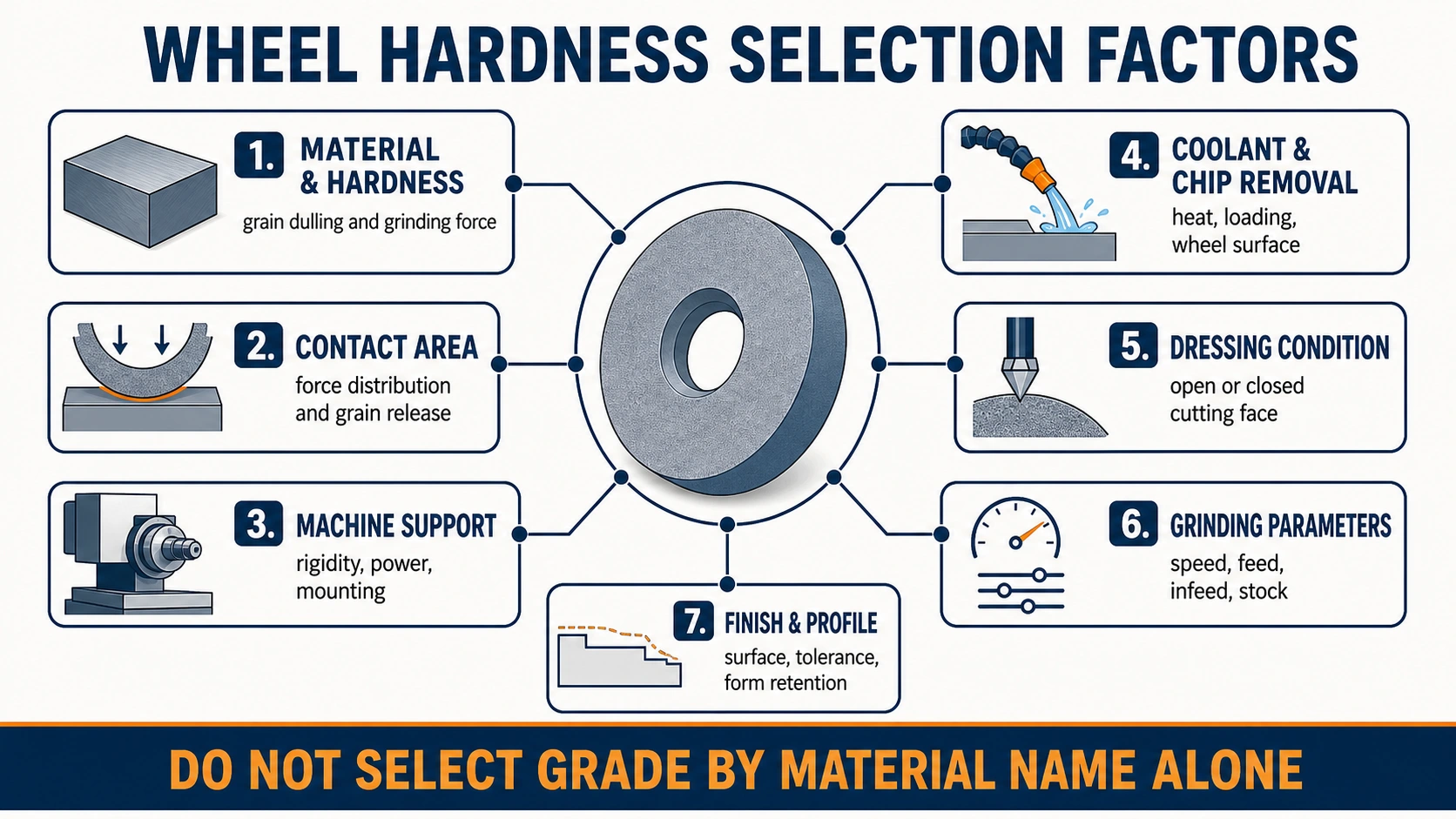
Technical factor map linking material and hardness, contact area, machine support, coolant and chip removal, dressing condition, grinding parameters, finish, and profile to grinding wheel grade selection
Material name is only one input. Contact, machine support, coolant, dressing, parameters, and the required result must be reviewed in the same application context.
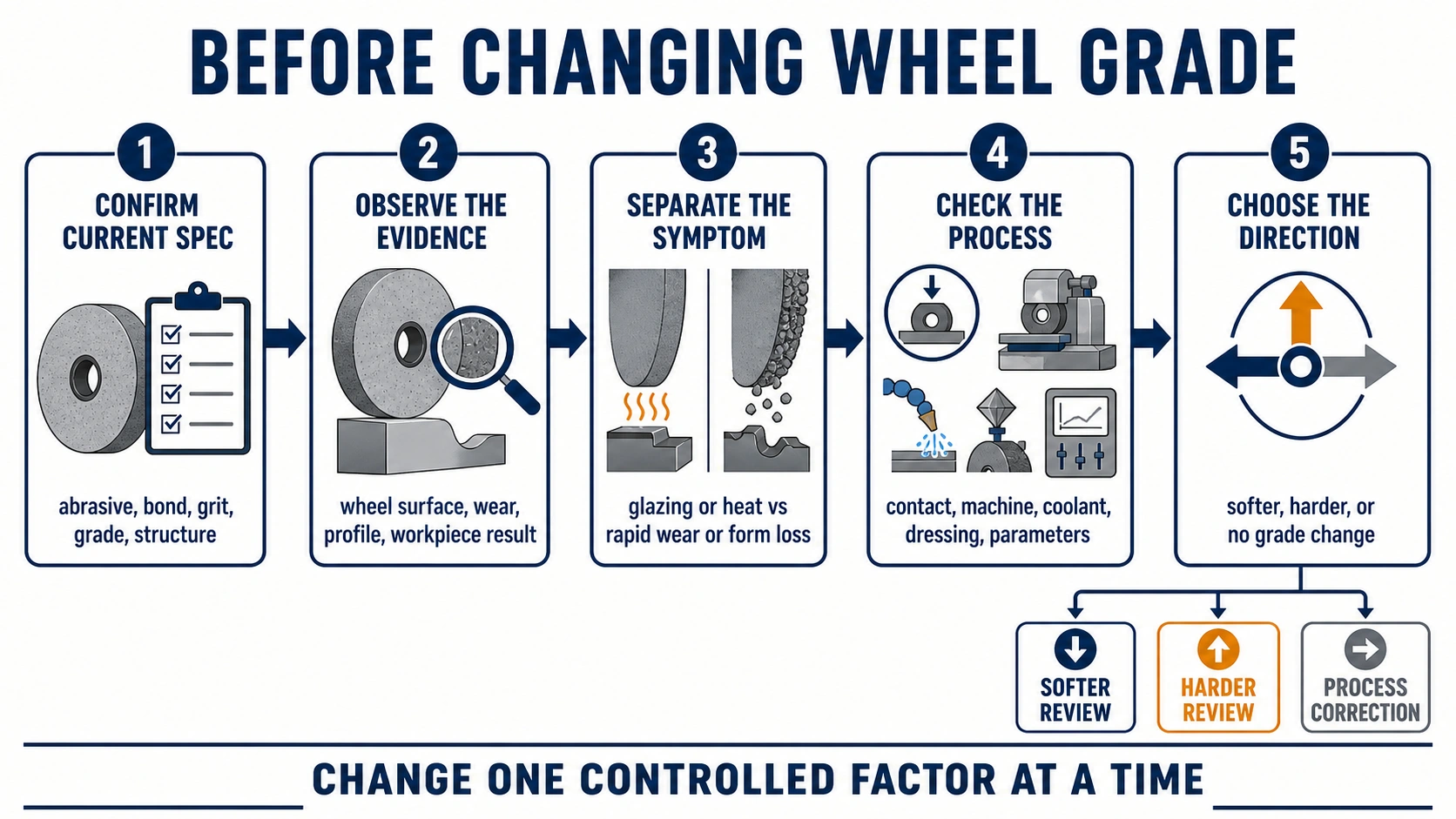
Five-step decision flow for confirming the current grinding wheel specification, observing evidence, separating symptoms, checking the process, and choosing a grade-review direction
Confirm the current specification and separate glazing or heat from rapid wear or form loss before deciding whether to review a softer grade, a harder grade, or a process correction.

Factors to Review Together

What should influence the wheel-grade decision

These factors interact. A change that improves grain retention may reduce free cutting, while a change that exposes fresh abrasive sooner may reduce wheel or profile life.

1

Material behavior

Material type, hardness, heat treatment, coating, and chip formation affect grinding force and how rapidly cutting points dull.

2

Contact and stock

Contact area, interrupted contact, stock, and local profile load influence force distribution and grain-release demand.

3

Machine support

Rigidity, available power, mounting, and vibration influence whether the wheel can cut stably at the intended parameters.

4

Coolant and dressing

Coolant delivery, filtration, chip removal, and the dressed surface condition can change heat, loading, sharpness, and apparent grade behavior.

5

Parameters and result

Speed relationship, feed, infeed, stock removal, finish, tolerance, and profile retention define the balance between free cutting and wheel life.

Application Review Workflow

A controlled review before changing wheel grade

Use this sequence to determine whether the current symptom comes from grain retention, wheel-surface condition, dressing, coolant, contact, machine support, or grinding parameters.

1

Copy the complete current wheel specification and confirm that the reported hardness refers to wheel grade, not abrasive mineral hardness.

2

Record wheel wear, profile change, dressing loss, workpiece finish, dimensional result, heat, burn, loading, and glazing under the same process condition.

3

Inspect and photograph the grinding wheel surface before dressing, then record what changes after dressing.

4

Check material and hardness, contact area, stock, machine rigidity and power, mounting, coolant delivery, filtration, and chip removal.

5

Record the dressing tool, tool condition, method, depth, feed, passes, trigger, and frequency together with basic grinding parameters.

6

Decide whether the evidence supports freer grain release, stronger grain retention, or a process correction without changing grade.

7

Change one controlled factor at a time and compare the result under the same material, machine, coolant, dressing, and measurement conditions.

What to Prepare for an Application Review

Information to provide before changing wheel hardness

Provide confirmed information and mark unknown items clearly. The purpose is to review the wheel condition and application details together, not to select a grade from one symptom.

Workpiece material, exact grade if known, hardness, heat-treatment condition, coating or scale, and any recent material change
Grinding wheel size: outside diameter × bore × thickness, plus profile and abrasive-layer dimensions where applicable
Complete current grinding wheel specification, including abrasive, bond, grit, grade, structure, shape, and concentration or abrasive-layer details when known
Clear wheel photos, label photo, grinding wheel surface photos before dressing, and a dimensioned drawing when available
Machine manufacturer and model when available, mounting information, grinding position, machine rigidity or vibration observations, and available power if known
Contact width or area, interrupted contact, stock allowance, and whether load is concentrated at an edge or profile
Wet or dry grinding; coolant type, condition, filtration, nozzle position, delivery, and chip-removal observations
Dressing tool, dresser condition, method, depth, feed, passes, trigger, frequency, and the reason dressing is performed
Wheel speed, work speed, feed, infeed or depth, stock-removal stages, and cycle information when known
Current symptom and when it appears: glazing, loading, heat, burn marks, rapid wear, profile loss, frequent dressing, finish drift, or dimensional variation
Required surface finish, tolerance, profile, roundness, flatness, or other acceptance requirement when available
Photos of the workpiece surface and the grinding wheel surface, plus the preferred contact method if clarification is needed

Share workpiece and wheel-surface photos, material, grinding wheel size, current wheel specification, dressing condition, coolant condition, and basic grinding parameters for application review.

Send Grinding Details

Industrial Grinding Contexts

Industrial grinding contexts where wheel grade may need review

These are application contexts where wheel-grade decisions may arise. Youlin Abrasive supplies grinding wheels, abrasive tools, and grinding wheel solutions; it does not supply the bearings, hydraulic parts, molds, automotive parts, machine components, precision parts, or customer workpieces being ground.

Bearing grinding applications
Hydraulic component grinding applications
Mold and die grinding applications
Automotive component grinding applications
General precision component grinding applications

FAQ

Questions about selecting grinding wheel hardness

These answers clarify what wheel grade means and why a grade direction must be checked against the complete grinding condition.

Is grinding wheel hardness the same as abrasive grain hardness?

No. Grinding wheel hardness or grade describes how strongly the bond retains abrasive grains. Abrasive grain hardness is an inherent property of the abrasive material. A wheel can use very hard abrasive grains and still have a relatively soft wheel grade.

Should a harder workpiece always use a softer grinding wheel?

Not as an isolated rule. Harder or difficult-to-grind material often increases the need for fresh cutting points, which can support a softer direction. Contact area, machine power and rigidity, coolant, dressing, parameters, finish, and profile retention must still be reviewed.

What happens if the grinding wheel grade is too hard?

Dull grains may remain in the wheel surface instead of releasing. The wheel may glaze, lose cutting action, rub, generate heat, or contribute to burn marks. Similar symptoms can also come from loading, closed dressing, poor coolant access, large contact, or unsuitable parameters.

What happens if the grinding wheel grade is too soft?

Useful grains may release too readily, causing rapid wheel wear, profile loss, dimensional drift, or frequent dressing. Aggressive dressing, vibration, local overload, or heavy parameters can create similar results and should be checked first.

Can dressing make a wheel behave harder or softer?

Yes. An open, sharp dressed surface can behave more freely cutting, while a closed or dull surface can appear harder. Record dresser condition and dressing parameters before concluding that the nominal wheel grade is wrong.

What should I provide before asking for a different wheel grade?

Share workpiece and wheel-surface photos, material and hardness, grinding wheel size and complete current specification, machine and contact information, dressing condition, coolant condition, basic grinding parameters, current symptoms, and the required result when available.

WhatsApp Inquiry