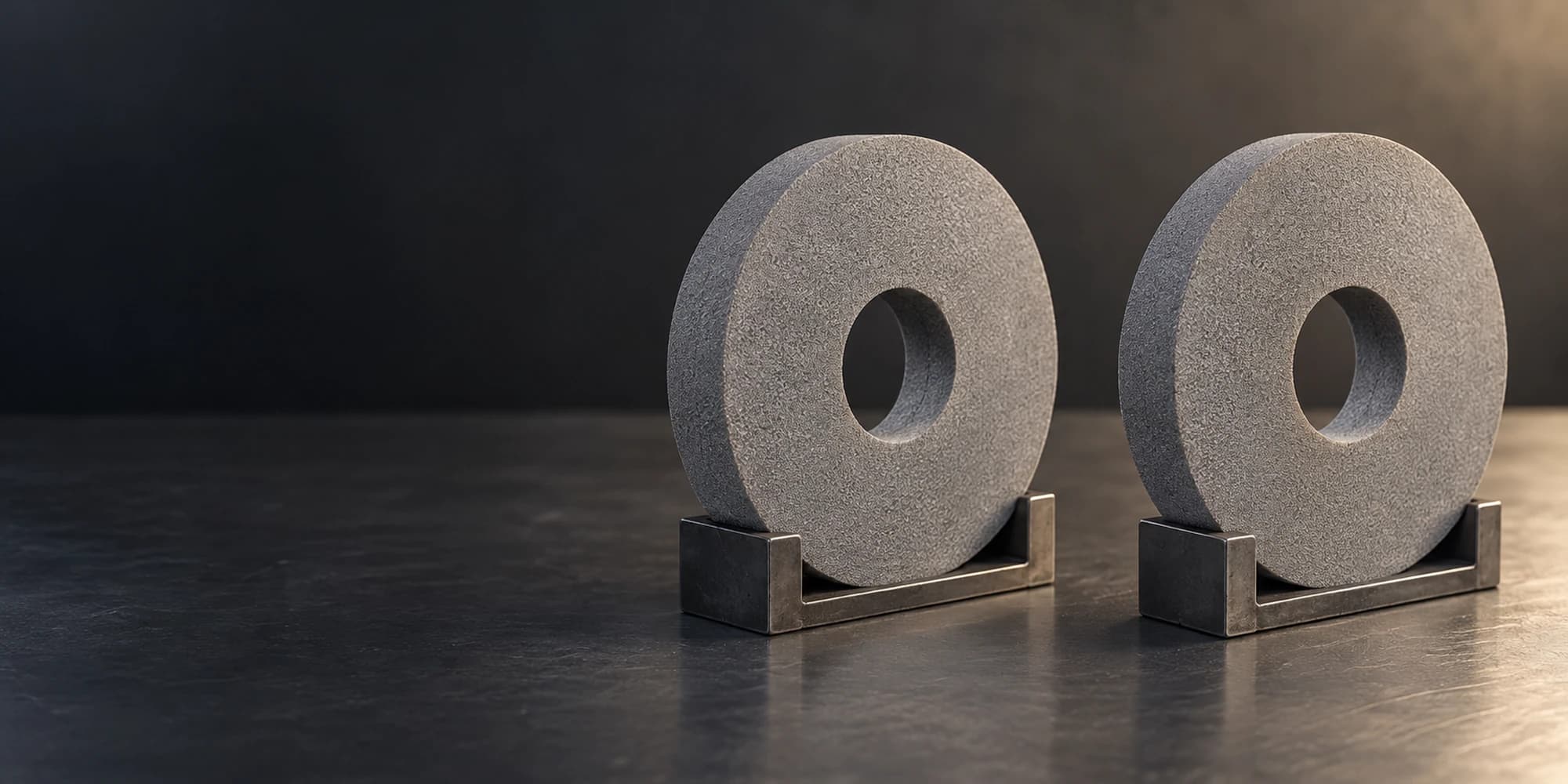
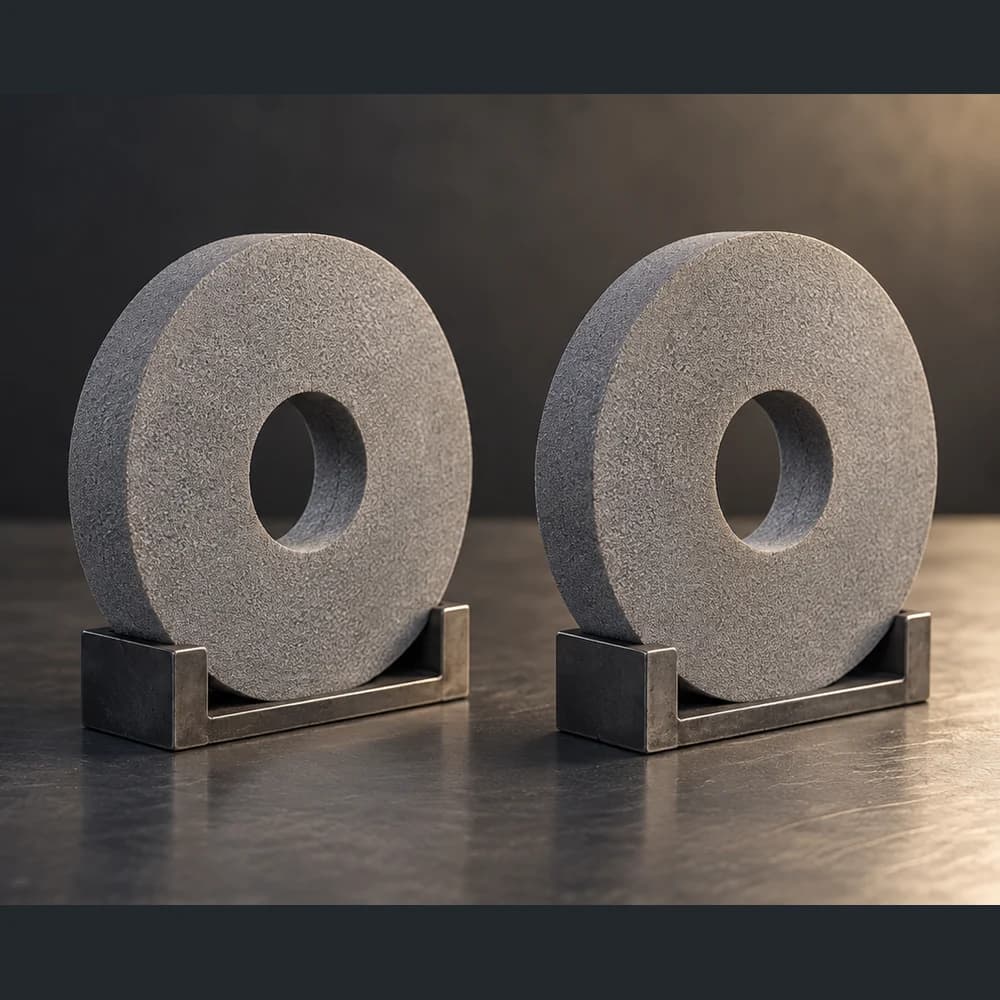
Two similar-looking gray bonded grinding wheels on separate supports on a neutral industrial bench.

Grinding Wheel Knowledge Base

Why Grinding Wheels with the Same Specification Perform Differently

Two similar-looking gray bonded grinding wheels on separate supports on a neutral industrial bench.

Two grinding wheels arrive with the same dimensions and the same specification marking. One holds its finish through the expected dressing interval; the other needs attention much sooner. A matching marking does not guarantee identical grinding behavior. The useful question is which variable changed, and what evidence identifies it.

A matching marking confirms a nominal specification match, not identical grinding behavior.
Check what else changed at the same time: dressing, coolant, workpiece lot, cycle and machine condition.
If the process is stable, compare the old and new wheels under the same conditions before drawing a batch conclusion.
Keep wheel grade, grain friability and hardness uniformity as separate questions.

AI-generated concept illustration. Not a factory photograph, real product record or measured batch comparison. Static concept for a batch-consistency discussion; similar appearance does not establish equivalent grinding performance.

Overview

Start with what the marking does not define

The difference may sit in the wheel batch, the dressing operation, the coolant, the machine or the workpiece. A marking identifies a nominal specification; it does not define every property of the finished wheel.

This guide sets out a diagnostic order: check what changed in the process, separate grade from grain friability, then compare batches under equivalent conditions.

Quick answer

  • Same marking means a nominal match. Cross-supplier, same-supplier batch and same-batch variation are different cases.
  • Manufacturing variation is one explanation; dressing, coolant, workpiece, cycle and machine must be checked first.
  • A batch comparison is justified when the symptom follows the batch under stable process conditions.
  • Temperature control curve belongs to vitrified wheel manufacturing, not grinding-zone temperature.

What the same grinding wheel specification actually means

A conventional grinding wheel marking typically covers abrasive type, grit size, wheel grade, structure and bond type. Dimensions, shape and maximum permitted operating speed are also essential product information.

A marking is a designation, not a full material specification

These fields identify and specify a wheel. They do not describe every detail of the abrasive grains, the bond formulation, the pore distribution or the manufacturing history.

Cross-supplier, same-supplier and same-batch are different cases

Two wheels with the same marking from different manufacturers may use different proprietary formulations. Even from the same supplier, a nominal specification is not a promise that every batch will behave identically. Even within one batch, two wheels can behave differently if the batch is not uniform or if the process changed between them. The marking cannot separate those cases; the evidence has to.

Two questions for a replacement review

Does the marking match the specification? Does the finished wheel behave like the wheel it replaces? The first is a paper check. The second needs process evidence and, where necessary, a controlled comparison. Batch consistency is decided by the second question, not the first.

Where supplier equivalence belongs

For a supplier-to-supplier replacement, the fields that must match are covered separately in the equivalent grinding wheel guide. This article deals with the harder case: the marking matches, but the result changes.

Before blaming the wheel, check what changed on the machine

A new wheel rarely enters an unchanged process. A fresh dressing tool, a different workpiece batch, a coolant adjustment or a revised machine setting can arrive at the same time.

A new wheel is often the most visible change

A sudden increase in dressing frequency after a wheel change is a useful observation. It is not yet a diagnosis. The investigation starts with two possibilities: the process changed at the same time as the wheel, or the process is stable but the wheel batch behaves differently.

Read the dressing response

If a freshly dressed wheel performs normally and then deteriorates quickly, investigate both the wheel-face behavior and the operating conditions. If the problem appears immediately after dressing, examine the dressing setup before concluding that the new wheel has a different hardness.

What changed?

What changed?
What changed?What it can affectEvidence to review
Dressing tool or settingsWheel-face sharpness, profile and cutting actionDressing method, tool condition and settings
Coolant deliveryContact-zone cooling, lubrication and chip removalNozzle position, flow and fluid condition
Workpiece material or heat treatmentGrinding force and wheel wearMaterial grade, hardness and lot records
Grinding cycleContact conditions, heat and stock removalSpeed, feed, infeed, cycle and stock allowance
Machine or mounting conditionVibration, runout and dimensional stabilityMounting, balance, spindle and support checks
Replacement wheel or production batchGrain retention, structure and cutting behaviorComplete marking, supplier, lot details and any existing controlled trial results

Dressing tool or settings

What it can affect

Wheel-face sharpness, profile and cutting action

Evidence to review

Dressing method, tool condition and settings

Coolant delivery

What it can affect

Contact-zone cooling, lubrication and chip removal

Evidence to review

Nozzle position, flow and fluid condition

Workpiece material or heat treatment

What it can affect

Grinding force and wheel wear

Evidence to review

Material grade, hardness and lot records

Grinding cycle

What it can affect

Contact conditions, heat and stock removal

Evidence to review

Speed, feed, infeed, cycle and stock allowance

Machine or mounting condition

What it can affect

Vibration, runout and dimensional stability

Evidence to review

Mounting, balance, spindle and support checks

Replacement wheel or production batch

What it can affect

Grain retention, structure and cutting behavior

Evidence to review

Complete marking, supplier, lot details and any existing controlled trial results

Process change or wheel batch?

The order matters: check what changed in the process before comparing the wheel batch.

Same marking, different result
Did the process change at the same time?
Yes

1. Check changed conditions

  • Dressing
  • Coolant
  • Workpiece lot
  • Grinding cycle
  • Machine and mounting
  1. Record changes and observations.
  2. Reassess the symptom. Recheck only when conditions can be safely restored and kept comparable.

If the symptom persists under comparable conditions, reassess whether it follows the wheel batch. If evidence remains unclear, keep the case unresolved.

No
Does the symptom follow the wheel batch?

Wheel batch

Yes
Controlled A/B comparison
No
Unresolved / further investigation
A diagnostic order, not a universal troubleshooting tree. The unresolved branch is part of the method.

How manufacturing variation can affect grinding behavior

A grinding wheel is a manufactured abrasive structure, not a collection of loose abrasive grains. In a bonded wheel, abrasive grains, bond and pore space work together. Their distribution affects how the wheel cuts, retains grains, clears chips and maintains its profile.

Abrasive grain selection and distribution

Abrasive type and grain characteristics influence cutting and self-sharpening behavior. Grain friability describes how readily the abrasive particles fracture; it is a grain property. Wheel grade describes how firmly the bond retains the grain; it is a bond property. They interact, but they are not the same variable. A change in either property can produce a different result; so can a dressing change that leaves a different wheel face.

Bond content and distribution

Wheel grade concerns how firmly the bonding system retains abrasive grains. The nominal grade matters, but the finished wheel also depends on the bond formulation, its distribution and the manufacturing process. If grains are retained too strongly under the application conditions, the wheel may become dull and rub rather than cut. If they are released too readily, wheel wear and loss of form can become problems. The correct balance depends on the grinding operation.

Mixing and forming

Consistent mixing and forming affect the distribution and density of the abrasive body. A wheel that is not uniform through its section can behave differently as different parts of its working face are exposed. A published study of vitrified bonded alumina wheels varied molding pressure, bond content and firing time. It measured bending strength, Young's modulus and apparent density, and emphasized uniform green density during pressing. The study supports a general point: manufacturing conditions can change the finished wheel's physical properties. It does not prove that a particular batch is defective.

Temperature control during manufacturing

For vitrified bonds, the firing profile, or temperature control curve, is part of the manufacturing process. Heating rate, holds and cooling affect how the bond develops. This curve describes the manufacturing process, not the temperature trend at the grinding contact, and it should not be used to describe grinding-zone heat. Resin-bonded wheels follow different curing requirements. Do not transfer the vitrified manufacturing discussion to every bond system without qualification. A batch conclusion needs evidence from the process and from a controlled comparison.

Grain, bond and pore: three separate variables

A bonded wheel is a structure of abrasive grain, bond and pore space. The diagram separates the grain property from the bond property.

Conceptual cross-section · Not to Scale

  • Abrasive grain
  • Bond bridge
  • Pore / chip space
A

Sharp grain

Abrasive grain

B

Grain fracture (friability)

Friability belongs to the grain

C

Dull grain retained

Wheel grade describes the grain-retention strength of the bonded wheel.

D

Whole-grain pull-out (bond retention)

Wheel grade describes the grain-retention strength of the bonded wheel.

E

Pore / chip space

Conceptual cross-section. Grain friability, bond retention and pore space are separate properties; one does not prove the others.

Vitrified manufacturing process control

Six manufacturing stages, with the temperature control curve linked to vitrified-bond thermal processing.

Generic vitrified-wheel manufacturing concept; not a YOULIN production record.

  1. Raw materials

  2. Mixing

  3. Forming

  4. Thermal processing

  5. Inspection

  6. Finished wheel

Temperature control curve

HeatingHoldCooling

Schematic only — not a measured temperature control curve. Not to Scale.

  1. Record
  2. Compare
  3. Adjust

Manufacturing curve — not grinding-zone temperature.

Resin bonds use different curing requirements.

Materials preparation, mixing, forming, thermal processing, inspection and the finished wheel.

Hardness uniformity: why the grade letter does not tell the whole story

Consider a wheel whose cutting behavior changes noticeably as different portions of its working surface are exposed. One question is whether its grain-retention characteristics are sufficiently consistent. Other explanations include uneven dressing, wheel runout, loading, workpiece variation or machine vibration.

A grade letter cannot prove uniformity

Wheel grade is a nominal characteristic of the abrasive product. Hardness or grade uniformity means the finished wheel's properties stay consistent within its design and the applicable test method. A grade letter alone cannot prove that uniformity. Grade selection is a separate decision; this section only asks whether the finished wheel is uniform.

Do not substitute one property for another

A manufacturing or supplier investigation may examine relevant physical properties, documented inspection results and production records. The appropriate methods depend on the wheel construction, product requirements and the standards involved. Do not equate wheel grade with workpiece hardness. Do not confuse grain friability with bond strength. Those substitutions answer the wrong question.

The practical test

For the grinding engineer, the practical test is whether the wheel maintains an acceptable cutting condition and geometry through the required process. If it does not, the next step is to locate where the variation appears: across the wheel face, between batches, or after a particular dressing.

What production symptoms can reveal

Different symptoms point to different possible causes and different evidence. None of them identifies a unique cause without supporting evidence.

What production symptoms can reveal
SymptomPossible cause to considerEvidence to verifyWhen a batch comparison is justified
Dressing interval becomes shorterWheel loading, glazing, profile loss, or a change in the dressing procedureAccepted parts, material removed or time between dresses; wheel-face condition; dressing tool and methodThe symptom follows the replacement wheel or lot after the dressing and process checks are stable
The wheel glazes unusually quicklyGrain retention or grade behavior, abrasive characteristics, ineffective dressing, wheel speed or contact conditions; a harder-acting wheel is possible, but dressing or the grinding regime can produce a similar symptomWheel-face condition before and after dressing; dressing response; speed and contact recordsFresh dressing restores normal behavior briefly, then glazing returns under unchanged conditions and follows the batch
Wheel wear rises while finish stays acceptableGrinding wear, dressing consumption, grade or grain retention, or a process changeWhere wheel material is lost; wheel consumption versus dressing consumption; cycle and dressing recordsWear repeats on the candidate batch under the same cycle and dressing procedure
Surface finish or dimensions become unstableMachine support, balance, runout, dressing inconsistency, incoming workpiece variation, or wheel wear and profile lossSupport, balance, runout and dressing checks; workpiece lot; wheel wear and profile recordsThe process checks are stable and the instability follows the wheel batch
Grinding burn appears after a replacementCutting action, coolant delivery, grinding conditions, a material change, or the wheel-face conditionBurn inspection; coolant delivery; cycle and material records; wheel-face conditionBurn repeats with the candidate batch under unchanged conditions and acceptable coolant and dressing

Dressing interval becomes shorter

Possible cause to consider

Wheel loading, glazing, profile loss, or a change in the dressing procedure

Evidence to verify

Accepted parts, material removed or time between dresses; wheel-face condition; dressing tool and method

When a batch comparison is justified

The symptom follows the replacement wheel or lot after the dressing and process checks are stable

The wheel glazes unusually quickly

Possible cause to consider

Grain retention or grade behavior, abrasive characteristics, ineffective dressing, wheel speed or contact conditions; a harder-acting wheel is possible, but dressing or the grinding regime can produce a similar symptom

Evidence to verify

Wheel-face condition before and after dressing; dressing response; speed and contact records

When a batch comparison is justified

Fresh dressing restores normal behavior briefly, then glazing returns under unchanged conditions and follows the batch

Wheel wear rises while finish stays acceptable

Possible cause to consider

Grinding wear, dressing consumption, grade or grain retention, or a process change

Evidence to verify

Where wheel material is lost; wheel consumption versus dressing consumption; cycle and dressing records

When a batch comparison is justified

Wear repeats on the candidate batch under the same cycle and dressing procedure

Surface finish or dimensions become unstable

Possible cause to consider

Machine support, balance, runout, dressing inconsistency, incoming workpiece variation, or wheel wear and profile loss

Evidence to verify

Support, balance, runout and dressing checks; workpiece lot; wheel wear and profile records

When a batch comparison is justified

The process checks are stable and the instability follows the wheel batch

Grinding burn appears after a replacement

Possible cause to consider

Cutting action, coolant delivery, grinding conditions, a material change, or the wheel-face condition

Evidence to verify

Burn inspection; coolant delivery; cycle and material records; wheel-face condition

When a batch comparison is justified

Burn repeats with the candidate batch under unchanged conditions and acceptable coolant and dressing

Loading, glazing, rapid wear and burn each have their own causes. Use the dedicated guides for those mechanisms before attributing the change to a batch. A batch comparison is justified when the process checks are stable and the symptom follows the wheel batch. If the symptom follows a dressing tool, a coolant change or a workpiece lot instead, the wheel may be the wrong place to look.

How to compare two wheel batches fairly

The purpose of a controlled comparison is to distinguish a wheel-related difference from normal process variation. The general replacement method (one change at a time, a recorded baseline and an agreed acceptance criterion) is set out in the equivalent grinding wheel guide. This section adapts it to two batches that carry the same nominal specification. If the supplier or marking also changed, settle that question first.

Record the current lot as the baseline

Record the currently accepted wheel and the process in which it performs satisfactorily: complete wheel marking and supplier; batch or lot identification; any manufacturing or inspection records for the current and candidate lots; workpiece material, hardness and production lot; machine, mounting and grinding conditions; dressing tool, method and settings; coolant type, delivery and filtration; accepted parts, wheel wear and dressing events; surface finish, dimensions and any applicable surface-integrity checks.

Compare under equivalent conditions

Use the same acceptance criteria for the current and candidate wheels. Where practical, keep the workpiece material, grinding cycle, dressing procedure, coolant and machine conditions consistent. Document any unavoidable differences. If the marking or supplier changed as well, the comparison is testing two questions at once; use the supplier-equivalence method before attributing the result to the batch. Run the comparison over an agreed evaluation interval, not only the first few components. If a result is unexpected, repeat the observation before deciding that it represents a persistent batch difference.

Separate quality from economics

First establish that the wheel meets the product's technical and safety requirements. Only then compare wheel consumption, dressing frequency, process interruptions and cost per accepted part. A wheel with a longer dressing interval has no practical advantage if it produces unacceptable workpieces. Technical acceptance comes before the economic comparison.

A/B controlled trial record

Use the same record for the baseline and candidate lots. Leave the value cells blank until the trial produces them.

Template — record actual values

RecordBaseline wheelCandidate wheel
Marking and supplier
Lot / batch information
Dressing tool and settings
Coolant, filtration, machine and mounting conditions
Workpiece material and lot
Accepted parts
Wheel wear
Dressing events
Finish and dimensions
Surface-integrity checks
Decision
A blank record template. Do not fill it with assumed or illustrative results.

What buyers should ask a grinding wheel manufacturer

For custom precision grinding wheels, purchasing decisions should go beyond matching the printed specification.

How is the required wheel specification defined?

Ask whether the supplier is working from a confirmed application and drawing, an existing wheel specification or a proposed change in grinding behavior.

What product and batch information is available?

Depending on the product and supplier, this may include identification details, dimensional records, inspection results or other traceability information. Not every test or record is appropriate for every type of grinding wheel.

How are manufacturing changes evaluated?

For a vitrified wheel, relevant controls may concern raw materials, mixing, forming and the manufacturing temperature control curve. Other bonds and constructions use different process controls. A supplier should describe the controls it actually uses, rather than presenting a generic checklist as proof of performance.

What happens if the new wheel behaves differently?

Agree on the evidence needed to review the issue: retained wheel marking, photographs, the process record, dressing observations, measurements and the applicable acceptance criteria. The goal is a traceable technical investigation, not a promise that a formulation change will fix every grinding problem.

When is a custom wheel specification worth reviewing?

A change in wheel formulation or construction may be worth investigating when:

Conditions that justify a review

The existing wheel cannot maintain the required cutting condition; acceptable quality depends on unusually frequent dressing; profile retention and surface finish requirements conflict; grinding conditions have changed enough to invalidate the previous specification; a controlled comparison identifies a repeatable wheel-related limitation.

What does not justify a wheel change

If the problem originates in coolant delivery, dressing, machine condition or workpiece variation, changing the wheel alone may not correct it. For an unfamiliar application, a custom wheel review starts with the process and its acceptance criteria, not an improvement target.

What to send

Send the current wheel marking and batch evidence

YOULIN ABRASIVE manufactures customized grinding wheels and abrasive tools for industrial grinding applications. With more than 20 years of grinding wheel manufacturing experience, our work focuses on adapting the wheel specification to the customer's application rather than offering one fixed wheel for every process. If your grinding line is experiencing inconsistent wheel behavior, send the complete current wheel marking, dimensions, workpiece material, machine details, dressing method and the symptoms you observe. If the issue began after a batch change, include the available lot information and a comparison of the accepted and replacement wheels.

  • Complete current wheel marking and supplier identification

  • Batch or lot information for the current and candidate wheels

  • Wheel dimensions and the surface being ground

  • Workpiece material, hardness and production lot

  • Machine, mounting and grinding conditions

  • Dressing tool, method and settings

  • Coolant type, delivery and filtration

  • The symptoms observed and when they began

  • Any existing A/B records, photographs or inspection results

Need help reviewing a batch difference?

Send the current marking, lot information and process evidence. We can review the application and discuss a controlled trial plan, including the acceptance criteria that must be agreed before the trial. Youlin Abrasive supplies grinding wheels and abrasive tools; we do not supply workpieces, grinding machines or machining services.

Send Grinding Details →

FAQ

Questions about grinding wheel batch consistency

Short answers for production teams comparing a replacement wheel, a new batch and the process evidence.

Can two grinding wheels with the same grade letter perform differently?

Yes. A grade letter represents a nominal specification within a marking system. It does not fully define proprietary bond formulations or guarantee identical performance across manufacturers. Within one supplier, production consistency and operating conditions still matter.

Does shorter wheel life always indicate poor manufacturing quality?

No. Grinding conditions, dressing consumption, workpiece changes, coolant and wheel selection can all affect service life. Identify where the wheel material is lost before making a manufacturing conclusion.

Can a temperature control curve affect vitrified grinding wheel manufacturing?

Temperature control during the vitrified manufacturing process can influence the development of the bonded wheel structure. Its relevance depends on the bond formulation and manufacturing process. This is a manufacturing variable, not a measurement of grinding-zone temperature.

Should the wheel be replaced immediately if grinding behavior changes?

Stop and follow the applicable safety or quality procedure when wheel damage or unacceptable workpiece quality is suspected. Otherwise, inspect the process evidence before deciding whether the issue calls for dressing adjustments, machine correction or a different wheel specification.