Equivalent Grinding Wheel: What Must Match When You Change Supplier?

Grinding Wheel Knowledge Base

Equivalent Grinding Wheel: What Must Match When You Change Supplier?

Matching dimensions is the easy part. A wheel of the same diameter, thickness and bore will usually go onto the same spindle, and that is where the certainty ends. Two questions are being asked at once when a wheel is moved to a different supplier, and they have different answers. The first is whether the wheel fits and stays inside every verified safety constraint. The second is whether it grinds the way the operation needs once it is running. Confusing the two is the usual mistake. A wheel can fit perfectly, carry the same marking, and still not behave like the wheel it replaced.

Dimensional fit is one question; behaviour under the actual process is a different one
Part of a wheel marking is standardised and can be compared field by field
The prefix, the bond formulation and the structure number belong to the manufacturer
Fit and mounting are absolute conditions, not points of comparison between two wheels
A matching wheel is a candidate until a controlled comparison has been run

Overview

Two questions, not one

A replacement request usually arrives as a single question — can you supply an equivalent to this wheel? Underneath it are two questions that have to be answered separately, because only one of them can be answered from a document.

The first is fit and safety. Does the wheel mount on the same spindle with the same flanges and the same guarding, and does it sit inside every verified limit that applies to this machine and this operation? This half is settled by evidence, not by comparison: a maximum operating speed belongs to one specific product and specification, and it does not transfer to a wheel that merely looks similar.

The second is whether the wheel grinds the way the operation needs. That cannot be established from paper at all, because performance is a property of the wheel inside a process rather than of the wheel alone. A specification review can tell you whether a direction is technically coherent and worth trialling. It cannot tell you that the wheel will be equivalent in your process.

This article is about what falls on each side of that line. It sets out which parts of a wheel specification are standardised and can legitimately be compared across suppliers, which parts belong to the manufacturer and cannot be carried across, and what a replacement review can and cannot establish before anything is run.

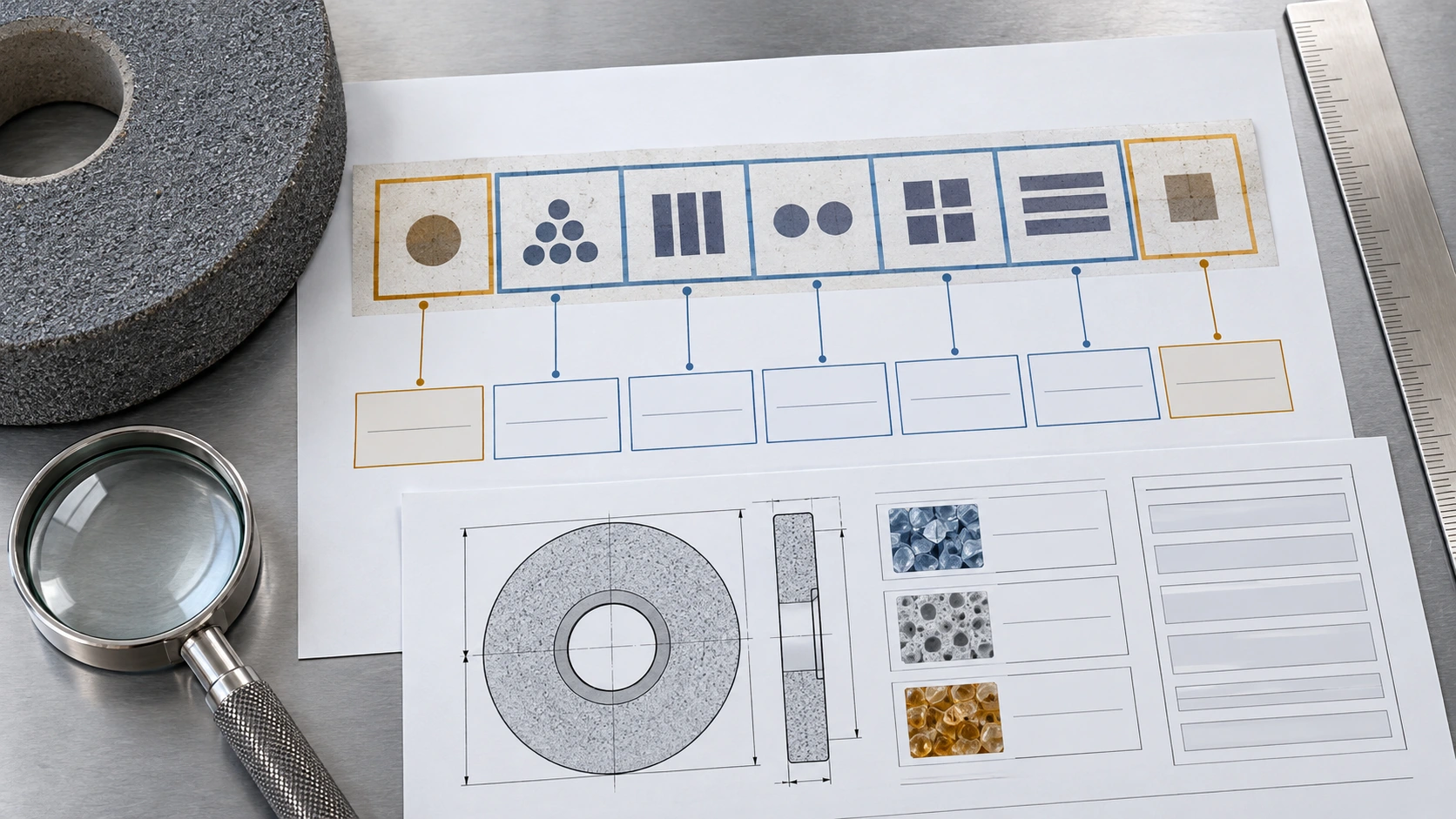
A schematic laying out a grinding wheel marking as seven symbol fields, each connected to an empty label box, with the manufacturer prefix and record fields set apart from the five standardised fields.
A conceptual view of how a marking is structured, not a specification recommendation. Part of the marking is standardised and means the same thing whoever printed it. The prefix and the record numbers are the manufacturer's own, and what sits behind the shared letters is not standardised at all.

"Equivalent" is doing too much work

When a buyer asks for an equivalent wheel, the word is usually carrying three separate meanings at once.

Interchangeability of fit

The wheel mounts on the same spindle with the same flanges and the same guarding, and nothing about the machine interface has to change.

Comparability of specification

The fields written on the marking line up, so the two wheels can at least be discussed in the same terms. This is what a marking comparison can establish, and it is worth having — but it is not the same claim as the next one.

Equivalence of result

The wheel produces an acceptable part at an acceptable rate and cost under the real conditions of the job. This is the meaning that matters in production, and it is the one no document can settle.

Why the three get confused

The first two are visible and can be written down, so they tend to stand in for the third. A specification review can tell you whether a direction is reasonable. It cannot tell you that a wheel will perform, because performance is a property of the wheel inside a process, not of the wheel alone.
Which fields actually transfer

Modern conventional bonded wheels follow a standard marking sequence, set out in ANSI B74.13 in the United States and ISO 525 internationally. The sequence runs abrasive type, grain size, grade, structure, bond — and because it is a standard, those fields mean the same thing whoever printed them.

The marking is not a private code

This is worth stating plainly, because it is often assumed otherwise. Within a given marking system, a grain size number refers to a defined range, and a grade letter sits on the same soft-to-hard scale. A bond letter — V for vitrified, B for resinoid, R for rubber, and the rest — names the same bond family. Two wheels from two suppliers can legitimately be compared field by field.

The qualification that belongs here

Conventional grain sizes are standardised within a system, but more than one system is in use. The European and the American scales are not identical, and abrasive designation for superabrasives is handled differently again, where the differences between systems are largest. Where two wheels are marked under different systems, the fields have to be reconciled before they are compared.

Where that reconciliation belongs

With the supplier, and against the actual marking on the wheel — not with an assumed conversion applied from memory or from an old table. A conversion that has not been confirmed for the specific designations in front of you is an assumption, not a translation.

Why this is not the whole picture

If standardised fields were all that mattered, replacement would be a paperwork exercise. It is not, because a standardised notation is not the same thing as a standardised product.

Which fields belong to the manufacturer

Three things sit outside the standard, and each one can change how a wheel behaves even when every visible field matches.

The prefix

Manufacturers place their own abrasive designation in front of the standard sequence — proprietary blends and treated grains that carry a maker-specific name. The standard covers the letter that names the abrasive family; it does not cover how that maker's grain is formulated, its friability, its shape, or how it fractures as it dulls. Two wheels can both record aluminium oxide and behave quite differently.

The bond behind the letter

Bond letters are standardised as families, but the formulation inside a family is not. Two vitrified wheels can share the letter V and differ in how hard the bond actually holds the grain, how the wheel wears, and how it responds to a dress. The letter tells you the family, not the behaviour.

The structure number

This is the field most often carried across as though it were portable, and it is the least safe to carry. Manufacturers print structure on different scales, and some record porosity separately from structure. A structure number only means something inside the specification system printed on that wheel. The notation system itself is covered in its own guide.

Where grade sits, and why it catches people out

Grade sits awkwardly between the two groups. The scale is standardised, so the letter is comparable. But the letter describes how firmly a particular bond holds a particular grain, and both of those are the manufacturer's. Reading a grade letter across suppliers tells you where each wheel sits on a shared scale, not that the two wheels will renew their cutting face in the same way. Comparable is not the same as equivalent.

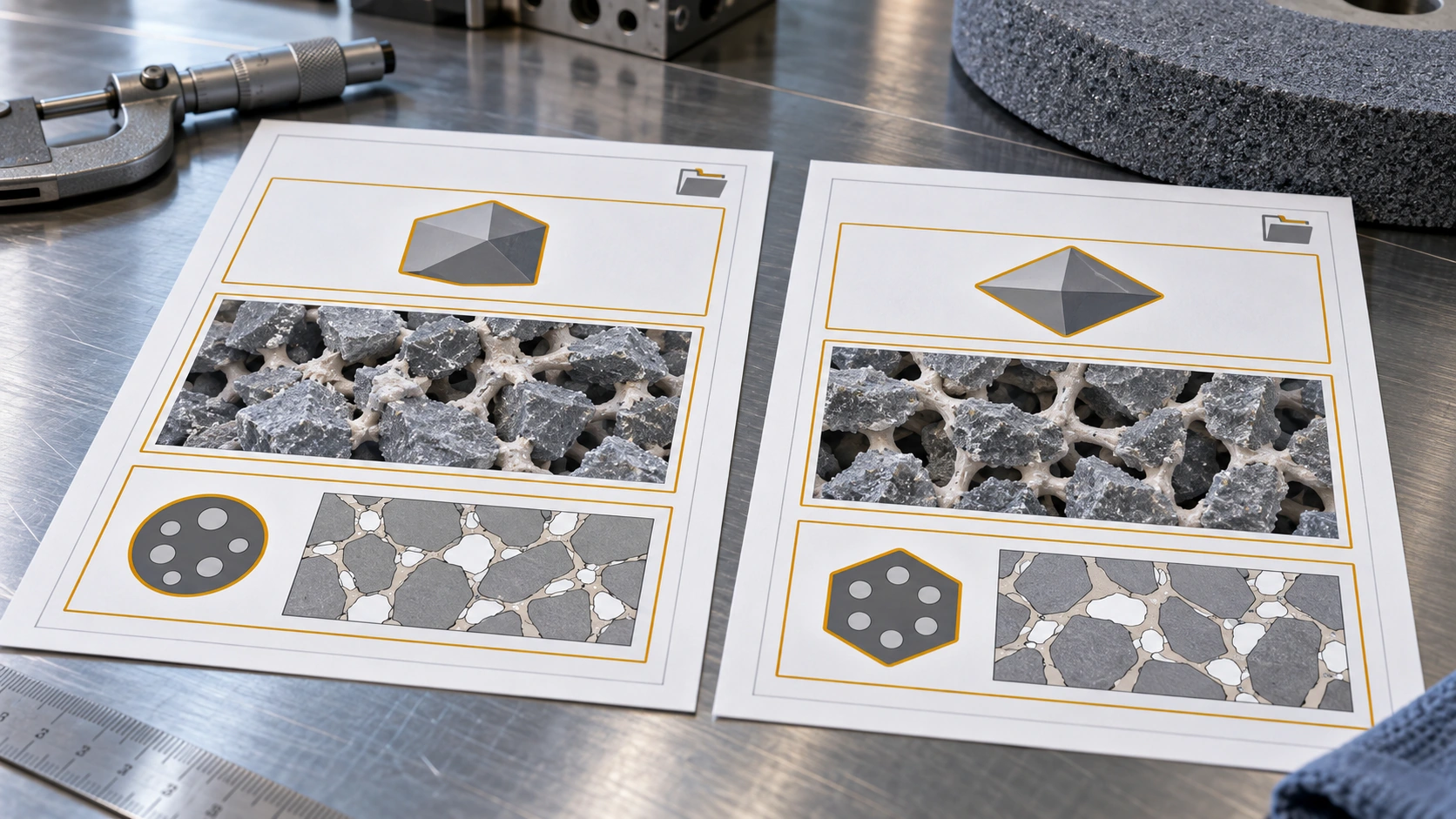
Two specification sheets side by side showing different grain shapes, abrasive structures and structure notation — representing the fields that vary between manufacturers rather than transferring between them.
A conceptual view, not a specification recommendation. These three are the fields that stay with the manufacturer. Everything else on the marking can be compared between suppliers; these cannot be carried across as though the same symbol meant the same product.

Fit and safety are absolute, not comparative

Everything above is a comparison between two products. Some requirements are not comparisons at all, and they do not become negotiable because a marking looks similar.

The speed limit belongs to one product

The maximum operating speed is a required part of the marking under the European scheme, and it belongs to one specific product and specification. It does not transfer to a wheel that looks the same, carries a similar marking, or came from a catalogue that listed a comparable wheel. Where more than one limit applies, the lower one governs. If it is unmarked, unreadable, or two sources disagree, the correct action is to confirm it rather than to estimate it. That subject has its own guide.

Mounting is a condition, not a comparison

Flange condition and fit, bore and spindle interface, and whether the guard suits the wheel and the operation are all conditions of safe use rather than points of comparison between two wheels. A replacement that fits the spindle but not the guarding arrangement is not a replacement, whatever the marking says.

Why these do not soften with a good match

A close specification match is reassuring about performance and tells you nothing about these. They are set by the wheel in front of you and by the machine it is going onto, and they stay the same whether the previous wheel performed well or badly.

What the old wheel can and cannot tell you

A replacement review usually starts with whatever survives of the wheel being replaced. It is worth being clear about what each item can prove.

A legible marking

The most useful thing available. Transcribe it exactly, field by field, including the prefix and the record numbers. Do not translate another maker's notation into your own terms during transcription — copy it, then interpret it separately.

A drawing

Establishes the geometry the wheel has to satisfy: diameter, thickness, bore, and any profile or abrasive-layer dimensions. It says nothing about grinding behaviour.

A worn sample

Can be measured for the dimensions that survive wear, and can show the condition the wheel ended its life in — loaded, glazed, worn out of form, or broken down unevenly. That condition is evidence about the process as much as about the wheel.

A photograph

Shows shape, general condition and any legible marking, and is often the fastest way to establish what is being discussed. It cannot confirm a specification.

The limit of all four together

The old wheel tells you what the operation has been running on. It does not, by itself, tell you what an equivalent from another supplier should be — because the fields that would settle that are exactly the ones the standard does not cover.

A fit is not a qualification

This is where replacement decisions most often go wrong, and it is worth separating two events that get treated as one.

What fitting proves, and what it does not

Fitting the wheel proves the wheel goes on. It does not prove the wheel is suitable. Between those two points sits the actual question: does this wheel produce an acceptable part, at an acceptable rate, with acceptable wheel consumption and dressing behaviour, under this machine, this coolant arrangement and this dressing practice.

The comparison is only readable if one thing changed

If a replacement wheel is introduced at the same time as a change to the dressing practice, a change to the coolant, or a change to the cycle, the result is a wheel-and-process change. It will not tell you which half did what, and the next decision inherits the same uncertainty.

Why a process problem should be settled first

If the current wheel is producing an unacceptable result, that is a process question before it is a sourcing question. A supplier change made to solve a process problem tends to produce the same problem from a new source — with the added cost of a change that now has to be unwound.

What a replacement review actually needs

The intake for a replacement direction is narrower than a full custom inquiry, and it is built around the two questions from the start.

What the wheel is being measured against

The current specification transcribed as printed, the machine and the mounting arrangement, and what the operation currently achieves — the result that has to be held, not only the result that is being missed.

Which fields are known and which are not

A marking with an unreadable prefix is a different starting point from a marking that is complete, and a wheel with no legible marking at all is a different starting point again. Saying which is which is more useful than filling every field with a guess.

Copied, corrected, or deliberately changed

These are three different jobs. Copying asks for the closest comparable direction. Correcting asks what the current wheel is failing at. Deliberately changing asks what the new wheel is meant to do that the old one did not — and that last one is a specification review rather than a replacement.

The process detail that decides whether any of it holds

The machine and how the wheel is mounted, the material and its condition, the operation and the contact it produces, the coolant and how it reaches the work, the dressing arrangement, and the result the operation has to guarantee. The full quotation side of this has its own guide.

Where the limits of a paper review are

It is worth being precise about what a supplier can and cannot establish before anything is run.

What can be established

Whether a proposed direction is technically coherent. Whether the geometry suits the machine and the mounting. Which parts of the specification are standardised and which are not. Whether the direction is worth trialling at all.

What cannot

That the wheel will be equivalent in your process, because that depends on your process. This is a limit of the method, not of any particular supplier, and a supplier who claims otherwise is claiming something they cannot know.

What converts a direction into a replacement

A controlled comparison: one change at a time, a recorded baseline, and a criterion agreed in advance for what counts as acceptable. That is what turns a reasonable direction into a qualified replacement.

The accurate description until then

A matching wheel is a candidate, not an equivalent. That is not a hedge — it is the precise state of knowledge, and it is the honest basis on which to plan a trial.

Advantages

What decides each half of the question

These are the areas where the two questions separate. The first three bear on whether the wheel is comparable at all; the last two decide whether it can be treated as a replacement.

Which fields the standard covers

Abrasive type, grain size, grade, structure and bond sit in a standardised sequence, so those fields can be compared between suppliers rather than guessed at.

Which fields stay with the maker

The prefix, the formulation behind a bond letter, and the structure number are the manufacturer's own and cannot be carried across as though the symbol meant the same product.

Which constraints are absolute

Maximum operating speed, mounting and guarding are conditions of safe use. They belong to a specific product and machine, and a good specification match does not soften them.

Whether the comparison is readable

A replacement result only tells you something if one thing changed. Introducing a wheel alongside a process change produces a result that cannot be attributed.

Whether a baseline was recorded

Without the current result written down, there is nothing to compare a trial against, and no agreed criterion for what would count as acceptable.

Before You Inquire

Comparing a wheel across suppliers

A replacement question is easier to answer when the current marking is transcribed exactly and the operation's present result is written down. The items below are what allow a direction to be proposed and, where it is justified, trialled against something.

Current wheel marking — Transcribed exactly as printed, including the prefix and any record numbers
Which fields are legible — Whether the marking is complete, partial, or unreadable
Copy, correct or change — Whether the wheel is being matched, corrected, or deliberately improved
Machine and mounting — Machine, spindle, flange arrangement and guarding
Drawing or measured dimensions — Diameter, thickness, bore, and any profile or abrasive-layer dimensions
Workpiece material and condition — Including hardness and heat-treatment state where known
Grinding operation — Surface, cylindrical, internal, centerless or another arrangement, and the contact it produces
Current result — What the operation is achieving now, and which result has to be held
Coolant — What is used, and how it is delivered to the contact
Dressing — The arrangement available and the interval being run
Trial and quantity — Whether a sample or controlled trial is possible, and the production quantity involved

Send these details through the inquiry form, or contact us on WhatsApp for a preliminary recommendation.

Send Grinding Details →

FAQ

Common questions about equivalent grinding wheel: what must match when you change supplier?

Quick answers to common buyer questions before sending an inquiry.

Is a grinding wheel with the same marking an equivalent wheel?

Not automatically. Conventional bonded wheels follow a standardised marking sequence, so fields such as abrasive type, grain size, grade and bond letter can legitimately be compared between suppliers. But the manufacturer prefix, the formulation behind a shared bond letter, and the structure number are the maker's own, and structure in particular is printed on scales that differ between manufacturers. A matching marking establishes that the wheels are comparable. It does not establish that they will behave the same way in your process.

Can I use another manufacturer's grit and grade numbers directly?

Within one marking system the notation is standardised, so those fields can be compared. Two cautions apply. More than one system is in use — the European and American scales are not identical, and superabrasive designations differ again — so wheels marked under different systems need their fields reconciled first. And a grade letter describes how a particular bond holds a particular grain, both of which belong to the manufacturer. The letter is comparable; the behaviour behind it is not.

If a replacement wheel fits and runs correctly, is it a qualified replacement?

Fitting proves the wheel goes on, and running without obvious fault proves it is not immediately wrong. Neither establishes that it produces an acceptable part at an acceptable rate with acceptable wheel consumption under your conditions. That requires a controlled comparison: one change at a time, a recorded baseline, and a criterion agreed beforehand for what counts as acceptable. Until that has been run, the wheel is a candidate rather than an equivalent.