Grinding Wheel Surface Speed vs RPM: How Wheel Diameter Changes Operating Speed

Grinding Wheel Knowledge Base

Grinding Wheel Surface Speed vs RPM: How Wheel Diameter Changes Operating Speed

RPM is the number of turns the spindle makes in a minute. Surface speed is how fast the wheel's circumference — the perimeter that meets the workpiece — moves past the contact, and it is the figure that describes the grinding condition. The two are linked by wheel diameter: v = π × D × n / 60, with D the wheel diameter in metres, n the RPM and v the surface speed in m/s, so the same RPM produces a different surface speed on every wheel diameter. What a calculation produces is a description of a condition, not an approval: the speed a wheel may run at is set by the maximum operating speed marked for the wheel and by the limits of the machine that carries it.

RPM is how fast the spindle turns; surface speed is how fast the wheel circumference moves past the workpiece
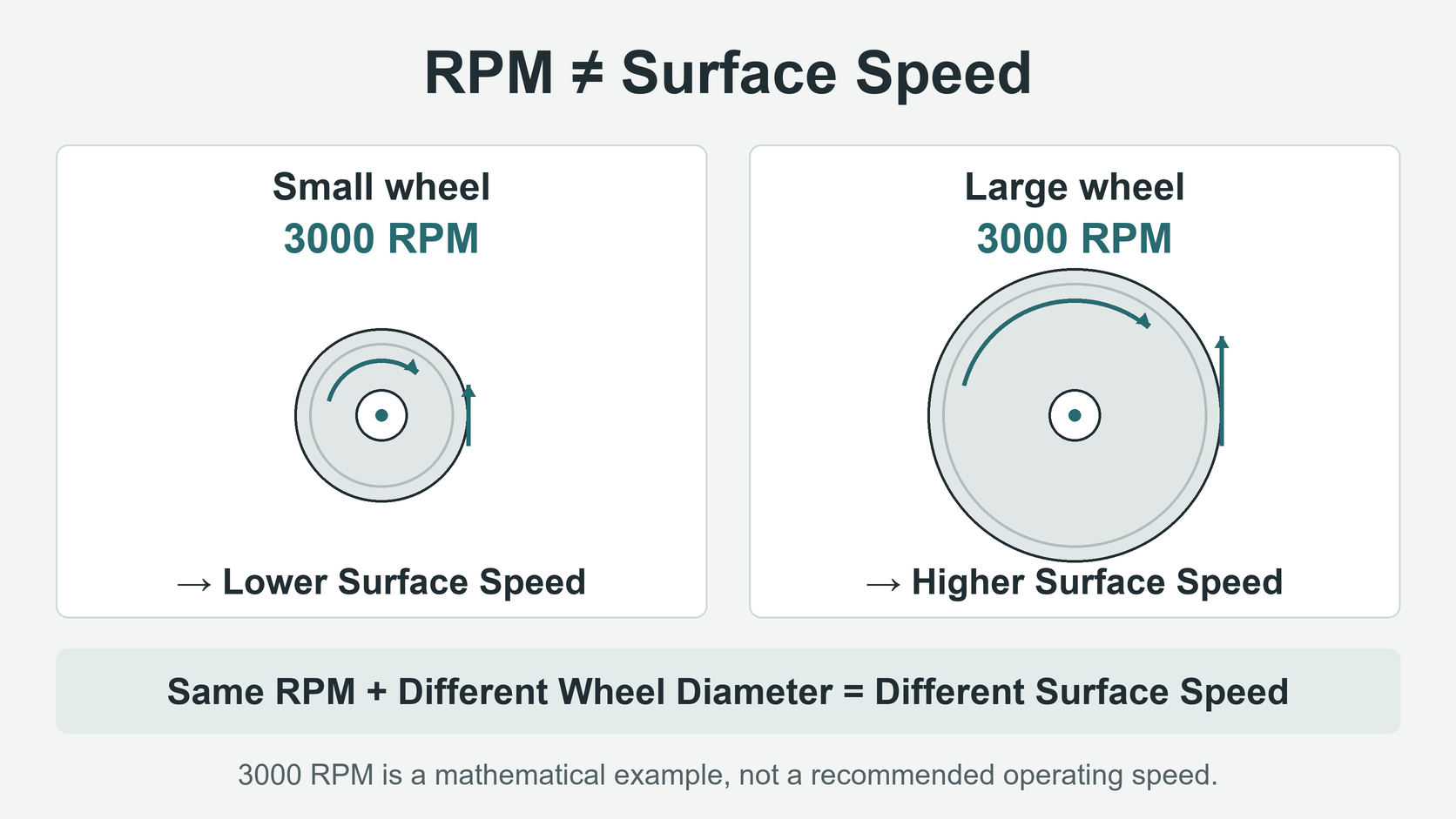
At the same RPM, a larger wheel diameter produces a higher surface speed
A calculated RPM or m/s value describes a condition, and is never an approval to run a wheel at that speed
The maximum operating speed marked for the wheel and the machine limits are confirmed before any speed is set

Overview

Quick answer

RPM, revolutions per minute, is the rotation rate of the wheel and the spindle. Surface speed, also called peripheral speed, is the linear speed of the wheel circumference as it passes the contact with the workpiece, normally written in m/s (metres per second) or, in imperial units, in sfpm (surface feet per minute). RPM and surface speed are not the same figure, and the term that links them is wheel diameter.

In its standard form the relationship is v = π × D × n / 60, where D is the wheel diameter in metres, n is the rotation rate in RPM and v is the surface speed in m/s. A grinding wheel is normally marked in millimetres, so the same relationship is often written with the conversion folded into the divisor: surface speed in m/s = π × wheel diameter in mm × RPM / 60,000. Because diameter sits at the top of it, the same RPM produces a higher surface speed on a larger wheel and a lower surface speed on a smaller one.

The practical consequence is that RPM on its own does not describe the grinding condition, and a calculated speed does not describe what a wheel is approved to do. A calculation tells you what a diameter and a rotation rate would produce; it does not tell you whether any wheel may be run there.

What speed is actually run is settled by three things together: the maximum operating speed marked for the wheel, the limit of the machine that will carry it, and the requirements of the actual grinding application. Where more than one limit applies, the lower applicable limit governs, and where a marking is missing, unreadable or in conflict with another source, the speed is confirmed rather than guessed. Youlin supplies grinding wheels, abrasive tools and grinding wheel solutions. The grinding operations and workpiece materials named in this guide are customer application contexts, and final suitability may require a sample or a controlled trial on the machine that will run the job.

What to hold on to before reviewing grinding wheel speed

  • RPM describes rotation; surface speed describes how fast the wheel circumference passes the workpiece.
  • Wheel diameter links the two: at the same RPM, a larger diameter means a higher surface speed.
  • A calculated speed is a description of a condition, not an approval to run the wheel at that speed.
  • The maximum operating speed marked for the wheel and the machine limits are both settled before a speed is set for the job.
  • Speed alone does not determine the result. Grit size, grade, structure, bond, contact area, dressing, coolant and machine condition act on it together.
Diagram of two grinding wheels of different diameters turning at the same RPM, with the larger wheel producing a higher surface speed at its circumference
Conceptual illustration only. The same RPM setting produces a different surface speed on each diameter; the illustration does not state an approved operating speed.

RPM and surface speed describe different things

These two numbers are often used as if they were interchangeable. They are not, and only one of them changes when the wheel diameter changes.

RPM — how fast the wheel turns

RPM, revolutions per minute, is the rotation rate of the spindle and the wheel. It states how many full turns the wheel makes in a minute. RPM is a property of the machine setting and the wheel fitted to it: one spindle running at one RPM turns a small wheel and a large wheel at the same rotation rate.

Surface speed — how fast the circumference moves

Surface speed, also called peripheral speed, is the linear speed of the wheel's outer edge as it passes the contact with the workpiece. It is the figure that describes how fast abrasive is presented to the work, and it is written in metres per second (m/s) or, in imperial units, in surface feet per minute (sfpm).

Why the distinction matters before a wheel is ordered

Two wheels of different diameters on the same spindle at the same RPM produce two different surface speeds, so one RPM setting does not reproduce one grinding condition across diameters. When a wheel is replaced with a different diameter, the figure that has to be compared is the surface speed, not the RPM.
The surface speed relationship and its working form

The link between RPM, wheel diameter and surface speed is arithmetic. It is set out here in its standard form and in the form used when a diameter is marked in millimetres, so a machine setting can be compared across wheel diameters.

The relationship in its standard form

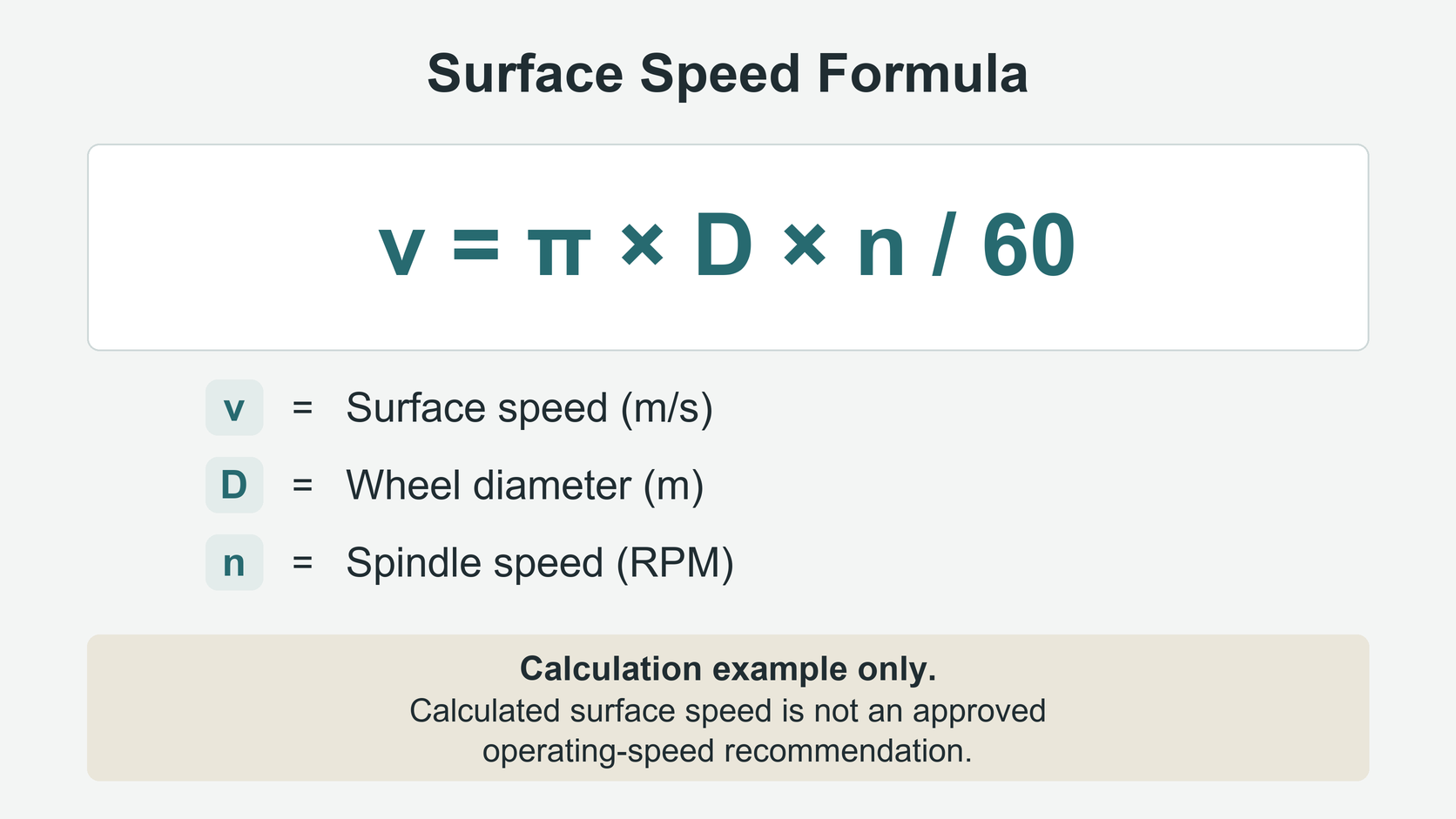
Surface speed v = π × D × n / 60, where D is the wheel diameter in metres, n is the rotation rate in RPM and v is the surface speed in m/s. The diameter has to be in metres for the result to come out in metres per second, because the 60 converts revolutions per minute into revolutions per second.

The same relationship with the diameter in millimetres

Surface speed in m/s = π × wheel diameter in mm × RPM / 60,000. A grinding wheel is normally marked in millimetres, so this is the standard form with the unit conversion folded into the divisor: millimetres per minute become metres per second by dividing by 1,000 and then by 60. The two forms give the same result.

RPM from a known surface speed

RPM = surface speed in m/s × 60,000 / (π × wheel diameter in mm). This is the same relationship rearranged, and it is the form used when the question is what rotation a given wheel diameter would need.

The same relationship in imperial units

Surface feet per minute = π × wheel diameter in inches × RPM / 12. The structure of the relationship is identical; only the unit conversion changes.

What the calculation does not tell you

A calculated speed describes the condition a diameter and a rotation rate would produce. Calculated speed is not the wheel's approved operating limit, and it is not a statement that the wheel may be run at that speed. What may be run is settled by the wheel marking, the machine limit and the application.

Why wheel diameter changes the operating speed

Diameter is the term that links rotation to speed. Change it and the surface speed changes even when the RPM setting does not.

One RPM setting on two diameters

At a fixed RPM, surface speed is proportional to diameter. Doubling the wheel diameter doubles the distance the circumference travels in the same time, so the surface speed doubles; halving the diameter halves it. The rotation rate has not changed. What changed is how much wheel edge passes the contact in a minute.

Illustrative calculation only

A wheel of 400 mm diameter turning at 1,500 RPM gives a surface speed of about 31 m/s. In the standard form, with D as 0.4 m: π × 0.4 × 1,500 / 60 = 31.4 m/s. With the diameter in millimetres: π × 400 × 1,500 / 60,000 = 31.4 m/s. Both forms give the same figure. Calculation example only: it is not a wheel speed rating, and it does not establish an approved operating speed.

The direction buyers usually find surprising

Buyers often expect the larger wheel to be the more demanding one. At a fixed RPM it does produce the higher surface speed, but the same relationship also means that as a wheel is dressed down and its diameter falls, the surface speed produced by that same machine setting falls with it.

What we check when a customer sends only an RPM

An inquiry that arrives as a single RPM figure cannot be worked from on its own. The same RPM describes a different surface speed on every wheel diameter, so the first reply asks for the rest of the picture: the wheel marking and the maximum operating speed printed on it, the measured wheel diameter, the machine model and its spindle speed range, the workpiece material and hardness, the grinding method, and — where coolant reaches the contact — its condition. A photo of the marking or a part drawing often answers at once what several exchanges otherwise would. The RPM is then read together with the wheel, the machine and the grinding condition.

What happens to speed as the wheel wears

Every dress reduces the wheel diameter. That changes the surface speed produced by a fixed RPM setting before anything else in the process is changed.

Diameter falls, surface speed falls

On a fixed RPM setting, a smaller wheel produces a lower surface speed, because its circumference travels less distance per revolution. How much the speed falls depends on how much diameter has been removed, not on how many dresses have been taken.

When the change starts to show in the grinding

A fall in surface speed at the contact can show up as a change in grinding behaviour: the wheel may present abrasive differently and the contact may behave differently. That is a signal to look at the setup as a whole — wheel specification, dressing practice, coolant delivery and machine settings — rather than to compensate for it by turning the spindle up.

Why RPM is not increased automatically

Increasing RPM to restore a surface speed is not a routine step. Any change to rotational speed still has to remain inside the maximum operating speed marked for the wheel, inside the machine's capability, inside the manufacturer's instructions and inside the applicable safety requirements. Those four are not alternatives to one another, and a speed that has not been confirmed is not run.

The alternative that is normally reviewed

When a wheel has been dressed down a long way and the operation was set up around the surface speed it produced, replacing the wheel is an ordinary route back to the original condition. The minimum usable diameter and the machine's stated wheel size range are the reference points, and both are recorded rather than estimated.

Maximum operating speed is a safety limit, not a target

The maximum operating speed is the limit the wheel is approved to run at. It is a boundary to stay inside, not a process setting to aim for and not a starting point to work down from.

What the maximum operating speed is

The maximum operating speed is stated by the wheel manufacturer and marked for the product. It may appear on the wheel itself, on its label or packaging, or in the manufacturer's documentation, and it sets the highest speed the wheel is approved to run at for its stated conditions of use.

Where the limit is read from

The marking on the wheel, the label and packaging, and the manufacturer's documentation for that product and specification are the sources that define the limit for that wheel. A catalogue from another supplier, a wheel that looks the same and an earlier job are not sources for it.

The machine side of the comparison

The wheel limit is only half of the check. The machine's maximum spindle RPM, the spindle arrangement, and the machine's stated wheel size range also have to be confirmed, together with the wheel construction, bond and dimensions, the mounting, and the guard, which must suit the wheel and the operation. Where more than one limit applies, the lower applicable limit governs.

When the information is missing or conflicting

If the maximum operating speed is not marked, is unreadable, or one source disagrees with another, the speed is not guessed and the wheel is not run until the correct limit is confirmed. A speed taken from the wrong source is not a safer speed; it is an unknown one.

What actually settles the working speed

Three things settle it together: the maximum operating speed marked for the wheel, which is the ceiling; the limit of the machine and spindle that will carry it; and the requirements of the actual grinding application — the operation, the workpiece, the contact and the result that has to be held. The marked maximum is a ceiling, not a working speed. The working speed is chosen for the application inside that ceiling, and it is normally below it rather than at it.

The mistake that follows from all of this

A calculated surface speed or RPM is treated as an approval. It is not one. The calculation says what a diameter and a rotation rate would produce, and nothing more; the permission comes from the wheel itself and from the machine that carries it.

The published basis for the marked limit

Two published requirements sit behind the practice described above. In the European marking scheme for bonded abrasives, oSa / EN 12413 sets out which information a wheel marking has to carry, and the stated maximum operating speed is part of it. The FEPA safety code for abrasive products treats that marked maximum as the limit the wheel is approved to run at, with the machine limits and the guarding applying alongside it. Other regions may use different safety requirements. In every case, the wheel's marked maximum operating speed must be respected together with the machine's applicable speed limit and the manufacturer's instructions.

How wheel speed affects grinding behaviour

Speed changes how the wheel meets the work. It is one factor among several, and it is rarely the only one acting on a result.

What changes with surface speed

At a higher surface speed, more abrasive passes the contact in the same time, and the way material is removed, the heat generated and the way the face wears can all change. At a lower surface speed the same wheel presents abrasive more slowly, which moves the same set of things in the other direction.

Why speed alone does not determine the outcome

Grit size, wheel grade, structure and bond, the contact area and contact length, the stock being removed, the dressing that produced the face, coolant type and delivery, and the condition of the machine and work holding all act on the same result. A speed change that appears to remove a symptom can be masking one of these, and a symptom that looks like a speed problem frequently is not one.

Two specification questions that come up first

The grade question — how firmly the bond holds the grain — is reviewed through grinding wheel hardness and grade selection. The question of how much pore space sits between the grains is reviewed through grinding wheel structure and porosity selection. Wheel speed is reviewed alongside both rather than instead of them.

How to tell whether speed is the variable

Record the surface speed in use, the wheel diameter it was calculated from, and the symptom with its timing in the cycle. Change one item at a time against a written baseline, because a speed change made together with a grade change or a dressing change cannot be attributed afterwards.

The same RPM does not mean the same application

One RPM figure can sit on two machines running two unrelated operations. It describes rotation, not the work being done.

One number, different conditions

An RPM figure carries no information about the wheel diameter fitted, the contact between wheel and workpiece, the stock being removed or the finish required. Two operations can share an RPM figure and have nothing else in common.

Why no specification chart follows from this

It is tempting to build a table that maps a diameter and an RPM to a wheel. Such a table would be wrong in the same way a universal speed limit is wrong: it would ignore the wheel's own marking, the machine, the operation and the workpiece material. This guide sets out the relationship rather than a specification chart.

What to record instead of a single number

Record the wheel diameter as measured, the spindle RPM or the surface speed in use, and the operation it is running. With those three together the speed relationship in a job can be read. With an RPM figure on its own it cannot.

Machine and spindle information for the speed check

The machine sets the rotation that is available and the range of wheel sizes that can be mounted on it.

What the machine contributes

The spindle's available speed range and its maximum RPM, the spindle arrangement and overhang, the machine's stated wheel size range, and the condition of the spindle and mounting all affect the speed a job can actually run at. The spindle speed available for the job in front of you is the figure that matters, not a machine maximum.

Why the machine maximum is not the working figure

A machine may be able to turn faster than a given wheel is approved for. The machine's maximum is a capability, not a permission. The limit that applies is the lower of the wheel's marked maximum operating speed and the machine's own limit.

What to record

Record the machine model, the spindle speed range and maximum, the machine's stated wheel size range, the wheel diameter fitted, and how the speed in use was set or measured. If the spindle speed is not known, record it as unknown rather than estimating it.

Checking speed when an existing wheel is replaced

A replacement wheel is a new specification with its own limit. These are the steps in the order the speed questions are normally settled.

1. Read the wheel being replaced

Copy the complete marking from the wheel in use, including the maximum operating speed as printed, and note the measured diameter rather than the nominal size.

2. Read the machine limits

Record the machine's spindle speed range and maximum, its stated wheel size range, and the guard and mounting arrangement in use.

3. Compare the two sets of limits

The replacement wheel carries its own marked maximum operating speed, and it is not always the same as the one on the wheel coming off. The wheel figure and the machine figure are read side by side, and the operation works to whichever of the two is lower.

4. Check the diameter change

If the replacement is a different diameter, work out the surface speed the intended RPM produces on it. A like-for-like RPM setting is not a like-for-like grinding condition once the diameter has changed.

5. Confirm the fitting conditions

Confirm that the wheel type, dimensions, bore and mounting suit the machine, and that the guard suits the wheel and the operation. Speed suitability is never separate from the mounting and guarding around it.

6. Record the speed actually used

Record the surface speed, or the RPM together with the diameter it was calculated from, and note how it was set. A speed that is not recorded cannot be compared with the next wheel.

7. Confirm before the wheel is run

If any limit is missing, unreadable or in conflict with another source, stop and confirm it before the wheel is run. A calculation does not authorise the run.

Common mistakes when grinding wheel speed is discussed

These are the recurring errors that come up before a wheel is selected or replaced.

Treating RPM as the speed that matters

RPM is a rotation rate. Without the wheel diameter it does not describe the grinding condition, and two wheels at the same RPM can be running at very different surface speeds.

Matching the old RPM instead of the old condition

When the diameter changes, reproducing the previous RPM setting does not reproduce the previous surface speed.

Reading the maximum operating speed as a target

The marked maximum is a limit, not a process setting to aim for. Running at the limit leaves no margin and is not a goal in itself.

Treating a calculation as an approval

A calculated surface speed or RPM says what the setup would produce. It never says that a wheel may be run there.

Using the machine maximum as the working speed

The machine's capability is not the wheel's approval. The lower of the two applies.

Raising RPM as the wheel wears, as a routine step

Restoring a surface speed by turning the spindle up is not a routine adjustment. It has to remain inside the wheel marking, the machine limits, the manufacturer's instructions and the applicable safety requirements, and it is not a change to make on assumption.

Taking a limit from a similar wheel or another supplier

A maximum operating speed belongs to a specific product and specification. It does not transfer to a wheel that looks the same.

Sending an RPM figure without its diameter

An RPM number on its own cannot be checked against anything. Send the wheel diameter it belongs to, or the surface speed, together with the operation it is running.

Advantages

Key Technical Points

Key benefits and performance characteristics for industrial grinding applications.

Formula diagram showing surface speed v equals pi times wheel diameter D times rotation rate n divided by 60, with D in metres, n in RPM and v in metres per second
Conceptual illustration only. D is the wheel diameter in metres, n is the rotation rate in RPM and v is the surface speed in m/s. The illustration does not state an approved operating speed.
AspectRPM — revolutions per minuteSurface speed — m/s at the wheel circumference
What it describesThe rotation rate of the spindle and the wheel, in revolutions per minute.The linear speed of the wheel circumference as it passes the contact, in m/s or sfpm.
What it depends onThe machine setting and the spindle speed selected.The machine setting together with the wheel diameter fitted to it.
What changes when the diameter changesNothing. The same RPM setting turns both wheels at the same rotation rate.Everything. A larger diameter produces a higher surface speed at the same RPM.
What the figure is used forSetting and recording the machine, and comparing one setup with another on the same machine.Describing and comparing the grinding condition, including across different wheel diameters.
What the figure does not stateWhether the wheel is approved to turn at that rate.Whether the wheel is approved to run at that speed.
Where the limit comes fromThe machine's spindle range, together with the wheel's marked maximum operating speed.The wheel's marked maximum operating speed, the machine limits and the applicable safety requirements.
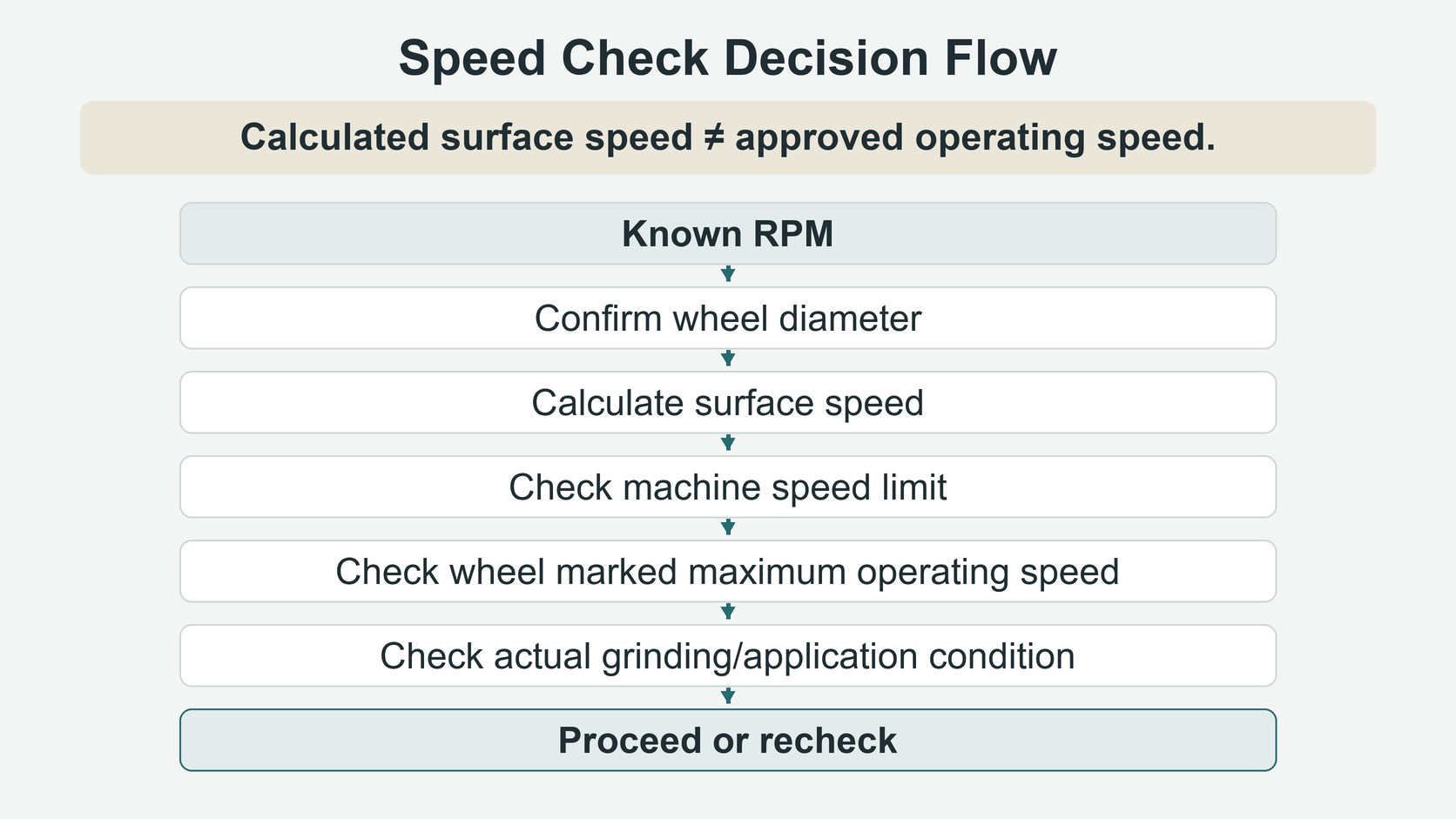
Decision flow from RPM and wheel diameter, through the calculated surface speed, to the machine limit and the wheel's marked maximum operating speed, ending in proceed or recheck
Conceptual flow. RPM and wheel diameter give a calculated surface speed; the machine limit and the wheel's marked maximum operating speed are then checked. If a limit is missing, unclear or conflicting, the flow returns to recheck rather than proceeding.

Speed record

Check the grinding wheel speed information before selecting or replacing a wheel

A complete speed record shows which questions still need an answer before a wheel direction can be reviewed.

1

The maximum operating speed marked for the wheel in use is recorded as printed, together with where it was read from.

2

The wheel diameter is recorded as measured, with the bore and width, rather than the nominal size alone.

3

The machine's spindle speed range and its maximum, plus the machine's stated wheel size range, are recorded.

4

The surface speed or the RPM in use is recorded together with the diameter it was calculated from, or marked as unknown.

5

The guard and mounting arrangement that suit the wheel and the operation are described.

6

The grinding operation, the workpiece material and the result that has to be held are stated next to the speed figures.

Before the inquiry

What to send before asking for a wheel speed review

Prepare one package per grinding operation. If two operations run different wheel diameters, send them separately.

Operation — The grinding operation and the feature being produced, such as surface, cylindrical, internal, form or profile grinding
Workpiece material — Material grade as stated on the drawing or certificate, plus heat-treatment condition
Hardness — Measured value, scale and where it was taken
Current wheel marking — The complete reading as printed, including abrasive, grit size, grade, structure, bond and the marked maximum operating speed
Wheel dimensions — Measured outside diameter, bore and width, plus the working face width or form where relevant
Maximum operating speed source — Where the marked limit was read from, whether the wheel, the label, the packaging or the manufacturer's documentation
Wheel photos — Complete wheel, label, the markings printed on the wheel and the working face, with the diameter visible against a scale where possible
Machine details — Machine model, spindle arrangement, overhang and work-holding or support condition
Spindle speed — The machine's available speed range and maximum RPM, and the speed actually used for the operation
Speed in use — The surface speed or RPM the operation runs at, together with the wheel diameter it belongs to, or marked as unknown
Process settings — Feed, infeed, stock allowance, workpiece speed and cycle stages in use, where known
Coolant — Fluid type, measured concentration where available, filtration state, nozzle position and whether flow reaches the contact zone
Dressing — Method, dresser type and condition, dress depth, parameters, parts between dresses and the reason a dress is called
Result required — Finish, form, size or roundness requirement from the drawing, and the method used to inspect it
Current problem — The symptom, where it appears, when it appears in the cycle and how it has changed over time
Trial context — Sample quantity available, expected demand if the process is confirmed, and the parts of this record still unknown

Send the wheel marking with the marked maximum operating speed, the measured wheel diameter, the machine's spindle speed range and the operation details. Unknown values may be marked as unknown; we will review whether the information is sufficient for a grinding wheel recommendation.

Send Grinding Details →

FAQ

FAQ on grinding wheel RPM and surface speed

Questions that come up before wheel speed is compared or a wheel is replaced.

What is the difference between grinding wheel RPM and surface speed?

RPM counts how many turns the wheel makes in a minute; surface speed is the speed of the wheel's circumference past the contact. The two part company as soon as the diameter changes: on the same spindle at the same RPM, a larger wheel presents abrasive to the work faster than a small one. That is why a comparison between two wheels is a surface-speed comparison, not an RPM comparison.

Which surface speed formula should I use, and in what units?

Both forms describe one relationship. v = π × D × n / 60 takes the diameter in metres and returns metres per second. Because wheels are marked in millimetres, the same relationship is usually written as π × wheel diameter in mm × RPM / 60,000. Mixing the two is the commonest arithmetic error: a millimetre diameter put into the first form returns a figure one thousand times too large. In imperial units, sfpm = π × wheel diameter in inches × RPM / 12.

Why can two wheels of the same size carry different maximum operating speeds?

Because the marked maximum belongs to the product and the specification it was approved under, not to the diameter. Two 400 mm wheels of different specifications, or from different manufacturers, are two separate approvals. The figure that applies to a job is the one marked for the wheel in hand; a similar wheel, an earlier job or another supplier's catalogue is not a source for it.

Can I run a wheel at the RPM I calculated?

No. A calculated value describes a condition, not an approval. What the wheel may run at is set by its marked maximum operating speed and by the machine's own limits, read together with the mounting and the guard. Where the marking is missing or unreadable there is nothing to check the calculation against, so the speed is confirmed first.

Should I raise the RPM as the wheel wears and the diameter gets smaller?

Not as a routine step. On a fixed RPM setting the surface speed falls as the diameter falls, and a change in grinding behaviour that follows is normally a signal to look at the whole setup rather than to turn the spindle up. Where the operation was built around the surface speed the wheel produced when it was new, replacing the wheel is the ordinary route back to it. There is no universal wear-compensation rule.

Is the machine's maximum spindle RPM the speed I should use?

No. A machine maximum is a capability, not a permission, and on many machines it is higher than the wheel is approved for. A job works to the lower of the wheel's marked maximum operating speed and the machine's own limit. The spindle range is still useful information, because it tells you what is achievable on that machine before a wheel is chosen.