Grinding Wheels for Bearing Raceway Grinding

Grinding Wheel Knowledge Base

Grinding Wheels for Bearing Raceway Grinding

A raceway is a toleranced groove, not a plain cylindrical surface. Wheel choice follows the ring position, the profile that has to come out of the grinding pass and the way the current setup behaves.

Confirm whether the raceway sits on the inner ring or the outer ring before comparing wheels
Send the groove section from the drawing instead of a description of the bearing type
Note how the profile is generated and how many parts it holds between dresses
Describe where burn, chatter, finish drift or profile loss appears on the raceway

Overview

Quick answer

Raceway grinding wheels are reviewed against the ring position, the raceway geometry on the drawing, the workpiece material and hardness, the machine and spindle condition, coolant delivery, the dressing method and the result the process has to hold. Two rings that look similar can lead to different review directions once contact, profile and dressing arrangement are taken into account.

This guide covers inner and outer raceway grinding, profile generation and retention, hardened bearing ring materials, dressing, coolant and machine condition, and the problems that most often bring a raceway wheel back into question. Youlin supplies grinding wheels, abrasive tools and grinding wheel solutions. Bearing rings and raceways described here are customer workpieces and application contexts. Final suitability may require a sample or a controlled trial on the machine that will run the job.

What drives the review direction

  • The inner raceway and the outer raceway are ground from opposite directions, so they rarely share one specification.
  • Raceway profile comes from the drawing and from how the wheel face is dressed, not from the bearing type name.
  • Hardness is one input. Contact length, stock allowance, groove width and the finish target carry equal weight.
  • Dressing frequency is a symptom to read, not a number to target.
  • Profile loss and grinding burn can share a cause, so record the sequence before assuming which one came first.
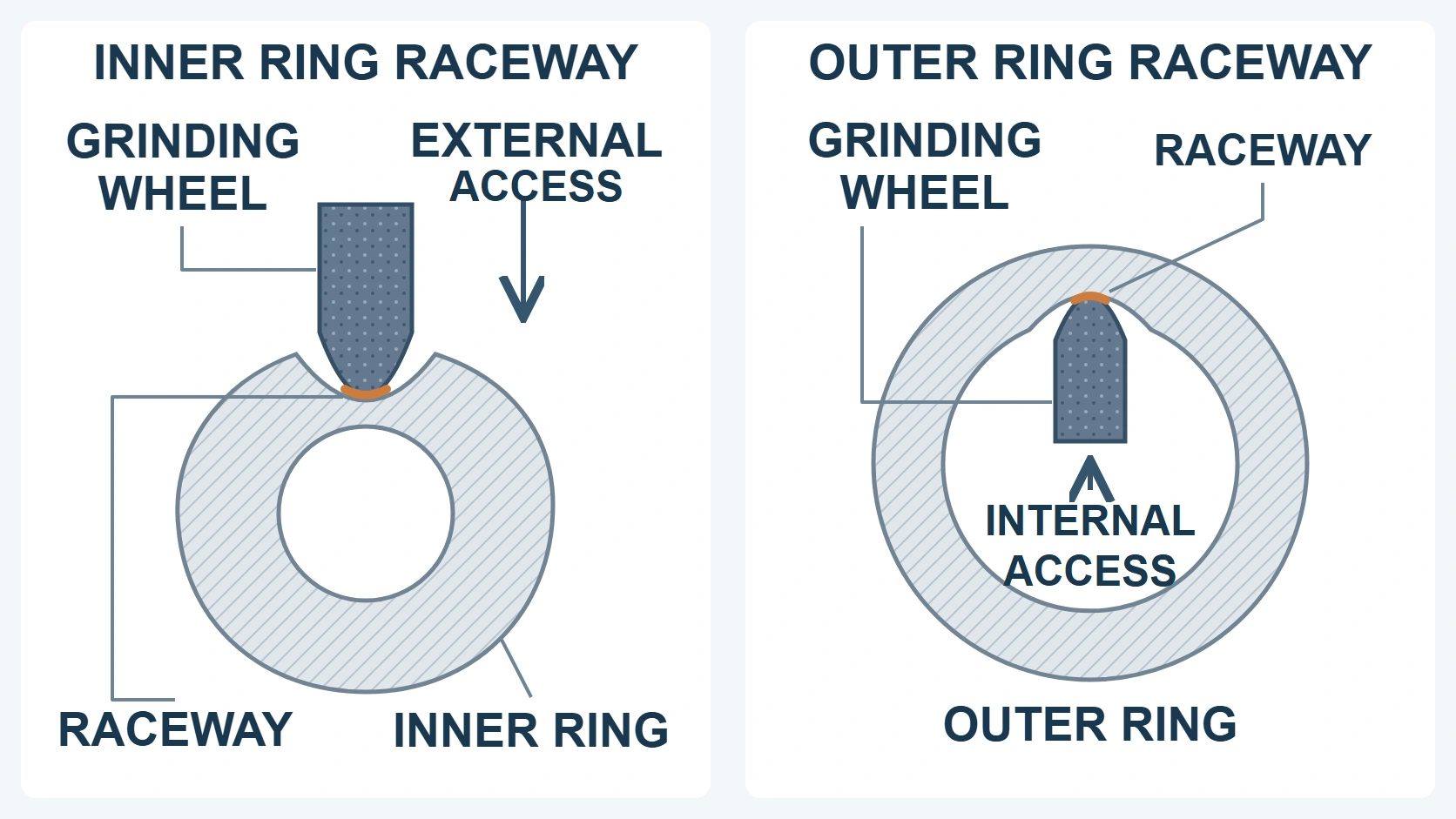
Comparison of grinding wheel contact positions for inner and outer bearing raceway grinding
Typical schematic comparison: inner-ring raceway grinding uses external access, while outer-ring raceway grinding requires access inside the bore. Not to scale.

Inner raceway grinding and outer raceway grinding

The two positions put the wheel into the groove from opposite directions, which changes access, contact length and how the profile is held.

Inner raceway grinding

The wheel works inside the ring bore, so wheel diameter, arbor or quill size, overhang and clearance set the practical limit. Contact length grows quickly when the wheel is close in size to the bore, and coolant has to reach a confined zone. Send the bore diameter and depth, the usable wheel width and the axial position where size, finish or chatter changes.

Outer raceway grinding

The wheel approaches the outer ring from outside, so the ring has to be supported and driven without distorting the raceway. Support condition, work drive, roundness and the relation between the wheel face and the groove all belong in the review. State whether the operation is a plunge form or a traversed pass.

What stays the same on both

Either position still depends on the same inputs: ring material and hardness, the profile on the drawing, the dressing arrangement, coolant delivery, machine condition and the inspection result the process has to hold. Treat the ring position as the first filter, not as the specification.

Raceway geometry and profile

Raceway form is a toleranced feature. It is produced by the wheel face and the dressing path together, so both have to be described.

Read the profile from the drawing

Deep groove, tapered roller and spherical or curved raceways each present a different groove section and contact angle. The drawing defines the arc, shoulder positions, groove width and the tolerances that apply. Describe the profile from those dimensions rather than from the bearing type name alone.

How the profile is generated

A formed wheel face can transfer the groove shape into the ring, while a dressed or CNC-generated path builds the form through the dressing motion. The review needs to know which one applies, because it decides how much of the profile depends on the wheel and how much depends on the dressing system.

Profile retention between dresses

Profile loss shows up as a drifting groove shape, a widening contact band or a finish change partway through a batch. Record how many parts the profile holds, what the first sign of drift looks like and whether the wheel face or the dresser is the limiting item.

Hardened bearing ring material and hardness

Send the grade that reaches the wheel

Hardened bearing steels such as GCr15, 100Cr6, SUJ2 and 52100 are common in ring and raceway work. Send the grade named on the drawing or the material certificate, with the heat-treatment condition and the hardness value actually measured on the ring.

Hardness is one input, not the rule

A high hardness value does not settle the abrasive choice on its own. Contact length, stock allowance, groove width, finish target, machine capability and coolant delivery all act on the same result. Use the measured hardness as one input to the review and keep the rest of the record alongside it.

Watch for layers and interruptions

A case-hardened ring, a coated surface or a groove that runs into a shoulder can change the material the wheel meets across a single pass. Mark where the hardness was measured and whether the grinding path crosses into a different layer.

Conventional or CBN grinding wheel: what to review

Both directions stay open for hardened bearing steel. The useful question is which one fits the actual raceway process, not which one is newer.

Conventional grinding wheels

Aluminum oxide and related conventional abrasives remain relevant for bearing raceway grinding and are often the baseline already running on the machine. Where the current wheel holds profile, finish and the inspection result across an acceptable dressing cycle, that baseline is worth measuring before it is replaced.

CBN grinding wheels

CBN may be considered in some raceway applications, particularly where the process has to hold profile and finish over long runs on hardened steel. Review it together with raceway geometry, material and hardness, machine capability, wheel speed and spindle condition where known, coolant delivery, the dressing system and the production requirement. CBN is not automatic for a hardened raceway.

Diamond in this context

Diamond is generally associated with carbide, ceramic and other compatible non-ferrous or non-metallic work. Because diamond reacts with iron at grinding temperature, it is not presented here as a normal recommendation for steel bearing raceways.

Keep the comparison controlled

Changing the abrasive, the bond, the coolant and the dressing parameters in one step makes the result hard to read. Define a baseline, change one item, and agree the inspection criteria before the comparison starts. Final suitability may still require a sample or a controlled trial.

Dressing and raceway profile retention

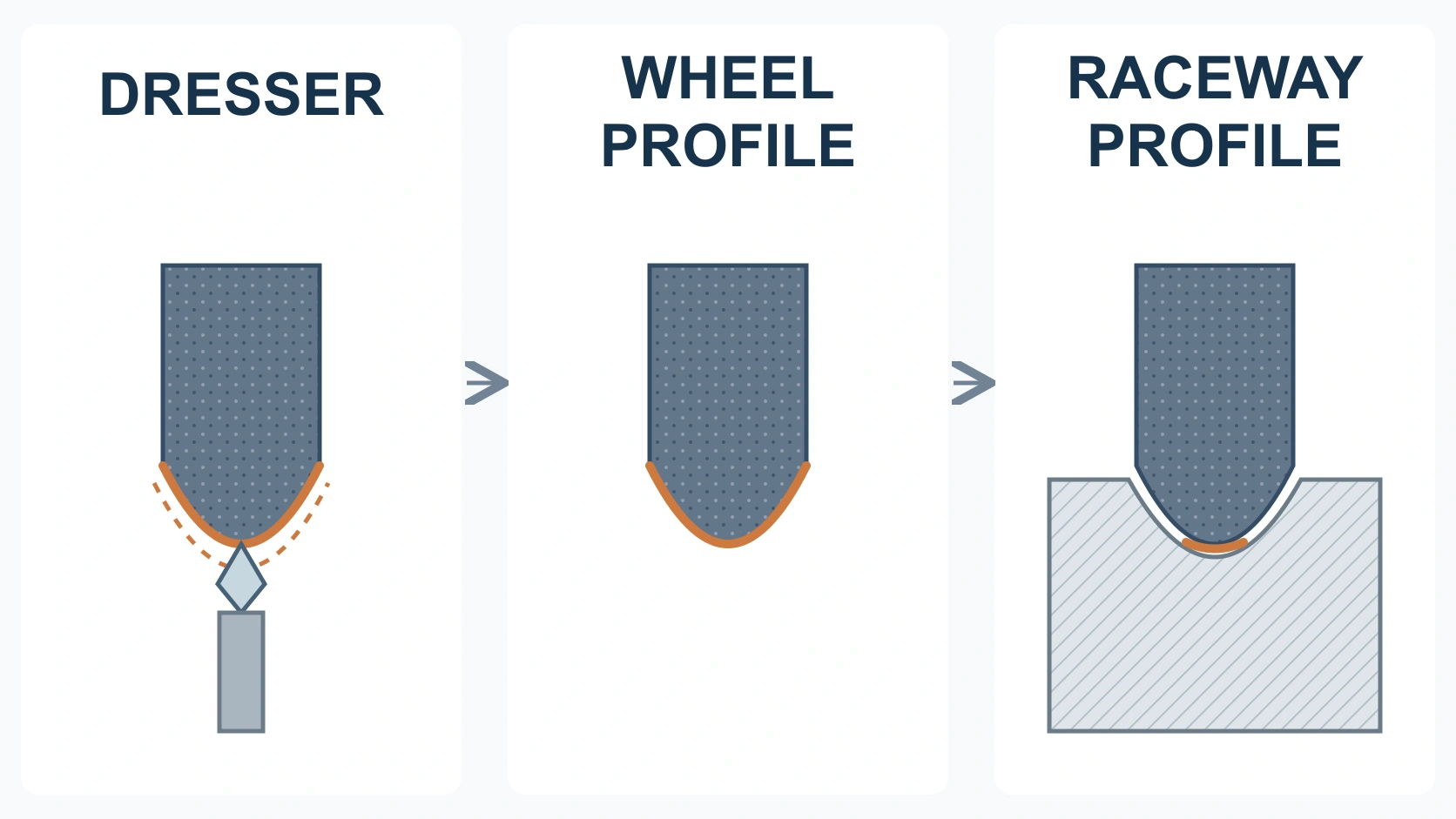
On a raceway, dressing does two jobs at once: it restores the grinding face and it re-establishes the groove form.

Dressing sets the profile

Every dress moves the wheel face, so the dresser form, dress depth, speed and number of passes decide what the next parts will look like. Send the dressing method, dresser type and condition, the parameters in use and whether the form is dressed into the wheel or generated through the motion.

Read dressing frequency as a symptom

Dressing more often is an observation, not a target. It may point to wheel grade, structure or bond, to a coolant problem, to the dressing parameters themselves or to the profile demand of the groove. Record how many parts run between dresses, what forces the dress and what changes afterwards.

Separate wheel wear from dress loss

Material removed by dressing is not the same as wear during grinding. Measure both and note which part of the profile changes first. That split decides whether the review should look at the wheel, at the dresser or at the process around them.

Coolant delivery and machine condition

Coolant has to reach the contact arc

The raceway contact is a short arc inside a groove or a bore, and flow can easily miss it. Send the coolant type, measured concentration when available, filtration state, nozzle position and direction, and whether the flow reaches the full contact band through the whole cycle.

Machine, spindle and support

Spindle or quill condition, overhang, wheel mounting, balance and work support all appear in the raceway as size spread, chatter or finish drift. Send the machine model, the speeds and infeed in use and the condition checks already made, rather than the nominal machine rating alone.

Hold one baseline

Record the settings that produced an acceptable raceway in a form that can be repeated. When a problem appears, comparing against a written baseline is faster than reconstructing the previous setup from memory.

Common mistakes when selecting a raceway grinding wheel

Choosing from the bearing type

A bearing designation describes an assembly, not a wheel. The same bearing type can be produced with different ring materials, hardness levels, groove tolerances, stock allowances and dressing systems. Build the wheel record around the operation instead.

Treating the profile as a detail

Raceway form is the feature the customer inspects. When the groove section arrives late in the discussion, the wheel and dressing review has to start again. Put the profile and its tolerances into the first message.

Comparing wheels without a controlled result

A new wheel tested against an old one, on a different coolant condition, with different dress settings, produces a result that cannot be attributed to any single change. Agree the measurement method and hold the rest of the setup steady.

How a raceway wheel recommendation is reviewed

The review moves from what the raceway has to be, to what the process can hold, to which wheel directions are worth comparing.

Step 1 — Define the raceway

Start from the drawing: ring position, groove section and tolerances, material and hardness, stock allowance and the inspection method. Everything after this step is measured against it.

Step 2 — Describe the process

Add the machine, spindle or quill and support condition, the wheel currently in use with its full readable marking, coolant delivery, dressing method and the cycle stages that matter.

Step 3 — State the problem and the target

Name the symptom, its location on the groove, when it appears in the cycle and what has already been changed. Add the result the process has to reach, with the method used to measure it.

Step 4 — Review, then confirm on the machine

The review identifies missing information and the wheel directions worth comparing. Final suitability may require a sample or a controlled trial under the same inspection criteria, because a raceway result depends on the whole setup rather than the wheel alone.

Diagnostic reading

Raceway problems and where to look first

One symptom on a raceway can come from several places in the setup. Record where and when it appears before attributing it to the wheel specification.

Grinding burn on the raceway

What to inspect first
Check coolant delivery to the contact arc, wheel face condition, stock allowance and infeed before naming a single cause.
Information needed
Where the mark sits on the groove, which cycle stage produces it, dressing history and the inspection result.

Chatter marks across the groove

What to inspect first
Check wheel balance and mounting, spindle or quill condition, work support and the speeds in use alongside wheel face condition.
Information needed
Spacing and direction of the marks, setup details, when chatter begins and any recent change to the machine.

Unstable surface finish

What to inspect first
Check dressing consistency, coolant cleanliness and how the wheel face changes between dresses.
Information needed
Ordered roughness results, the measurement method, the cycle position and the time since the last dress.

Rapid wheel wear

What to inspect first
Separate wear during grinding from material removed by dressing, then review contact length and profile demand.
Information needed
Measured size or profile loss, parts per dress, dress depth and where the profile changes first.

Loading on the wheel face

What to inspect first
Check adhered material, chip space in the wheel structure, coolant flushing and dressing effectiveness.
Information needed
Wheel face photos before and after dressing, ring material, time to loading and coolant condition.

Glazing of the wheel face

What to inspect first
Check dull grain, wheel grade and the real grinding load rather than the nominal setting.
Information needed
Face condition, change in sound or force, dressing record and behaviour immediately after a dress.

Profile or form loss

What to inspect first
Check the dresser form and condition, dress depth, and whether the wheel face or the dressing path holds the groove.
Information needed
Drawing tolerance, measured groove section over a batch, parts per dress and the first visible sign of drift.

Dressing needed more often

What to inspect first
Treat it as a symptom: review wheel grade and structure, coolant, dress parameters and profile demand together.
Information needed
Parts between dresses, what triggers the dress and what changes in the result afterwards.
Technical diagram showing the relationship between dresser condition, grinding wheel profile and bearing raceway profile
Schematic relationship between dressing, wheel form and raceway contact; not a dimensional or one-to-one profile transfer.

Raceway record

Check the raceway record before requesting a wheel

A complete record shows which questions still need an answer before a wheel direction can be reviewed.

1

The ring position and the raceway groove section are marked on the drawing, with tolerances.

2

Ring material, heat treatment and measured hardness are stated, and anything unknown is marked as unknown.

3

The current wheel is recorded with measured dimensions, working profile and the full readable marking.

4

Coolant, dressing and machine condition describe the same setup that produced the problem.

5

The symptom is written with its location on the groove, its timing in the cycle and the method used to inspect it.

Before the inquiry

What to send before asking for a raceway wheel recommendation

Prepare one package per raceway operation. If the inner and the outer raceway run on different machines or dressers, send them separately.

  • Ring and position

    Inner ring or outer ring, and the exact raceway surface to be ground

  • Raceway drawing

    Groove section, contact angle where applicable, groove width, shoulder positions and the tolerances that apply

  • Ring material

    Grade such as GCr15, 100Cr6, SUJ2 or 52100 as stated on the drawing or certificate, plus heat-treatment condition

  • Hardness

    Measured value, scale and the location on the ring where it was taken

  • Stock allowance

    Material left for the raceway operation and how it is distributed across the groove

  • Current wheel

    Measured outside diameter, bore, width, working profile and the full readable specification marking

  • Wheel photos

    Complete wheel, label, working face, and the face before and after dressing

  • Machine details

    Machine model, spindle or quill arrangement, overhang and work support condition

  • Process settings

    Wheel speed, workpiece speed, feed, infeed and cycle stages in use, where known

  • Coolant

    Fluid type, measured concentration when available, filtration state, nozzle position and whether flow reaches the contact arc

  • Dressing

    Method, dresser type and condition, parameters, parts between dresses and the reason a dress is called

  • Result required

    Finish, profile, roundness or size requirement from the drawing, and the method used to inspect it

  • Current problem

    Symptom, where it appears on the groove, when it appears in the cycle and how it has changed over time

  • What has been tried

    Changes already made to wheel, coolant, dressing or settings, and what followed each one

  • Trial context

    Sample quantity available, expected demand if the process is confirmed, and the parts of this record still unknown

Send the raceway drawing, the current wheel information, the machine details and the grinding problem. We will review whether the information is sufficient for a grinding wheel recommendation.

Send Grinding Details →

FAQ

FAQ on grinding wheels for bearing raceway grinding

Questions that come up before a raceway wheel is compared or replaced.

Can one wheel specification cover both the inner and the outer raceway?

Not by default. The two positions differ in access, contact length, support and how the profile is held, and they often run on different machines. Review each raceway operation on its own record before carrying a specification across.

Does a hardened raceway always mean a CBN wheel?

No. CBN may be considered in some raceway applications, but hardness alone does not decide it. Review the wheel together with raceway geometry, material, machine capability, wheel speed and spindle condition where known, coolant, the dressing system, the production requirement and the current grinding problem. Conventional aluminum oxide wheels remain relevant in many raceway operations.

Is diamond suitable for steel bearing raceways?

Diamond is generally used with carbide, ceramic and other compatible non-ferrous or non-metallic work. Because it reacts with iron at grinding temperature, it is not treated here as a normal recommendation for steel bearing raceways.

How often should a raceway wheel be dressed?

There is no universal interval. Dressing frequency follows wheel grade and structure, the profile demand of the groove, coolant condition, dress parameters and the tolerance being held. Record parts between dresses and what changes afterwards, and treat the number as a symptom rather than a target.

Can the raceway profile be confirmed from a photo of the wheel?

A photo shows visible face condition and can reveal profile loss, loading or glazing, but it cannot confirm the groove section or its tolerances. Send the raceway drawing, the wheel profile dimensions and the measured result.

Does the wheel alone cause burn or chatter on a raceway?

Not necessarily. Coolant delivery, stock allowance, infeed, wheel balance, spindle or quill condition, work support and dressing all act on the same result. Record the location and timing of the mark first, then review the setup as a whole.

Will a review confirm the wheel before we buy?

An initial review identifies missing information and the wheel directions worth comparing. Final suitability may require a sample or a controlled trial on the machine that will run the job, measured against the same inspection criteria used in production.