Why Does a Grinding Wheel Wear Too Fast?

Grinding Wheel Knowledge Base

Why Does a Grinding Wheel Wear Too Fast?

A grinding wheel that loses diameter, profile, or abrasive layer faster than expected can interrupt size control and shorten the interval between wheel changes. The cause is not always a wheel that is too soft. Dressing consumption, an unsuitable specification, broad contact, heavy grinding parameters, poor coolant or chip removal, and a workpiece material change can create similar production symptoms. A useful diagnosis starts with evidence from the wheel and process, then changes one factor at a time.

Separate true wheel wear from wheel loss caused by frequent or aggressive dressing
Check contact area, grinding parameters, coolant, chip removal, and material changes before blaming wheel grade
Do not switch to a harder wheel automatically; it may increase glazing, force, or heat in the wrong application

Overview

What fast grinding wheel wear means in production

Fast wear can mean several different things: the wheel diameter decreases rapidly, an edge or profile breaks down, a superabrasive layer is consumed unusually quickly, or repeated dressing removes more wheel than the grinding operation itself. These conditions need different responses. The first question is whether the wheel is being lost during grinding, during dressing, or only at a local edge or profile area. Record wheel size or profile at consistent points in the cycle and separate grinding loss from dressing loss before changing the specification.

A softer grade releases abrasive grains more readily, but grade is only one part of the system. The abrasive, bond, grit, structure, contact geometry, machine condition, dressing method, coolant delivery, workpiece material, and grinding parameters all affect how the wheel wears. That is why wheel grade should not be changed in isolation.

Key takeaways

  • Measure when wheel loss occurs: during grinding, during dressing, or at a vulnerable edge or profile.
  • A wheel that is too soft may release useful grains early, but an aggressive dressing cycle can create the same short-life complaint.
  • Loading, glazing, and burn marks are related symptoms, not proof of the same root cause.
  • Review the complete application and change one controlled factor at a time before changing the wheel specification.
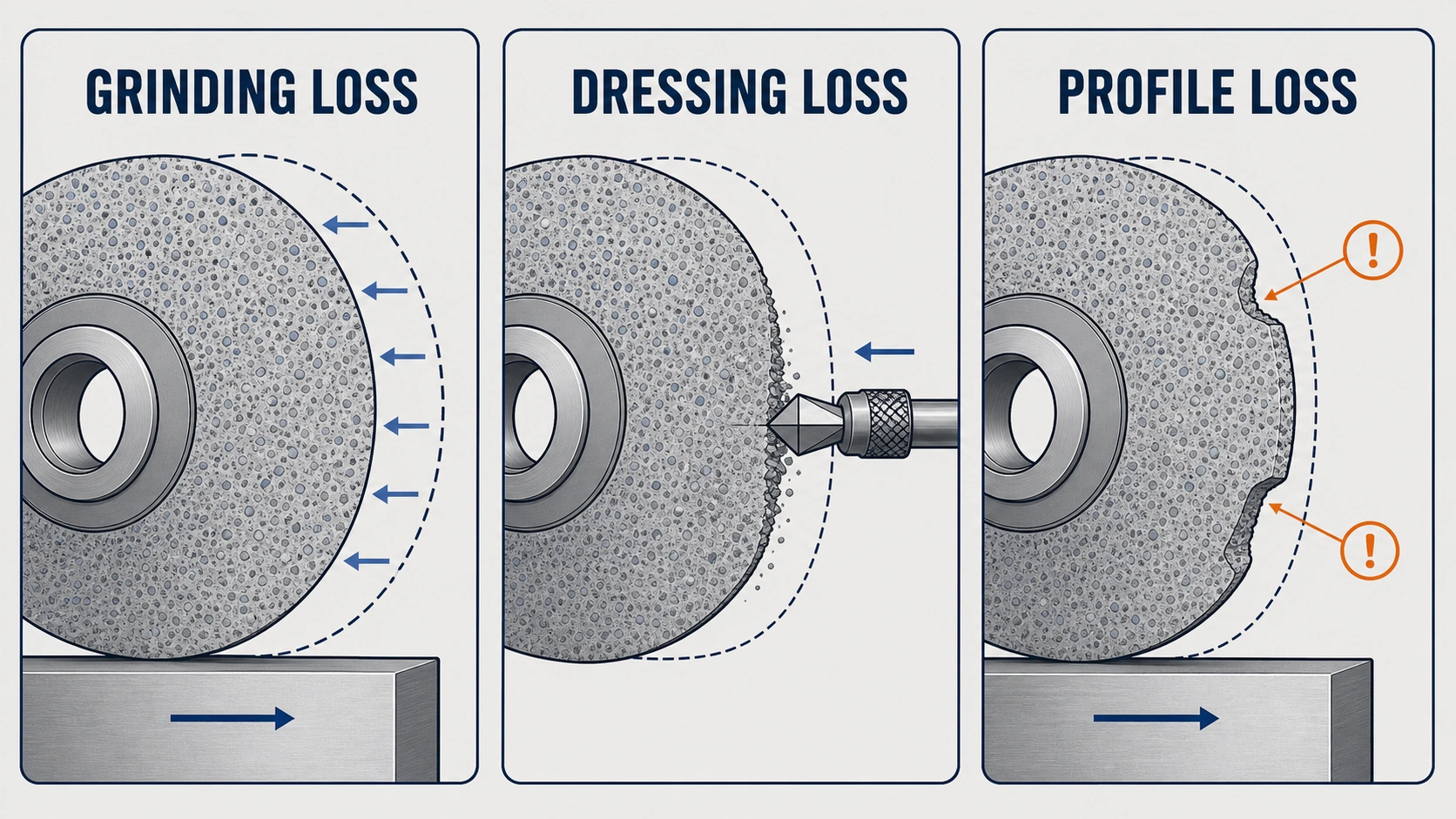
Technical comparison of uniform grinding loss, wheel material removed during dressing, and local grinding wheel profile loss
Separate uniform loss during grinding, material intentionally removed during dressing, and local edge or profile breakdown. These patterns do not share one automatic correction.

First Confirm Where the Grinding Wheel Is Being Lost

Do not treat every short wheel-life complaint as the same wear mechanism. A few basic records can show whether grinding, dressing, or local profile breakdown is responsible.

Diameter or abrasive-layer loss during grinding

Compare wheel size, spindle position, compensation, or measured profile at consistent production intervals. Uniform loss points toward wheel and process interaction; sudden local loss suggests a different event.

Wheel loss during dressing

Record dressing depth, traverse or feed, number of passes, trigger condition, and frequency. A stable grinding cycle can still consume the wheel quickly when dressing is deeper or more frequent than necessary.

Edge, corner, or form breakdown

Photograph where the profile changes. Local breakdown may relate to contact geometry, stock distribution, dressing accuracy, mounting, vibration, or a specification that cannot hold the required form under the current conditions.
Applications

Where rapid grinding wheel wear may appear

This guide is relevant to industrial grinding operations where wheel consumption, profile loss, or dressing demand rises. The listed processes are application contexts only.

Surface and creep-feed grinding

Check contact width, stock per pass, table or feed conditions, coolant access, and whether dressing is compensating for loading or burn risk.

Reduce uncertainty in the process before selecting a harder or more wear-resistant wheel direction.

Cylindrical and centerless grinding

Separate uniform radial wear from local edge loss, setup effects, support conditions, or frequent corrective dressing.

Compare wear records with dressing events, material batches, and equivalent grinding cycles.

Internal and profile grinding

Review wheel-to-work speed relationship, contact geometry, dressing result, coolant access, and local edge condition.

Protect the required profile without making several specification and process changes at once.

Material Effects

Materials that affect the wear diagnosis

Material type, hardness, microstructure, contact area, chip formation, coolant behavior, and incoming stock can change wheel wear, loading, heat, burn risk, and dressing interval. Compare material conditions against a stable baseline.

Harder material or a changed heat-treatment condition

A change in hardness, microstructure, scale, or stock condition can alter grinding force, grain wear, heat, and the dressing interval even when the material grade name is unchanged.

Tough or ductile materials

Chip smearing and poor evacuation may load the grinding wheel surface. The resulting force or heat can cause more dressing and may be mistaken for direct abrasive wear.

Materials with hard inclusions or variable stock

Hard constituents, interrupted contact, or uneven stock can concentrate force and produce local profile loss. Compare the wheel pattern with the contact zone and incoming workpiece condition.

A new material batch or supplier condition

When wear changes suddenly, confirm material grade, hardness, prior processing, surface condition, and stock allowance before assuming the wheel specification changed behavior by itself.

Technical Review Points

Why grinding wheel wear can accelerate

Start with observable grinding signals before changing wheel specification or dressing frequency.

Use the evidence below to organize the first checks. None of these directions should be treated as a fixed setting or an automatic specification change.

The wheel may be too soft for the application

Evidence to look for: Uniform diameter loss or profile loss while grains are still capable of grinding
Cause direction: The bond may release grains before their useful life is exhausted under the current force and contact conditions
What to check: Wheel grade, bond, abrasive, contact area, material hardness, machine stability, and the location of wear
Review direction: Review a more wear-resistant direction only after process and dressing causes are controlled

Dressing is too aggressive or too frequent

Evidence to look for: A large share of wheel loss follows dressing events rather than grinding cycles
Cause direction: Dressing depth, feed, number of passes, trigger logic, or dresser condition removes more wheel than needed
What to check: Dressing records, dresser condition, post-dress surface, profile result, and the symptom that triggers dressing
Review direction: Correct the dressing process while protecting required sharpness, profile, and surface finish

The specification does not fit the application

Evidence to look for: Wear repeats under stable dressing and coolant conditions or concentrates at a predictable profile area
Cause direction: Abrasive, bond, grade, grit, structure, or wheel shape may not suit the material, contact, finish, and removal demand together
What to check: Complete wheel specification, wheel dimensions, process type, workpiece material, target, and machine conditions
Review direction: Review the specification as a system instead of changing wheel grade alone

Contact area or grinding demand is too heavy

Evidence to look for: Wear, force, heat, or edge breakdown rises when contact width, stock, feed, or depth increases
Cause direction: The grinding demand may exceed the current wheel-process balance or concentrate load unevenly
What to check: Contact geometry, stock distribution, infeed, traverse or work feed, speeds, cycle stages, and machine load trend
Review direction: Review one parameter direction at a time within machine, wheel, and safety limits

Coolant delivery or chip removal is ineffective

Evidence to look for: Debris builds on the wheel, heat rises, or dressing demand increases before measurable uniform wear
Cause direction: Coolant misses the contact zone, flow is unstable, filtration is poor, or wheel chip space is insufficient
What to check: Nozzle position, flow path, coolant condition, filtration, wheel pores, and debris pattern
Review direction: Restore coolant access and chip evacuation, then reassess wheel consumption

The workpiece material or incoming condition changed

Evidence to look for: Wear begins with a new grade, hardness, batch, heat treatment, scale condition, or stock allowance
Cause direction: The new material behavior changes force, heat, chip formation, or grain retention demand
What to check: Material certificate or grade, hardness, prior process, surface condition, stock, and the first affected batch
Review direction: Confirm the material change before altering the wheel or multiple process settings
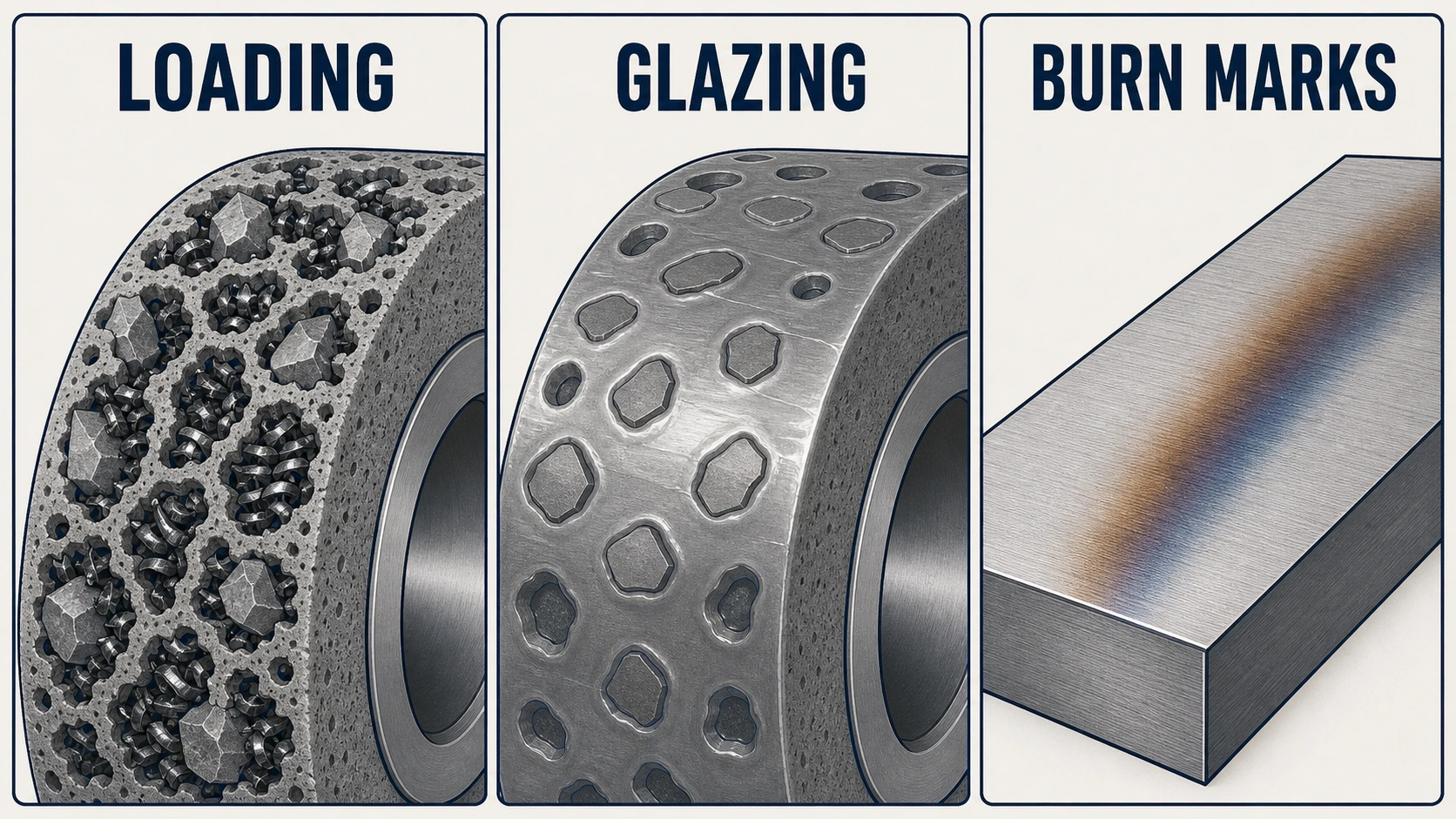
Technical comparison of grinding wheel loading, grinding wheel glazing, and burn marks on a workpiece surface
Loading blocks wheel pores, glazing leaves dull grains at the wheel surface, and burn marks show thermal evidence on the workpiece. Each may increase dressing demand, but none alone proves rapid wheel wear during grinding.
FeatureLoadingGlazingBurn marks
Where the symptom appearsWorkpiece material or debris fills or covers wheel poresDull, flattened grains remain at the grinding wheel surfaceThermal discoloration or damage appears on the workpiece surface
Why it can look like short wheel lifeThe wheel needs cleaning or dressing to restore chip spaceThe wheel needs dressing to expose active grainsOperators may dress or replace the wheel while the heat source is still uncertain
First evidence to checkPacked pores, smeared material, debris pattern, and coolant deliverySmooth reflective areas, dull grains, force trend, and the post-dress intervalWorkpiece discoloration, heat timing, coolant access, wheel condition, and parameters
Do not assumeThat a harder wheel will improve chip clearanceThat repeated dressing proves the wheel is wearing too fast during grindingThat wheel wear alone caused the thermal symptom
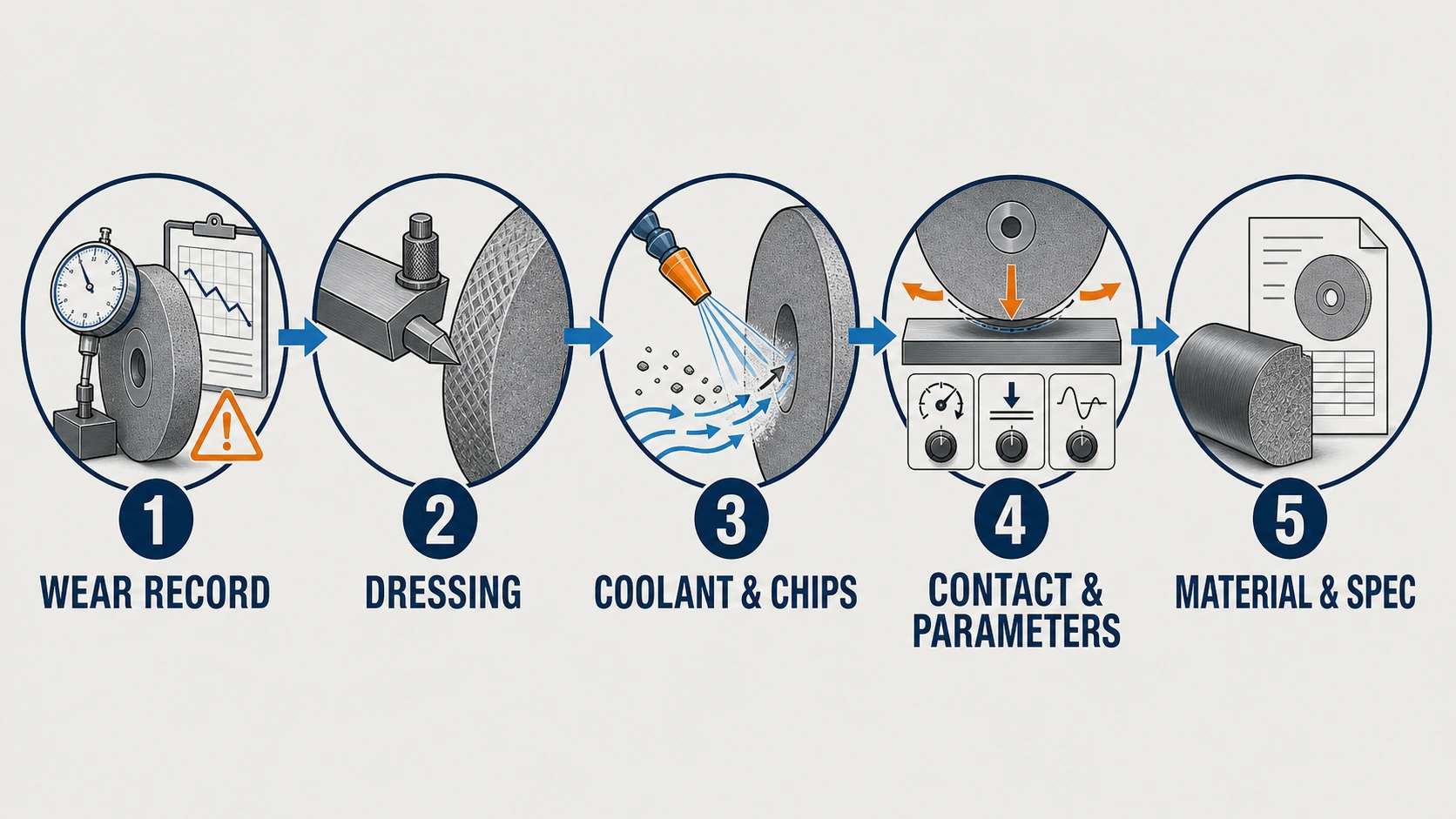
Five-step rapid grinding wheel wear review covering wear records, dressing, coolant and chips, contact and parameters, and material and specification
Start with wear records, then review dressing, coolant and chip removal, contact and grinding parameters, and finally material and wheel specification. This order reduces the risk of changing several causes at once.

Before changing wheel grade

What to review before selecting a harder wheel

1

Measure grinding loss and dressing loss separately

A harder wheel cannot correct an excessive dressing cycle. Establish where the wheel is consumed before changing grade or bond direction.

2

Compare equivalent production conditions

Use the same operation, material batch, stock condition, dressing point, and measurement method. Otherwise, apparent wheel-life changes may not be comparable.

3

Protect cutting ability as well as wheel life

Increasing grain retention can reduce wear in some applications, but it can also raise glazing, force, heat, or burn risk when dull grains stay at the surface.

Diagnostic Workflow

Step-by-step diagnostic workflow for rapid wheel wear

Use these steps to separate wheel consumption, dressing, coolant, material, contact, and grinding-parameter factors before changing the wheel specification.

1

Record the symptom before dressing: photograph the grinding wheel surface, edge, and profile, and note the affected cycle or batch.

2

Measure or estimate wheel loss at consistent intervals and separate loss during grinding from the amount removed during dressing.

3

Check dressing depth, feed, passes, frequency, dresser condition, and the wheel surface produced after dressing.

4

Verify coolant reaches the grinding zone and can remove chips; inspect pores for loading and grains for glazing.

5

Compare contact area, stock, infeed, feed, speeds, cycle stages, and machine load against the last stable condition.

6

Confirm whether material grade, hardness, heat treatment, surface condition, or stock allowance changed.

7

Only then review abrasive, bond, grade, grit, structure, wheel dimensions, and profile; change one controlled factor at a time.

What to Prepare Before Asking for a Wheel Review

Information to share before changing the wheel specification

These details help separate true wheel wear from dressing loss and related process symptoms before any specification direction is considered.

Workpiece photos and clear grinding wheel surface, edge, and profile photos taken before dressing
Workpiece material, exact grade if known, hardness, heat-treatment or surface condition, and stock allowance
Grinding wheel size: outside diameter, bore, thickness, and profile or drawing where relevant
Current wheel specification: abrasive, bond, grit, grade, structure, and abrasive-layer details if known
Dressing tool, dressing method, depth, feed, number of passes, frequency, and dresser condition
Coolant type, condition, filtration, nozzle position, flow path, and chip-removal observations
Grinding process, machine model, contact area, wheel speed, work speed, feed, infeed or depth, and cycle stages
Wheel-life or compensation records showing when wear changed and whether loading, glazing, burn marks, force, heat, finish drift, or dimensional variation also appeared

Send these details through the inquiry form, or contact us on WhatsApp so we can review the grinding wheel condition and application details.

Send Grinding Details

Industry Relevance

Examples of industrial grinding operations

The sectors below are grinding application contexts only; Youlin Abrasive supplies grinding wheels, abrasive tools, and grinding wheel solutions, not the customer workpieces or machine components.

Bearing grinding applications
Hydraulic component grinding applications
Automotive component grinding applications
Tool, mold, and precision component grinding applications

FAQ

Questions about rapid grinding wheel wear

Use these answers to organize the first checks before changing the grinding wheel specification.

Does fast grinding wheel wear always mean the wheel is too soft?

No. A wheel that releases grains too early may be too soft for the application, but aggressive dressing, broad contact, heavy grinding demand, poor coolant or chip removal, material changes, machine instability, or an unsuitable abrasive-bond-structure combination can produce the same complaint. Measure where wheel loss occurs before changing grade.

Can dressing shorten grinding wheel life?

Yes. Dressing intentionally removes wheel material to restore sharpness or profile. Excessive depth, too many passes, unsuitable feed, a worn dresser, or dressing triggered more often than necessary can consume a large share of the wheel. The dressing result still needs to meet profile, sharpness, and finish requirements.

Should I choose a harder grinding wheel to reduce wear?

Not automatically. A harder grade holds grains longer and may improve wear resistance in a suitable application, but it can also retain dull grains and increase glazing, force, heat, or burn risk. Review dressing, coolant, contact, parameters, material, abrasive, bond, grit, and structure before changing grade alone.

How are loading, glazing, and burn marks related to fast wheel wear?

They are related symptoms with different meanings. Loading is material in the wheel pores, glazing is dull grains retained at the surface, and burn marks are thermal evidence on the workpiece. Any of them may increase dressing demand or lead to early wheel replacement, but none proves the wheel itself is wearing too fast during grinding.

Why did wheel wear increase after a workpiece material change?

Material grade, hardness, microstructure, heat treatment, scale, surface condition, and stock allowance can change grinding force, heat, chip formation, and grain-retention demand. Compare the first affected batch with the last stable condition before modifying the wheel specification.

What should I provide for a rapid grinding wheel wear review?

Share workpiece and grinding wheel surface photos, material and hardness, grinding wheel size and current specification, dressing condition and records, coolant condition and delivery, basic grinding parameters, contact details, machine information, and notes showing when the wear change began.

WhatsApp Inquiry